Latest Posts

Talk to Trip Expert
+977 9704823980 (Whatsapp)


Talk to Trip Expert
+977 9704823980 (Whatsapp)Welcome
Manaslu Circuit Trek is an example of the best and least crowded treks in Nepal. It circles the eighth highest mountain in the world (8,163m) called Mount Manaslu. Manaslu is different from the more touristy Everest or Annapurna areas because it has unspoiled natural beauty, real cultural relationships, and a real feeling of wildness. This track is worth visiting during the fall trekking season in Nepal, which begins in September. The sky start to clear, the landscapes become bright and green, and the path returns to life after months of being quiet as the monsoon rains stop.
The best season to walk the Manaslu Circuit is in the fall (September to November) and the spring (March to May) seasons. Rhododendrons are in blossom in the spring, and there is no bad weather. During the autumn, the air is cool, the mountain scenery is clear and the trails are new. September is an extremely special month because it is the beginning of fall. It is days following the rainy season, the weather is becoming more stable and the air is fresh. There are less people hiking on the route now than in October, which is great for those who want to be alone and observe beautiful things. Winter trekking (December–February) is possible but harsh, while summer (June–August) is generally avoided due to heavy rains and landslides.
In September, the weather shifts from rainy to dry, making it a dynamic but rewarding season to trek. Daytime temperatures vary from 15°C to 20°C at lower altitudes (700m to 2,000m), while overnight temperatures may drop to 5°C to 10°C. At higher altitudes (above 3,000m), nights can get cold, and sometimes they even freeze. In early September, there may still be small afternoon showers, but as the month goes on, the rain is less intense and less frequent. Visibility becomes a lot better, and you can see snow-covered peaks like Manaslu, Himalchuli, and Ngadi Chuli in the early morning. In wooded places, trails may still be a little muddy or slippery, and leeches may be found at lower altitudes, so it’s a good idea to wear leech socks or salt.
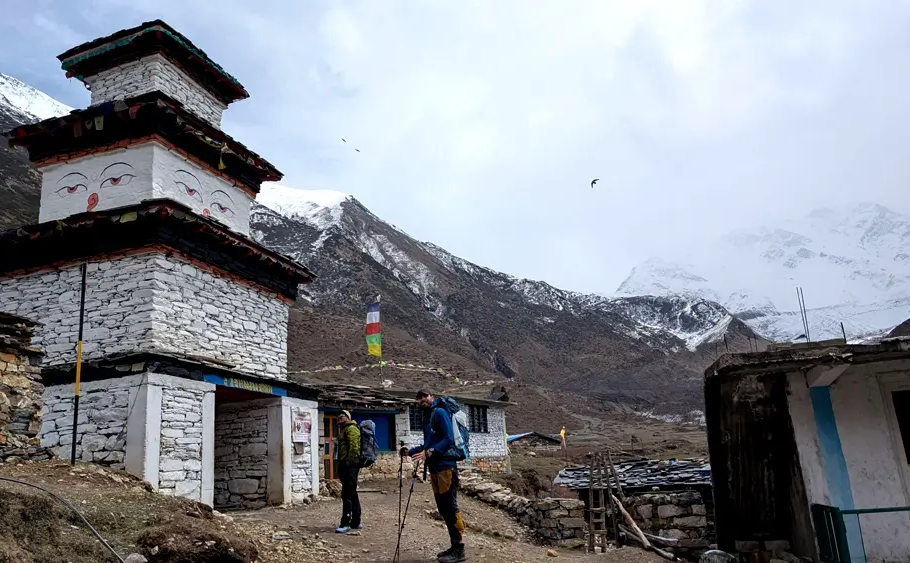
If you hike the Manaslu Circuit in September, you’ll see beautiful green trees, full rivers, waterfalls that flow down, and a lively environment. The route goes past beautiful old villages like Lho, Samagaon, Samdo, and Namrung, where Tibetan culture is still alive and well. The highest point of the journey, Larke La Pass (5,160m), is normally open by mid-September. This is when the alpine scenery is at its best sans the snowstorms that happen in winter. September is also a perfect time to see cultural festivities in the area. The trails are less busy, so you can enjoy your hike more fully and peacefully.
In order to go hiking in the Manaslu region, you need some permission since the region is restricted. You will require Manaslu Restricted Area Permit (RAP), Manaslu Conservation Area Permit (MCAP), and Annapurna Conservation Area Permit (ACAP) because the trip would terminate at Annapurna region. Only given an escort by a government licensed guide and a party of two or more people is the RAP provided. The reason why such rules exist is to preserve the environment and the local culture. All of the permits you will require
will be typically taken care of by your trekking company, though it is important to be aware of these limitations when you are planning your trip.
When you go on a Manaslu trek in September, you should be attentive about how you layer your clothes and ensure that they are weatherproof. Breathable base layers, a down jacket or warm-up fleece and a waterproof outer shell will be required in order to deal with any remaining rain. Rainy or rocky weather requires heavy waterproof hiking boots with good traction. Do not leave your trekking poles behind, particularly on a downward trip. You need a headlamp, a first-aid pack, water purification pills, and sunscreen. It’s a good idea to bring insect repellent and leech socks with you because leeches can still be found in the lower jungle areas. Lightweight gloves and a warm hat are also recommended for the colder mornings and nights at high altitudes.
The Manaslu Circuit Trek takes between 9 and 14 days depending on your plans and the time it takes you to get used to the altitude. The expedition begins most often in Soti Khola or Machha Khola, approximately 7 to 9 hours by road to Kathmandu. It terminates in Dharapani where the Annapurna Circuit begins. From there, you’ll go return to Kathmandu by Besisahar. Accommodation along the way is in teahouses small guesthouses providing simple accommodations and substantial meals. You may expect modest meals (dal bhat, noodles, tea, eggs), but the higher you go, the less choices you have. Some villages have electricity and Wi-Fi, but they don’t always work. A local guide and porter can help you make your visit a lot more pleasant and secure.
There are certain things to bear in mind with September, even if it has a lot of good things going for it. Some paths, particularly those at lower altitudes, may still be blocked by landslides or debris during the monsoon. Occasional rain may make routes muddy or treacherous, requiring vigilance. The leeches in the lower woodland areas are a little annoyance, but they can be dealt with. Also, since September is a transition month, weather may be unpredictable, and trekkers must be flexible with their schedules. Most of these problems may be avoided by making good plans and hiring a guide who knows what they’re doing.