Govt. Tourism License 3195/080/81





Everest Base Camp Trek 14 Days


US$ 1349 per person
For a group of 7-12 pax.
-
1 -
1 person
US$ 1499
-
2 -
2 person
US$ 1449
-
3 -
6 person
US$ 1399
-
7 over
9999
US$ 1349
- Best Price Guarantee
- Secure Online Booking
- Flexible booking dates
- Owner operated company
- Decades of experience
- Dedicated sherpa team
- 100% success rate
- 5/5 ratings by travelers


Highlights of Everest Base Camp Trek 14 Days
- Trek to Everest Base Camp (5,364 m).
- Summit Kala Patthar (5,550 m) for sunrise.
- Scenic mountain flight to Lukla Airport.
- Trek through Sagarmatha National Park.
- Explore traditional Sherpa villages.
- Visit the historic Tengboche Monastery.
- Panoramic views of Everest, Lhotse, Nuptse & Ama Dablam.
- Stay in authentic Sherpa tea houses.
- Led by experienced local Sherpa guides.
- Safe itinerary with proper acclimatization days.
Trip Overview
Make your dream of standing at Everest Base Camp a reality. Walk in the footsteps of legends and take the ultimate adventure to Everest Base Camp. With towering peaks of the Himalayan Mountain range all around, you have the opportunity to take pictures against the backdrop of some of the most famous peaks in the world. Everest Base Camp trek is a once in a life time opportunity to experience a slice of Sherpa and Buddhist culture and see enchanting monasteries while taking in some of the most scenic and mesmerizing views of the mighty Himalayas.
Everest Base Camp is located in Sagarmatha National Park in the Khumbu region of Solukhumbu, Nepal. The journey to the iconic Everest Base Camp holds the historic footprints of Tenzing Norgay and Edmund Hillary from 1953. Since then, the best Everest trekking experience in the Everest Khumbu region in Nepal has been visited by numerous legendary climbers, including Josh Gates and Bear Grylls.
14 days Everest Base Camp Trek takes you through some of the most beautiful Sherpa settlements in the Khumbu region, including Lukla city, Phakding village, Namche Bazaar, Tengboche village, Dingboche village, Lobuche, and Gorakshep.
Then, you will reach Everest Base Camp and climb the renowned Kala Patthar (5,550 meters, also known as Black Stone Peak in the Indian Language). During the 14 Days Everest Base Camp Trek, you will be able to see the icy and rocky peaks, offering panoramic views of Everest, Lhotse, Nuptse, Ama Dablam, Thamserku, Changtse, Taboche, Makalu, Kangtega, Island Peak, Lobuche, Cholatse, Pumari, Lingtren, Khumbutse, Lhola, and many more views.
Additionally, on the Everest Base Camp journey, the entire day of hiking will allow you to observe and get lost in the natural beauty of the Everest Region. You will walk through thickets of rhododendrons, fir, pine and some juniper trees, accompanied by the raging Dudh Koshi River and the Imja (Khola) River.
Thus, the trek to Everest Base Camp is truly remarkable, with many unforgettable moments along the way. Meeting the Sherpa people is one of the highlights of the journey. Their relationship with the Himalayas and Buddhist traditions, their rich culture and their warm hospitality give us the chance to experience this region in a unique way. When you walk through the Khumbu villages, you will be able to meet the friendly residents of these beautiful mountains and get to experience their way of life.
Everest Base Camp journey is a part of the Himalayan journey. You can also enjoy some tea/coffee or breakfast with spectacular Himalayan views at the Everest View Hotel, one of the highest hotels in the world, which stands at an elevation of 3,880 meters. You will then have an acclimatizing walk to Nagarjuna Hill in Dingboche. In addition, you will have the chance to explore the oldest monasteries in Pangboche and Tengboche, where you can observe the tranquil lives of the monks away from the hustle and bustle of the city.
Thus, the experiences you gain 14 day EBC trek deserve to be recorded among the most impressive travel experiences you have ever had.
How does the EBC journey begin?
We start our trek to Everest Base Camp from Kathmandu, which is often called an open-air art museum. We fly to Lukla Tenzing Norgay Airport, where there is 2,800 m mountain settlement, and our Everest Base Camp trek starts through the beautiful Himalayas, Sherpa villages, and landscape scenery in the Everest region.
We fly from Kathmandu to Lukla, a Sherpa village at 2,800 meters, where our Everest Base Camp trek begins. From Lukla, we trek through Phakding, Namche Bazaar, Phortse, Dingboche, and Lobuche before reaching Everest Base Camp and climbing Kala Patthar. Not repeating the familiar path, we will again return down all the way to Lukla via the same path, Lobuche, Dukla, and a short turnaround path via Pheriche, then Pangboche, Tengboche, and Namche. Our 14-day base camp journey will end at Lukla, followed by the flight back to Kathmandu.
Allow a few contingency days at the end of your trip. Lukla flights are more likely to get cancelled or delayed during the shoulder seasons. About 10% of flights get cancelled or delayed. Your dates may not be able to account for that. The trek to Manaslu or Annapurna Circuit may work better for you then. Those treks don’t have flights and are still long treks.
Are you ready to plan and make a memorable Himalayan journey in 2026 or 2027 with Hill Sherpa Trekking Team?
Video Testimonials: Highlighting Memorable Moments
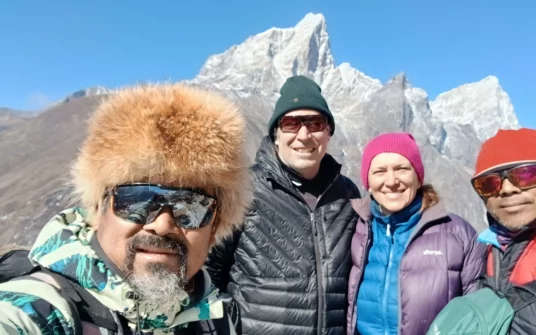
Everest Base Camp Trek 14 Days Itinerary
01
Day 01: Arrival in Kathmandu
Upon your arrival at Tribhuvan International Airport, our representative will greet you and give you a private transfer in a tourist vehicle to your hotel.
Before the trek, you will attend a pre-trip meeting either at our office or your hotel. It is there that you will meet your trekking guide and discuss the details of your trek and itinerary. The meeting is also the last minute planning venue to confirm that you have all necessary arrangements made for your trip.
Important Documents & Final Preparation
Please bring the following to the pre-trip meeting
- Your passport copy scan
- One passport-sized photo
- Your travel insurance policy
- Balance payment
- Signed trip agreement and liability waiver
These documents enable us to complete your trekking permits and make our final preparations to ensure you have a hassle free experience beginning your Himalayan journey.

Duration
20 minute drive to hotel
Max Altitude
1300 m
Meals
Excluded
Accommodation
Tourist Standard Hotel
02
Day 02: Flight to Lukla and trek to Phakding
Lukla flights are rerouted from Ramechhap/Manthali during the months of March, April, May, September, October, and November because of the massive air traffic at Kathmandu. Rather than Kathmandu to Manthali, we have to drive 4-5 hours, which becomes an alternative to the gateway of Lukla during these months.
On Departure Day
Your trek starts between 1 am to 2 am. You will take a shared tourist vehicle to Manthali Airport and then fly for a short 20 minutes to Lukla Airport.
Kathmandu-Lukla Flights off-Season (Jan-Feb, Jun-Aug, Dec)
During these months, flights to Lukla usually depart directly from Kathmandu and not Manthali. On such a day, expect an early morning departure. It’s a 25 minutes drive from your hotel to Kathmandu’s domestic airport, then a scenic flight takes you straight to Lukla.
Note: Flight timings are subject to change depending on the number of passengers, since they are operated by the airlines.
Helicopter Option
Everest Base Camp Trek 14 Days, For those wanting luxury, speedy service, we can arrange the direct helicopter transfer service from Kathmandu to Lukla with an additional cost of USD 500-600 per person on a plane sharing of five persons. How to avoid the 4-5 hours’ road drive to Manthali from Kathmandu, and a good night’s sleep loss, in the peak trekking months, March-May and October-November?
Pre Trek Preparation & Trek to Phakding
One day ahead of your departure flight, pack and organize your trekking gear. Early in the morning, report at Tenzing Hillary Airport in Lukla and take a healthy breakfast. At Lukla, meet the porters who will transfer your gear, two trekkers to a porter.
The trek begins from Lukla to Phakding via an easy hike. The trek continues gradually uphill along the bank of Dudh Koshi River, and you go through Chheplung and put yourself on the trail to Everest base camp. Moving a little ahead, you face Ghat, a very small village, before you reach Phakding and get ready for tomorrow’s experience at Namche Bazar.
Duration
3 hours
Max Altitude
2650 m
Activity
Trekking
Meals
Breakfast, Lunch, Dinner
Accommodation
Lodge


03
Day 03: Trek to Namche Bazar
We will have breakfast and then depart and travel up a zigzagging path along the banks of the Dudh Koshi River passing across to and across suspension bridges supported by prayer flags blowing in the wind. As we make our way higher into the depths of the Khumbu region, the valley around can be heard chanting about a far away river in the backdrop and the sassy.
Not long after, we arrive at the Sagarmatha National Park gate and here we stop to have our permits checked as we await entry into this age-old zone. The trail begins to climb, gradually and then rapidly, as we go on till we are at a higher elevation. The better it gets when you go on. Ancient mani stones with prayer inscriptions are lined by the route as though there were guardian spirits. Snow-capped mountains are pointing towards the sky and the glacier streams sparkle in the sun.
By late afternoon we arrive in Namche Bazaar, a friendly Sherpa village in a natural amphitheater in the Himalayas. We spend the night here and the sounds of the Himalayas surround us and all around us is so much beauty and ancient culture.
Duration
5-6 hours
Max Altitude
3440 m
Activity
Trekking
Meals
Breakfast, Lunch, Dinner
Accommodation
Lodge
04
Day 04: Acclimatization, Hike to Hotel Everest View
After breakfast in Namche Bazaar, begin a scenic hike to Hotel Everest View, one of the best viewpoints in the Everest region. The trail climbs gradually through the hills above Namche, passing through beautiful pine and rhododendron forests with spectacular views of Mount Everest, Ama Dablam, Lhotse, Nuptse, Thamserku, and Kongde.
At Hotel Everest View, take time to enjoy the panoramic Himalayan scenery and relax with a drink while surrounded by some of the world’s highest mountains. The hike is also an important part of your acclimatization day, allowing your body to adjust gradually to the increasing altitude before continuing toward Tengboche and Everest Base Camp.
After enjoying the views, return to Namche Bazaar by the same scenic trail and spend the afternoon resting or exploring the vibrant Sherpa town.
Duration
2 hours walk up
Max Altitude
3880 m
Activity
Acclimatization
Meals
Breakfast, Lunch, Dinner
Accommodation
Local Teahouse
05
Day 05: Trek to Tengboche
After breakfast in Namche Bazaar, you will have an incredible opportunity for photo-taking as you will get your first views of Mt. Everest, Ama Dablam, Lhotse, Nuptse, Thamserku, Kushum Khanguru, and other peaks as you descend towards the Dudh Koshi River and further up to Tengboche.
Along the way, you will walk through a beautiful forest of rhododendron and other trees. Tengboche is home to the largest monastery in the Khumbu region, and you will have an opportunity to visit the monastery and see the beautiful surroundings. You will stay at a local tea house in Tengboche.
Duration
5 - 6 hrs Walk
Max Altitude
3867 m
Activity
Trekking
Meals
Breakfast, Lunch, Dinner
Accommodation
Lodge
06
Day 06: Trek to Dingboche
We left Tengboche early in the morning after a restful night there. We were going to climb to Dingboche. We walk through the strange alpine woodland of Deboche, where the unusual mountain air makes the twisted pines murmur to each other. We have to cross the Imja Khola’s cold streams on a shaky suspension bridge. It’s like going from one world to another.
Eventually, the trail leads us to sacred mani walls, which are stones that have been carved with Buddhist prayers that have been there for a long time and have not changed. They represent the mystery of the Himalayas.
The view of Ama Dablam, the valley’s towering guardian, with its white peak rising for the heavens, is a great reward for your hard work at lunch. We keep going past Pangboche, the highest settlement in the area, and cross the wide trail into the large Imja Valley.
Every step seems more like a picture book until we finally reach the high settlement of Dingboche, which is a calm place to stop and get used to the Khumbu.
Duration
4-5 hurs
Max Altitude
4410 m
Activity
Trekking
Meals
Breakfast, Lunch, Dinner
Accommodation
Lodge
07
Day 07: Rest day otion
It’s smart and important to add another day of getting used to the altitude before going up to greater altitudes. One of the most enjoyable ways to do this is to hike to the beautiful Chukkung Valley (4,730m), and you can even go on to the legendary Island Peak (Imja Tse).
Up on top of Dingboche is Nagkartshang Hill View Point, challenging but well-rewarding ascent that will take 2 to 3 hours and pays off with amazing vistas. Or visit your neighbor Pheriche, where you can listen to a talk in the afternoon about altitude sickness. This is a great experience for any trekker in extreme weather.
The journey to Chukkung goes past the secluded outpost of Bibr (4,570m), which is encircled by a spectacular amphitheater of Himalayan giants. Taboche, Nuptse, Lhotse, and the stunning, flute shaped Amphu Laptsa Pass, with the beautiful Ama Dablam spire looming on the horizon.
Chukkung itself features a few lodges and is a favored staging stop for climbers intent on reaching Island Peak. If you are used to the altitude, climbing farther up the grassy slope of Chukkung Ri (5,550m) will give you an amazing, unforgettable perspective, including a stunning glimpse of Makalu, the fifth-highest peak in the world.
Duration
4-5 hours / 6-7 hours
Max Altitude
5083 m
Activity
Acclimatization
Meals
Breakfast, Lunch, Dinner
Accommodation
Lodge
08
Day 08: Trek to Lobuche
After breakfast, we walked along a quiet path to Thukla lunch site, which was a nice way to be ready for the stunning views that were coming up. After that, the path goes up steeply over the barren terminal moraine of the huge Khumbu Glacier, and we enter a scary but spectacular area of cascading boulders and rock slopes.
We climb to Chupki Lhara through calm air which is respectful. In this case, real monuments are the groups of stone cairns and prayer flags in the wind. This holy monument was built by Sherpas to commemorate the death of the mountaineers. There their names are heard in the Himalayan legend. The notorious American climber Scott Fischer and the legend we speak of Babu Chhiri Sherpa, the 10 times summiteer of Mt Everest who perished in his attempt to get to the peak.
Based on this sentimental standpoint, the journey carries on towards the brink of the Khumbu Glacier that opens up a panoramic view that lies under the behemoth Himalayan titans. Khumbutse, Lingtren and snow covered mountains of the Mahalangur Himal. Later in the day we reach the rocky, windy village of Lobuche where we sleep and ponder under the tallest mountains in the world.
It is a two part, awe-inspiring adventure and trip to the base of the tallest mountain in the world. Our initial trek gives us time to traverse Lobuche to the little known outpost of Gorak Shep. Next, we trek to Everest Base camp that is at 5,364 meters high and may leave you gasping at breath.
Duration
4-5 hours
Max Altitude
5030 m
Activity
Trekking
Meals
Breakfast, Lunch, Dinner
Accommodation
Local Teahouse
09
Day 09: Trek to Gorakshep and continue trek to EBC (5,364m)
Breakfast being over we bade adieu to Lobuche rock houses that the winds have separated. We then start our slow but steady trek summerning the glacial moraine trail of Khumbu Glacier. The shadows are on the face of the mounds on Mt. Nuptse as the rays of the dawn are playing up. All this has to do with mountains solitude that is cut off with sounds of boots crunching on ice and rocks.
This is where we stop at Gorak Shep that is the final stop before reaching the everest base camp. before us lay a horrible, interminable route which twined about a labyrinth of shattered rock and ice. On the way up to this deserted place we have the unusual and beautiful Khumbu Glacier and the sparkling and flowing Khumbu Icefall.
Here we are at the Everest Base Camp a historic place where dreams begin and big plans are made. It is to be in awe and wonder at being here, in the holy face of Everest, flanked by Nuptse, Pumori, Khumbutse and a further-worldly mountain-wall of the gods above. It is neither a location in a map nor a thing that can give you goosebumps, it is something which it stays in your heart and you can always recall it.
At the end of the climbing season, the international climbing groups establish their colorful tents everywhere on the glacier, and it resembles the camp of tents of climbers. We can return to Gorak Shep, filled with our hearts, clear minds and renewed spirits after being impressed by its beauty, and the lesson living has taught us.
Now we top the base camp of Everest and the famous Kala Patthar. It is the ultimate destination of tour and the place to get the panoramic beauty of Himalayas.
One morning we started to climb under a blanket of stars as the world grew taut, sharp and cold and smelled like promise. First of lights, an object of vision, the first golden-morn light covers the summits in flame and glory and the great divinities Everest, Lhotse, Nuptse, and Pumori emerge out of the ground sending their tips aflame with fire and magic.
Kala Patthar not only presents you with a view, but it also presents you with a feeling of bare transcendence as well. When you reach 5,550 meters, you feel overwhelmed by the world above and every corner of your heart resounds with the power and beauty of the mountains, which fill your air with wonder. There is the raw beauty, the silence, you are going to remember this moment forever.
Duration
6-7 hours walk
Max Altitude
5364 m
Activity
Trekking
Meals
Breakfast, Lunch, Dinner
Accommodation
Local Teahouse
10
Day 10: Hike to Kala Pathar and trek down to Periche
Today, we ascend to the top of the legendary Kala Patthar, the trip’s highest point and finest viewpoint for observing the majesty of the Himalayas.
Early in the break of dawn, we undertook to climb under a cloak of stars, the sharp, icy air redolent of promise. In the first light, a sight to awe beholds: earliest golden dawn-light envelops summits in flame and light, Everest, Lhotse, Nuptse, and Pumori giant deities risen from the earth, their crests aflame with color and magic.
Kala Patthar does not give you a view, it gives you an experience of pure transcendence. So at 5,545 meters, you are in awed silence before the summit of the world, each beat resounding with the power and majesty of mountains that fill your air with wonder. The raw enormity, the raw beauty, the quiet, it’s a moment forever marked on the soul.
Surrender every moment. Let the wind carry off your joy, your work, your awe. Beneath the shadow of Everest, you are tiny and boundless.
In pursuit of this most memorable mountain-top encounter, we descend back into Gorak Shep, heart full and eyes wide open. We continue then down, along the path downhill to the serenity of village Pheriche, with victory only the Himalayas can gift us.
Duration
6-7 hours
Max Altitude
4260 m
Activity
Climb Kalapathat / Trek down
Meals
Breakfast, Lunch, Dinner
Accommodation
Local Teahouse
11
Day 11: Trek to Namche Bazar
After a wholesome breakfast, we travel down to Namche Bazaar, retracing our path along the trail but with memories dancing in our heart and soul, forever indented with the mountains.
Coming down, the landscape changes from the glacial clasp of higher altitudes to the softer embrace of alpine forests and lower river valleys. We pass along the perpetual village of Pangboche, concealing beneath the shadow of commanding summits, and on again to the sacred place of Tengboche, home of its namesake monastery and views over Ama Dablam.
The route leads us across swaying suspension bridges suspended high above roaring glacial streams, then down through ancient rhododendron and pine woods. The mountain air is crisp with the scent of earth and pine, and the steady beat of earth kicking boots heralds the steady drop down to lower ground.
Lastly, we come back once more to the vibrant heart of the Khumbu . Namche Bazaar. Set in a bowl of a mountainside, the village greets us with its returning vitality, colorful lodges, and prayer flags flapping in the wind, a perfect place to rest, relax, and rejoice at this stage of the trek.
Duration
6-7 hours
Max Altitude
3443 m
Activity
Trekking
Meals
Breakfast, Lunch, Dinner
Accommodation
Lodge
12
Day 12: Trek down to Lukla
And on the final day of our astounding Himalayan journey, we are returning to Lukla, the place of our initial start-off, the mountain airfield. The determination, friendship and astonishment help moving on one step further along the road with each stride, reflecting on the memories that will never be forgotten, which are abandoned along the trails.
It is no ordinary day anymore, but also a day of introspective triumphs, shared miseries and the unshakable friendships that have been made under the imposing shadow of the world highest mountains.
Now it is time to take a deep breath, look back with pride and grasp the overwhelming feeling of success which is provided by being among giants. After you get to Lukla, the rest of the day is yours to rest, perhaps with a long overdue hot shower, hot drink, and some time to sit back and take it in.
And at night, we all meet again one final time to reflect on the trip, to share our tales and memories and send off the mountains that transformed us under the Himalayan starlights with laughter and music and maybe even a bit of dancing.
Duration
5-6 hours
Max Altitude
2800 m
Activity
Trekking
Meals
Breakfast, Lunch, Dinner
Accommodation
Lodge
13
Day 13: Flight back to Kathmandu
Return Flight 2 Options Kathmandu/Manthali to Lukla
Flight to Manthali from Lukla: (March-May, September, October-November)
During busy trekking seasons, flights from Lukla operate to Manthali Airport in Ramechhap. This short 20 minute flight is followed by a scenic 5 to 6 hours drive back to Kathmandu. Please note that road travel times can vary depending on highway traffic conditions. Upon arrival, you will be comfortably transferred to your hotel in Kathmandu via a shared tourist vehicle.
Flight to Kathmandu from Lukla: (January and February), (June-July, August, and December months)
During the off-season, flights operate straight from Lukla to Kathmandu, with an overall total flight time of around 35 minutes. Upon arrival at Tribhuvan International Airport, you will be dropped off at your hotel in Kathmandu in a shared tourist van.
Note: flight routes are liable to change based on air traffic control, weather, and airline policy as per seasonal passenger demand.
Helicopter Transfer Option
For convenience and speed, there’s also a direct helicopter flight from Lukla to Kathmandu at an additional cost of USD 500-600 per person (depending on a group of 5 sharing). The most effective choice during the high season months to save you from the long overland drive from Manthali. Ideal for time-strapped travelers or to add that special touch of luxury to one’s Himalayan adventure.
Extend Your Adventure / Recommended by Hill Sherpa Trek
If your heart is not yet ready to depart Nepal, we have unforgettable post-trekking activities to the country’s most popular spots:
Pokhara – Tranquil lakes, panoramic mountain scenery, and adventure sports.
Chitwan National Park offers jungle safaris, including elephant back safaris and rare wildlife.
Kathmandu Valley Cultural Tours – Dive into ancient temples, palaces, and UNESCO World Heritage Sites.
Beyond Nepal? We also offer cross-border tours to Tibet, India, and Bhutan, thoughtfully designed trips that extend your Himalayan experience beyond the mountains to a broader cultural experience.
Duration
20 mins flight / 5 hours drive
Max Altitude
1300 m
Meals
Breakfast
Accommodation
3-Star Hotel
14
Day 14: Departure
We will transfer to the international airport by private car, and then bye bye.
Max Altitude
1300 m
Meals
Breakfast
Accommodation
Excluded
Trip Note:
we customize the itinerary
Includes & Excludes
What is included?
- Free airport pickup and drop-off by private car
- Standard tourist hotel, twin-sharing room accommodation for 2 nights in Kathmandu with breakfast.
- Domestic flight from Kathmandu to Lukla to Kathmandu, or Ramechap to Lukla to Ramechap, including 15 kg of baggage.
- Neccessary permit for Everest region Sagarmatha National Park
- Khumbu Pasang Lhamu Rural Municipality fee.
- Full board meal Breakfast, Lunch, and Dinner, one item to choose from the menu system
- Complementary daily fresh fruit after dinner.
- Accommodation, a tea house during the trek, twin sharing room.
- Experience, speak english, license holder, sherpa guide
- Staff wages, food, drinks, accommodations, transportation, and insurance
- A strong porter for 2 clients to carry your trekking gear
- A normal first aid kit with a guide.
- An assistant guide for groups of 8 people.
- Free Helicopter rescue service in case of an emergency, but covered by your travel insurance.
- Nepal government tax and the company’s official charge.
- Hill Sherpa Trekking provides down jackets, duffel bags, sleeping bags, and trekking poles, but they should be returned after the trek.
- An oxygen meter to check your pulse and oxygen level (AMS) (acute mountain sickness)
- Hill Sherpa Company provides trip certificates after the success of your adventure.
What is excluded?
- International airfare tickets
- The Nepal entry visa fee and visa will be obtained on arrival at the international airport in Kathmandu.
- Additional accommodations, food, and drinks in Kathmandu (if staying an extra day)
- Any sort of dessert, sweet item, chocolate, cake, Tea, coffee, pie, pudding, mineral water, or bar bills, for any extra personal expenses
- During the trek, hot showers, mobile, camera, power bank, any battery charging, Wi-Fi Internet,
- Kathmandu sightseeing, entrance fees
- Your personal medical and travel insurance
- Personal first aid kit
- maximum baggage weight of more than 15 kg, including hand carry
- Tips for Guides and Porters
Departure Dates
Departure Date
Trip Duration
Availability
Price
2026-10-23
14 Days
3
US$ 1349
2026-11-11
14 Days
2
US$ 1399
Note:
We also operate private trips.
Trip Information of Everest Base Camp Trek 14 Days
Best season to go to Everest Base Camp
The best time to sign up for the 14 days Everest Base Camp Trek is from autumn (September, October, and November when the sky is clear and the weather is warm and mild. The temperature in the Sagarmatha region fluctuates between 6 and 22°C during the day and 2 and -5°C at night.
We recommend the Everest Base Camp Trek 14 Days from March to May. Spring fills the landscapes and Khumbu valleys with colour and life. Deciduous trees have leaves again, and the fields are covered with beautiful flowers. Mother Nature will be at her Fullest as the temperature remains mild, between 14°C and -10°C in Khumbu.
From June to August, the rains are hefty, especially in the Kathmandu Valley. Temperatures are high at around 28°C in the mountainous regions at this time of year, posing the risk of landslides and avalanches.
We are less likely to push for this Everest Base Camp Trek from the last month of December to February; the winter season prevails, lowering the temperature down to 0 degrees Celsius or below. It is possible to hike in the Sagarmatha region, but you have to make yourself very warm as the temperature will be much lower (at least -5 ° C). However, we at Hill Sherpa Trekking Team think it’s a good time to enjoy the snow along the route for Everest base camp trek 14 days
Elevation and trekking distance
14 Days Everest Base Camp Trek destination is approximately 200 to 300 km away from Kathmandu and proudly sits in the Everest National Park at an elevation of 5364 m above sea level. The Base Camp journey will commence from Lukla, which is a Sherpa town at 2800 meters altitude, reachable within 30 to 35 minutes by flight from the capital city due to the short distance of 135 km.
From here, Lukla, the impressive Everest Base Camp is only 65 km away, and a circular route back to Kathmandu thus covers 130 km in total. Kala Patthar, towering at 5550 meters, represents the highest point of our Everest Base Camp 14 Days, while Gorakshep, at 5180 meters, serves as the highest overnight stop during our journey.
Maximum/Minimum walk per day
Throughout our Everest Base Camp Trek 14 Days, we will walk for 12 days, averaging 3 to 7 hours of hiking per day. Our teams have carefully planned the walking duration following the basic rule of acclimatization. Most of the day, we will walk steadily at our pace without exerting our bodies too much. The shortest and easiest walk will be on day 2, according to the best experience of our company’s Hill Sherpa Trekking itinerary, when we travel from Lukla city to Phakding Village within 3 hours.
The most arduous walking will be on day nine as we journey from Lobuche village to get to the Everest Base Camp at 5,364 meters via Gorakshep, and by the next day, early morning, summit Kala Patthar, and safely descend to Lobuche, respectively. Both days demand a 7 to 8 hours journey on foot along the glacial landscape on this 14 days Everest Base Camp Trek.
Difficulty and Acclimatization
The 14 day Everest Base Camp trek is labelled as a moderately challenging expedition in the great Himalayas. The 12 days hiking trip doesn’t need any technical expertise, special gear, or experience in high-altitude journeys. And the route is well-marked, so there is no chance of getting lost.
Almost all of the trail runs along a rocky path that transitions from the dense forests to barren land. However, we won’t lie, some days can be difficult, especially when proceeding to Namche Bazar; you will have to overcome a wide slope. When marching to Everest Base Camp, you will have to overcome the snow ridges inclined at almost 30 degrees angle.
On the other hand, you will reach an altitude of more than 5000 meters within a few days. You’ll be quickly transitioned from 1350 m to 2800 m within 30 minutes, gaining almost 1400 meters. Therefore, we’ve scheduled a rest day in Namche Bazar and the next city, Dingboche, with the best plans to hike to their respective landmarks above sea level.
Can a beginner join this trip?
The Everest Base Camp Trek is not an easy trek to be taken lightly; however, it is also not a hard and challenging trek that you cannot take. With a mediocre challenge for this Everest Base Camp Trek, the 14-day mountain journey is suitable for a newcomer to Nepal who likes to see the Great Himalayas that exist on the planet.
The prerequisites for this 14 days Everest Base Camp Trek are good health, a positive attitude, average fitness, adaptability, good stamina, and a huge smile. If you fulfil all these conditions, then you are more than welcome on this exceptional journey of a lifetime.
We promise you that after completing the Everest Base Camp journey, you won’t remember the difficulties but only the silhouettes of the world’s highest peaks, the power of the ice and stone of the mountain region in the Himalayas, hanging bridges, the Nepalese greeting, and the smiling of the Sherpas in the mountains.
Preparation and Training
It is essential to prepare for the Everest Base Camp trek to ensure the journey is both safe and enjoyable. While the trek does not demand mountaineering skills, it does require a fair amount of physical fitness and some level of stamina. Ideally, we want you to start some light training at least 6–8 weeks before your trek. Good forms of cardio, like jogging, swimming, cycling, or even hiking, will help you prepare.
Hiking on uneven terrain and practising long walks will help your legs and stamina, too. Equating your training to the trek will help you prepare for the mental challenges, like the changing weather, basic facilities, or several hours of walking each day. If you have the right attitude, good trekking boots, and clothes, you will most likely succeed on the trek to the base of the world’s highest mountain.
Alternate Routes
Although the iconic 14 day trek from Lukla to Everest Base Camp continues to be the most prevalent, there are other paths to consider. The Gokyo Lakes route is a prime example, guiding trekkers to the beautiful Gokyo Lakes, over the challenging Ngozumpa Glacier, and through the mountain crossing of Cho La Pass before merging onto the main EBC trail. Another possibility is the tougher Three Passes Trek, which combines the Renjo La, Cho La, and Kongma La passes and delivers breathtaking 360° views of the Himalayas.
If you are looking for a more solitary route, the Jiri to Everest Base Camp trek is a perfect choice and was historically a classic route for the early explorers. It begins with a beautiful mountain drive from Kathmandu and a gradual rise through Sherpa settlements and villages. The specifics of each route are different in terms of the time taken, as well as the complexity, and therefore, trekkers have the possibility to pick the route best suited to their requirements and objectives.
Altitude Sickness
Altitude sickness presents one of the first challenges on the Everest Base Camp Trek. The trail crosses 3,000 meters as the body needs time to adjust to the thinning air. In addition to altitude sickness, the most common primary symptoms are headaches, fatigue, and dizziness. To most, the risk can be mitigated by acclimatization, which is why the itinerary includes acclimatization stays on the trek at Namche Bazaar and Dingboche.
Staying hydrated and fed along a gradual ascent is essential to the body’s adjustment to prevent AMS, which is also why we ask that trekkers abstain from smoking and drinking alcohol. Having altitude response training, guides may initiate a rescue response if alcohol or smoking poses a risk. This may include a ground or helicopter descent. Most trekkers will complete the Everest Base Camp Trek safely if they take the time to acclimatize.
Accommodation, Food and Drink
Accommodation for each night of your Everest Base Camp Trek 14 days of stays in familiar, comfortable teahouses and lodges owned by the local Sherpa community. Rooms are usually twin-sharing, with simple bedding for the guests to use, and with shared bathrooms. At greater heights, the lodges lack the basic necessities, for the region is Remote, but kindness will still and hospitality will be shown.
Meals are served in the dining hall, which is cozy and includes local Nepalese and Western options like dal bhat, which is rice, lentil soup, and vegetables, pasta, pancakes, and fried rice. To prevent stomach upsets at high altitudes, freshly cooked vegetarian meals are recommended.
Drinking water is available for purchase, but it is more economical and eco-friendly to use water filters or purification tablets. During the trek, you will be supplied with gently warm drinks of tea, coffee, and ginger lemon honey to help keep you warm and hydrated.
Transportation
Travelling from Kathmandu to Lukla marks the beginning of the journey to Everest Base Camp. It is considered one of the most picturesque flights in the world. During this 30 -35 minute flight, one enjoys the most spectacular views of the majestic Himalayas, and the flight ends in a dramatic landing on a short airstrip hugged by the mountains.
The region’s weather is known to be hard to predict, which may take a toll on the flight schedule. Hence, we suggest keeping one to two buffer days at the end of your trek. If you experience a long flight cancellation, there are alternative options of helicopter transfers between Lukla and Kathmandu, or a lengthy drive to Phaplu followed by a several day walk to connect to the main trail. Our team takes care of all logistics to ensure your journey runs seamlessly from beginning to end.
Communication, Gadgets Charging, and Internet/Wi-Fi
It is possible to remain in contact while in the Himalayas, although the range diminishes at higher elevations. Mobile networks, primarily Ncell and NTC, offer communication services in the foothills of Lukla, Namche Bazaar, and Tengboche. After this point, most teahouses offer paid Wi-Fi access. These teahouses Wi-Fi networks are powered by Everest Link Wi-Fi, and the connection is weak and intermittent.
Electricity is also intermittent, so pack extra power banks and assume that the batteries for your phone and camera will need to be supplemented as well. In the higher elevations beyond Namche, charging your electronics will incur additional fees. For safety and navigation, guides are equipped with mobile phones and emergency communication tools. While you will be relatively unconnected, the digital detox is quite welcome and allows trekkers to immerse themselves in the Himalayan wilderness.
Trekking to Everest Base Camp requires two main permits. The first is the Sagarmatha National Park Entry Permit, which provides access to the UNESCO World Heritage Site that safeguards the area’s biodiversity. The second one is the Khumbu Pasang Lhamu Rural Municipality Permit, which now replaces the old TIMS card.
All trekking packages cover the cost and arrangements for both permits, which can be obtained in either Kathmandu or the Park’s entry point. Everest Base Camp trekkers are legally required to carry all obtained permits, which are checked at multiple points along the trail. Rest assured, we will handle all the necessary documents to cover any hassle you might experience.
What to Expect
Embarking on the Everest Base Camp Trek entails undertaking myriad challenges alongside appreciating the wonderful sights and learning about diverse cultures. This trek consists of breathtaking elements of nature and rich landscapes comprised of deciduous and evergreen forests and diverse wildlife along the path. Also, the vanishing glaciers provide a majestic view, along with the sky-scraping altars where the ancient monasteries are built.
Anticipate daily stretches of the trek, simple lodging, and, what’s most crucial, the changeable weather, which entails soft frosts after thunderstorms. Finally, experience the folded valleys and chants of wind harmonized prayer flags composed with the serenity of the monumental Buddhist shrines. This trek gets one closer to the almighty Himalayas, and one’s true inner self.
Why travel insurance
Confirming your travel insurance before your Everest Base Camp trek is one of the most crucial parts of your preparation. Trekking the Himalayas involves unpredictable weather, rough terrain, and remote trails. Along the paths to Everest Base Camp, there are no roads or medical facilities, and professional help is rarely accessible. This places the trek in remote and dangerously unprepared conditions for illness or injury, and critical altitude sickness is a concern.
Rescues like these are expensive and often the only option for serious emergencies. The financial and medical risks of emergency helicopter evacuation would provide peace of mind to let you experience the Everest Base Camp Trek. Comprehensive travel insurance alleviates those risks of emergency helicopter evacuation.
High altitude coverage
High altitude coverage is important when getting travel insurance for the Everest Base Camp trek. Most travel insurance policies only cover trekking up to 3000 meters. Base Camp sits at 5300 meters and the nearby peaks of Kala Patthar exceed 5500 meters.
If high altitude trekking is not a part of your travel insurance, your insurance on the trek could be void when you need it the most. Verifying your travel insurance covers altitude treks protects you against altitude sickness, injury, or other emergencies that can arise from high altitude trekking.
Helicopter Evacuation Costs
Roadless zones in the Everest region make helicopter evacuation the only viable option for some medical emergencies. Air transport to the nearest hospital may be needed for severe altitude sickness, fractures, or infections.
Helicopter evacuations in Nepal can cost you from USD 2,500 to 8,000. If your travel insurance covers helicopter evacuations, you won’t have to worry about the high cost, and you will also get the rapid medical assistance that can be crucial during your Everest Base Camp trek. Medical Treatment and Hospitalisation.
When trekking at high altitudes, one must be careful with the challenges that come with the activities, such as altitude sickness, difficulties with breathing, injuries, and potential infections that can lead to the need for hospitalisation. The cost of treatment, if you need to go to an exclusive medical center/international hospital, can be extremely high.
Comprehensive travel insurance can pay for emergency treatment, hospitalization, medicine and more. With this type of insurance, you just have to focus on getting better, and not on how you’re going to cover the medical expenses. This definitely can be a plus to your trekking experience to the Everest Base Camp.
Choosing the Right Travel Insurance
Insurance is very important for the Everest Base Camp trek, and so, it is vital to choose the correct insurance for your travel. The most popular international travel insurance companies that cover altitude trekking include World Nomads, IMG Global, Allianz, Covermore, True Traveller, and Safety Wing. It is important to go over the altitude boundaries, the different adventure activities included, and whether chopper evacuations are included. If you choose an insurance company that is specialized and experienced in claims for trekking in the Himalayas, you will have faster support during an emergency.
Trekking Emergency Prep
Hill Sherpa Trekking, along with other reputable trekking companies, requires specific details and forms from your insurance before the start of your trek. These details would include your insurance provider’s name, the policy number, policy coverage and the emergency hotline, and whether the policy covers trekking above certain altitudes and helicopter evacuations. Providing this information to your guide will allow for the most effective emergency response and can be critical to your survival at high altitudes along the Everest Base Camp trek.
Conclusion
Travel insurance is an absolute requirement for the Everest Base Camp trek. More importantly, though, it is your safety net from medical emergencies and costly evacuations, as well as altitude sickness. Trekking to Everest Base Camp is an immense personal achievement, and regardless of whether this is your very first trek or you are an old, seasoned trekker, insurance allows you to take in all the beauty of the landscapes and the cultures without the stress of emergencies.
Altitude Chart of Everest Base Camp Trek 14 Days
Frequently Asked Questions
 General
What is included and excluded in the Everest Base Camp Trek package?
The package includes the services stated in the Inclusions section of this page, such as trekking accommodation, meals during the trek, a guide, a porter and required permits.
Personal expenses, travel insurance, international flights, tips and services not specifically listed are generally excluded.
Please check the detailed inclusion and exclusion list before booking.
How does the Kathmandu to Lukla flight work?
Everest Base Camp Trek normally begins with a flight from Kathmandu or, depending on seasonal flight operations, from Ramechhap/Manthali to Lukla.
Flight arrangements can change because of weather and airport operations, so our team provides the latest practical information before departure.
What happens if my Lukla flight is delayed or cancelled?
Lukla flights are weather dependent. If a flight is delayed or cancelled, our team will help arrange the most practical available option, depending on flight availability and conditions. We recommend keeping some flexibility in your itinerary for possible flight delays.
What is the Everest Base Camp Trek?
Everest Base Camp Trek is a classic Himalayan trekking adventure in Nepal’s Khumbu region, 14 days journey takes you through Sherpa villages, Buddhist monasteries, and Sagarmatha National Park to Everest Base Camp at 5,364 meters, with spectacular views of Mount Everest and the surrounding Himalayas.
How much does the Everest Base Camp Trek cost?
Everest Base Camp Trek cost depends on the group size, services, and itinerary. Hill Sherpa Trekking offers competitive packages that include accommodation, meals during the trek, an experienced Sherpa guide, porter service, and required trekking permits. Please check the current price and inclusions on this page.
How many days does the Everest Base Camp Trek take?
Our classic Everest Base Camp Trek takes 14 days from Kathmandu to Kathmandu. The itinerary includes acclimatization days in Namche Bazaar and Dingboche to help you adjust gradually to the high altitude.
What is the Everest Base Camp Trek itinerary?
14 day itinerary follows the classic route from Lukla to Phakding, Namche Bazaar, Tengboche, Dingboche, Lobuche, Gorak Shep, and Everest Base Camp, followed by a hike to Kala Patthar and the return journey to Lukla and Kathmandu.
Can I customize the Everest Base Camp Trek itinerary?
Yes. Hill Sherpa Trekking can customize the Everest Base Camp Trek according to your schedule, fitness level, preferred pace and travel requirements.
Private departures, additional acclimatization days and alternative Everest-region itineraries can be arranged on request.
 Preparation & Fitness
How do I prepare for the Everest Base Camp Trek?
Walking or hiking regularly and/or cardiovascular exercise is the best prep. Stair climbing is great for leg conditioning. Training for altitude and changing/cold weather is helpful too. Be sure to allow time to acclimate and follow your guide’s instructions.
How many kilometers is the Everest Base Camp Trek?
The total trekking distance is approximately 130 km round trip, although the exact distance can vary depending on the route and daily trail conditions.
How difficult is the Everest Base Camp Trek?
Everest Base Camp Trek is considered moderate to challenging. It does not require technical climbing skills, but you should be prepared for long walking days, steep sections and high altitude. Good fitness, proper acclimatization and a steady pace are important.
Do I need previous trekking experience for Everest Base Camp?
No, previous high altitude trekking experience is not essential. Many first time trekkers successfully complete the Everest Base Camp Trek with proper preparation, a suitable pace and support from an experienced local Sherpa guide.
How many hours do you walk each day on the Everest Base Camp Trek?
You generally walk around 5 to 7 hours per day, depending on the route, altitude and trail conditions. Some days are shorter, while longer days include the trek to Everest Base Camp and the Kala Patthar viewpoint.
 Insurance and Visa
Is travel insurance required for the Everest Base Camp Trek?
Comprehensive travel insurance covering high altitude trekking and emergency evacuation is strongly recommended. Your policy should cover medical treatment and helicopter evacuation at the maximum altitude reached during your trek.
 Guides & Support Staff
Do I need a guide and porter for the Everest Base Camp Trek?
A local guide is highly recommended for safety, navigation, acclimatization support and local knowledge. A porter can carry your main luggage, allowing you to trek more comfortably. Hill Sherpa Trekking provides experienced Sherpa guides and porter support according to your package.
 Accommodation and Facilities
What type of accommodation and food can I expect?
Accommodation is mainly in comfortable local teahouses and lodges along the trekking route, with hotel accommodation in Kathmandu, according to your package.
Meals generally include local and international options such as dal bhat, noodles, rice, pasta, soup, vegetables, eggs and other basic trekking meals.
Is Wi-Fi and electricity available during the Everest Base Camp Trek?
Wi-Fi and electricity are available at many teahouses, but availability can vary by location and weather conditions. Charging facilities may have an additional fee at higher elevations, so carrying a power bank is recommended.
 Weather & Seasons
What is the best time to trek to Everest Base Camp?
The best seasons for the Everest Base Camp Trek are generally spring (March-May) and autumn (September-November).
These seasons usually offer favorable trekking conditions, good visibility and spectacular mountain views. Winter and monsoon trekking are also possible with appropriate preparation.
 Health & Safety
What happens if I get altitude sickness during the trek?
Your guide monitors your condition throughout the trek and helps you recognize early symptoms of altitude sickness. If symptoms become serious, the priority is your safety, which may include resting, descending to a lower altitude and arranging appropriate medical or emergency assistance when necessary.
What is the highest altitude reached on the Everest Base Camp Trek?
Everest Base Camp is at approximately 5,364 meters (17,598 feet). The highest point of the standard itinerary is Kala Patthar at around 5,550 meters (18,209 feet), offering exceptional views of Mount Everest and the Khumbu Himalayas.
 Packing & Gear
What should I pack for the Everest Base Camp Trek?
It’s best to have warm layers, a down jacket, good trekking boots, comfortable clothes for trekking, gloves, a hat, sunglasses, sunscreen, and a sleeping bag for overnight stays on the trek.
Bring enough water to drink and your personal medication. Use trekking poles and carry your things in a daypack.
Hill Sherpa Trekking can assist you in arranging or providing a sleeping bag and down jacket, if needed, for the duration of your trek.
 Booking & Payment
How can I book the Everest Base Camp Trek?
You can book online or contact Hill Sherpa Trekking directly. We will confirm your departure date, package details and booking process.
What departure dates are available for the Everest Base Camp Trek?
We offer fixed group departures and private treks. Contact us for the latest available departure dates.
Can I choose my own departure date?
Yes. Private Everest Base Camp Trek departures can be arranged on your preferred date, subject to availability.
Reviews on Everest Base Camp Trek 14 Days






US$ 1349 per person
For a group of 7-12 pax.
-
1 -
1 person
US$ 1499
-
2 -
2 person
US$ 1449
-
3 -
6 person
US$ 1399
-
7 over
9999
US$ 1349
US$ 1349

Talk to Trip Expert
+977 9704823980 (Whatsapp)
✖
Free Travel Guide
Get Expert Guidance from Experienced Sherpas