Latest Posts

Talk to Trip Expert
+977 9704823980 (Whatsapp)


Talk to Trip Expert
+977 9704823980 (Whatsapp)Namaste! Today I am sharing with you my travelogue of Kathmandu- the capital of the marvelous land of the world- the mystical Kingdom of Nepal. During my short three-day visit, I really had the incredible opportunity to immerse myself in the stunning beauty of this remarkable land.
After many months spent deciding where to go for the short holiday, I and my couple of friends came to the unanimous decision to visit Nepal. We had the intention of undertaking either the Annapurna Base Camp trek or the Everest Base Camp Trek (let’s see where Nepal will take us). On the way, we decided to stay for three days in Kathmandu.
The experience I gathered through my short journey and the moments I captured in my mind and heart urged me to write the travelogue of Kathmandu. I wanted to guide those who wonder if there is anything worthy to see in this ancient capital which is often portrayed as the noisy and dusty town of the world.
The plane landed me and my friends on the busy runway of the Tribhuvan International Airport. After finishing the entry and tourist visa formalities, we were met by our guide who welcomed us with white Khata.
Then he took us to our accommodation in Thamel district. The welcome at the hotel was very friendly and our room was cozy as well with a little balcony overlooking the surrounding city.
After a micro nap, we set out to take a walk through the Thamel district. It is the tourist district of the capital with joyful chaos, colorful markets, and charming little beauties hidden among the small alleys.
We had our dinner in the open terrace of one of the beautiful little restaurants and had our first taste of momos. The view from the terrace was really extraordinary, however, we were really physically and mentally exhausted so we decided to go to bed early planning the city excursion the next day.
The second day in Kathmandu gives us a completely different picture of the city. We were able to make connections and captivate the unique street atmosphere. Guess the next few pages of my travelogue of Kathmandu will be filled with only happy days and new experiences.
First, we direct our path to the most sacred and religious Pashupatinath Temple around 5 km to the east of Kathmandu. As we progressed through the paved pedestrian street of the temple, we saw numerous brightly colored stalls selling flowers and several other accessories which we later understood to be the pious offerings for the worship of God Pashupatinath (Lord Shiva).
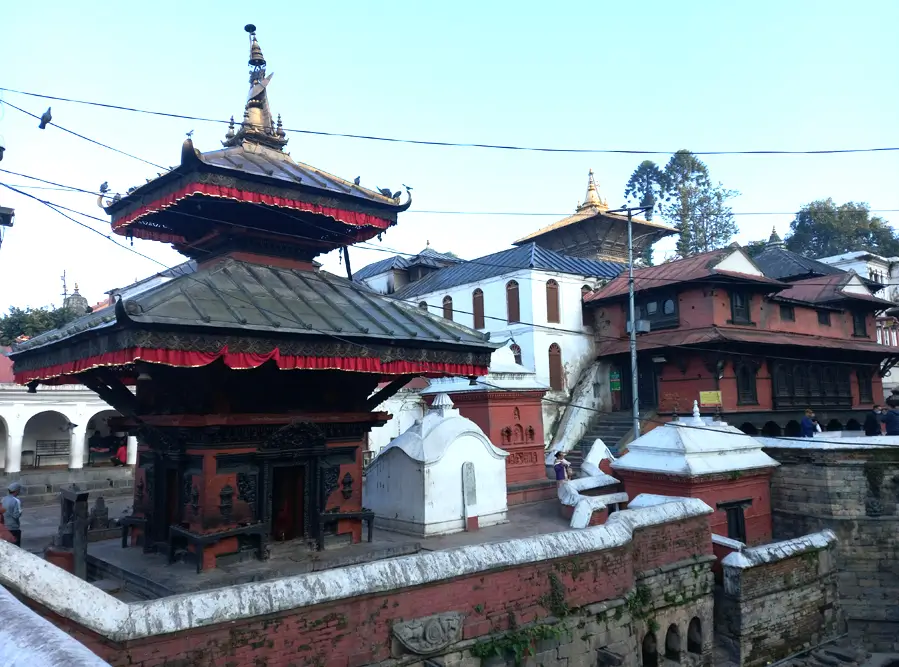
We were not able to enter the main temple (as the entrance is prohibited for foreigners and non-Hindus), but thankfully our guide took us to the sacred Ghat bathed by the Bagmati River. Our guide was well-informed and told us the river flows into the Ganga (Ganges in India).
It is therefore here that the cremations take place and the ashes are thrown into the river hoping for the eternal liberation of the deceased souls. During our visit, we were able to witness several cremations and our guide also encouraged us to take photos and videos.
The experience was something very new for us; however, we did not linger much and moved on to another famous destination of Boudhanath which is approximately 8 km towards east of Kathmandu.
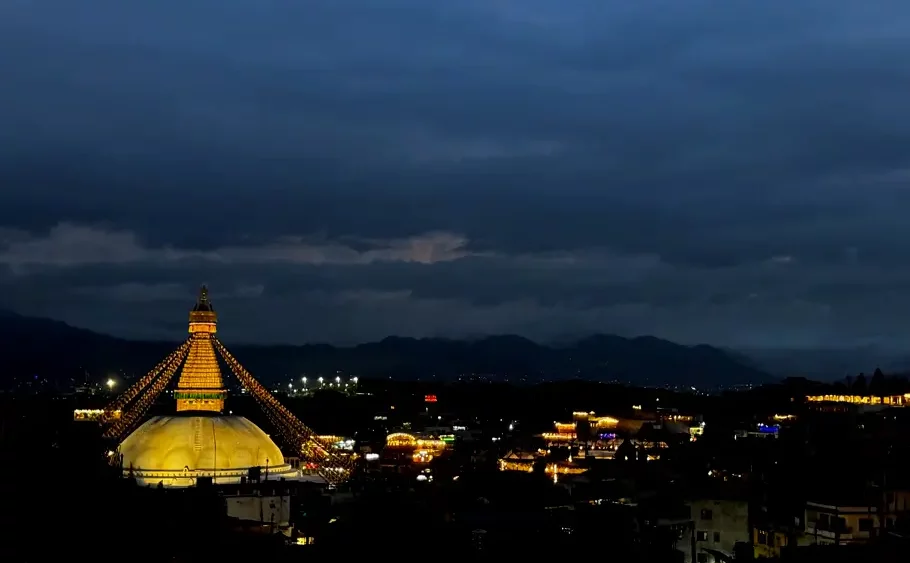
It is the town where the largest stupa in the country is located by the same name. This small town served as the safest sanctuary back in the ancient days for the Tibetan traders. Now, many have settled here permanently and turned this little town into the major Buddhist sanctuary of the capital.
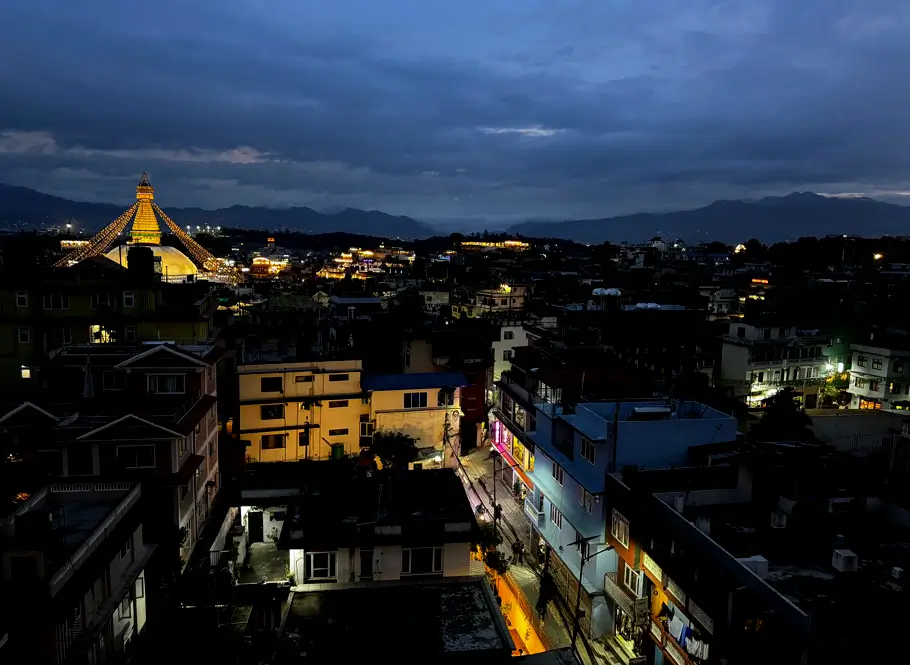
Here we were again surrounded by a large number of shops selling various authentic Tibetan handicrafts. We saw many people circling the stupa, turning the prayer wheels. We too joined the flow, absorbing the spiritual essence that these pilgrims must have felt.
Since we were eager to maximize our time in the capital, we decided to keep our visit to Boudhanath brief and headed to the Fantasmic Swayambhunath Temple. With a rich history of more than 2500 years, the temple is nestled on top of the hill that embraces the entire Kathmandu city.
It is literally on top as we had to climb maybe 365 stone steps (after some time I gave up counting) to reach the main temple. As always, everything beautiful is after a staircase or a hill to die for.
The temple was very cool and was full of monkeys (now we understand why the temple is also referred to as the Monkey Temple). If you don’t want them to come close to you or jump on you, please don’t carry anything that seems tasty and colorful.
As we reached the top, some very nice views of the entire Kathmandu city greeted us. Then we slowly turned our gaze to the dome-shaped stupa containing the relic of the giant Buddha. Here also, we went around the stupa in a clockwise direction rotating the prayer wheels.
Each prayer wheel contains a sacred text and devotees believe that by rotating them, the prayer is carried by the wind for the benefit of all beings. Since we also want to contribute to world peace, we also turned the wheel with our hands.
We took our time to walk around the stupa and wander among the residential houses and the 18th-century Sikhara (stupa in the shape of a Hindu temple) that also makes up the temple. It must be said that there was a very captivating atmosphere accentuated by the sunset.
Here and in Boudhanath, we noticed something very different, that is the concentration of the Tibetan population; something very different from what we have noticed around the Pashupatinath.
As the sun began to set, our guide urged us to return to the peace and comfort of our hotel. We obviously headed out for a while to spend some time in the lively crowd of one of Thamel’s pubs but decided to end the tour early as Kathmandu had much more to show us.
Before coming to Kathmandu, our group had learned that the capital is also lovingly called the City of Temples and we expressed our desire to explore this idea to our guide. Thus, today, he took us to the Thahiti tole a little downward from Thamel.
It has a small square presided over by a white stupa from the 15th century that is surrounded by street vendors of fruits and vegetables. To one side is the Nateshwar temple dedicated to Shiva.
As we walked a few meters away, we saw a small square guarded by two bronze lions and surrounded by chaityas and small statues, the Kathesimbu Stupa dating back to 1650. According to our guide, it is a minor copy of Swayambhunath and a well-known pilgrimage site in old neighborhood.
We passed a small stone lion and a statue of Ganesha. We then turned left and passed in front of the Temple of Ugratara, a three-roofed pagoda where our guide said that prayer does wonders for the eyes; and Haku Bahal, a courtyard with a small stupa, a chaitya, and a spectacular carved wooden window. We had arrived at the famous Asan Tole Chowk regarded as the heart of Kathmandu Bazaar.
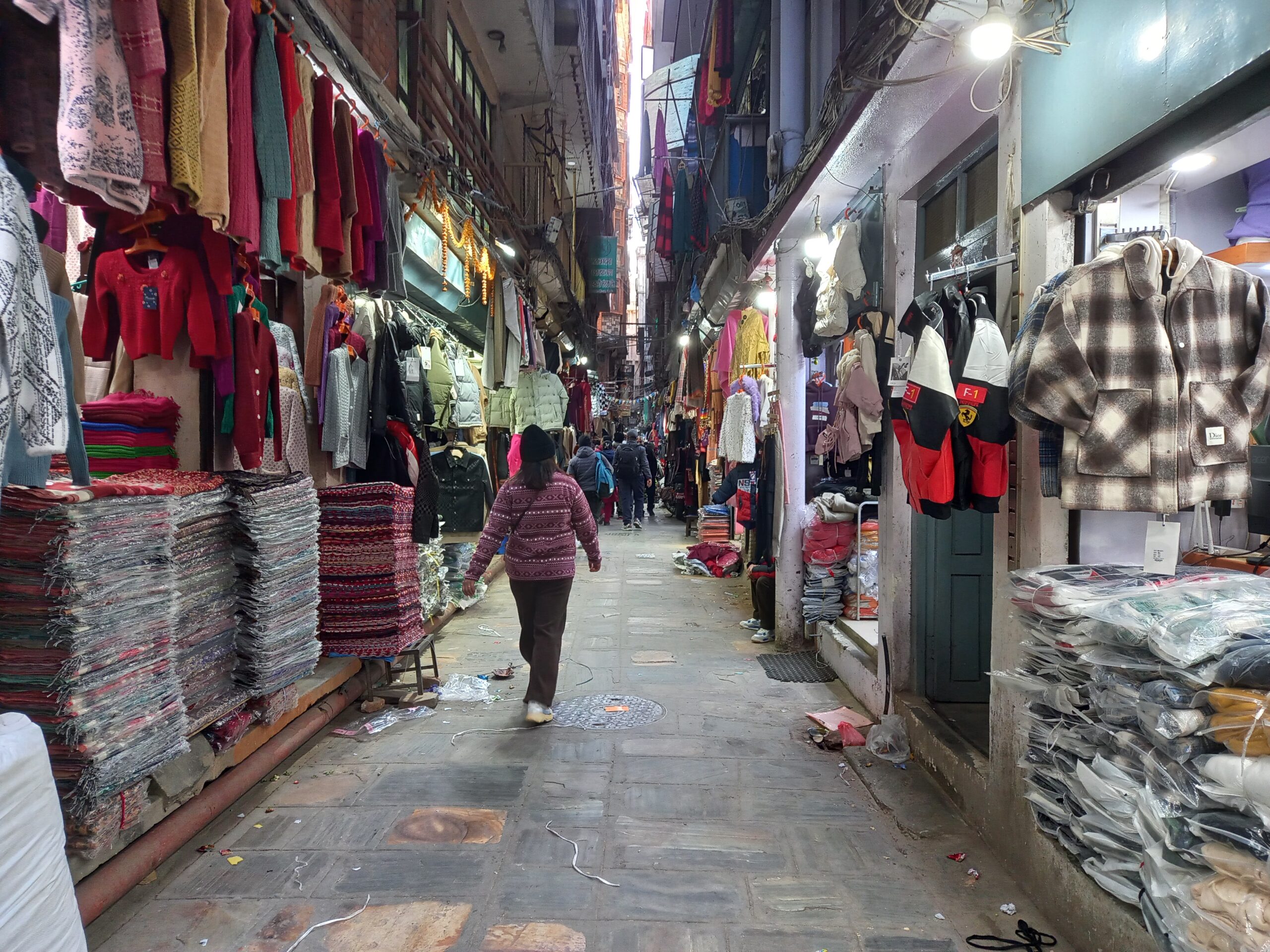
This central town is the meeting point of six important streets of the city and until 1934 the departure point for caravans to Tibet. A whole lot of shops can be found here and based on what our guide told us, here everything and we mean everything can be found and purchased at some very reasonable rates.
But what caught our eyes was the small Annapurna Temple, a three-story pagoda dedicated to the god of abundance. We certainly felt the temple was in need of some serious restoration work.
Continuing with our visit, we walked to the Seto Machhendranath temple, revered by Hindus and Buddhists as the god of rain. Every year in the month of Chaitra (March/April), the Jatra (procession) of this god is celebrated in Kathmandu praying for the abundant monsoon rain in the valley.
From here, we followed the Makhan Tole and came across another picturesque and major temple of Lord Shiva- the Makhan Mahadev. What we missed out on in Pashupatinath we saw here was the gigantic Shiva Lingam with four faces seeing the four compass points.
After offering our prayers, we walked to Indra Chowk, a courtyard where stalls selling fabrics and blankets are set up on the platforms of the Mahadev temples. It is surprising for us to see how any urban element, regardless of its history, age, or religiosity, becomes an object of daily use.
Next comes Itum Bahal, a huge, peaceful courtyard where next to some chaityas and a temple with a pretty carved wooden window, there is a small white stupa. Finally, before reaching Durbar Square we entered Yatkha Bahal, another courtyard with a large stupa in the center.
And now, here we were in the renowned and the major attraction of the capital- the Durbar/ Palace Square which about 100 years ago was the residence of the Kings. The square contains the authentic architectural jewels of the city, most of which date from the 17th and 18th centuries.
But the 2015 Earthquake shook the city and caused some serious damage. The continuous work of rebuilding and restoration has still been in progress.
Watching the site, we arrived in front of the Kumari Ghar (the house of Kumari the only Living Goddess of the World). Actually, she is a little 3 to 5-year-old girl chosen from the Newar Caste and provided with a perfect body and horoscope.
A new Kumari Goddess will be selected once she has the onset of her first menstruation. Pretty confusing how the goddess keeps on changing but it is amusing and very extraordinary as well.
Pushing through the crowd of travelers like us, we arrived in front of the Gaddi Baithak. In 1908, Chandra Shamsher constructed this white building as an addition to the palace during the reign of then-King Prithvi Bir Bikram Shah.
The site is well-guarded and is commonly used as a platform for observing important religious ceremonies, such as Indra Jatra, by the hierarchy authorities.
Our guide then took us through the outer part of the square and we passed by the large stone statue that represents the destructive force of Lord Shiva as Kal Bhairava. We watch how multitudes of devotees offered flower garlands, some black clothes, and to our amazement alcohol as well as the offering for God.
We then returned to the interior side of the square and right in front of us was the Jagannath Temple built on a three-level platform and two roofs. It has numerous erotic sculptures carved on the beams that support the roofs.
To its left is a kneeling statue of God Hanuman, a Hindu god who is always represented in the form of a monkey, and next to it is the main gate to the Hanuman Dhoka Palace, with a pair of stone lion statues as guardians of this gate.
Leaving the palace behind we pass between the Temple of Degutale more commonly known as Taleju Bhawani temple. It was the deity of the family of the Malla kings and now opened once a year for faithful during the Dashain Festival.
After all the exploration, sensing our tiredness and hunger, our guide led us to dine in one of the terraces of the beautiful restaurant overlooking the entire Durbar Square. From sizzlers to egg curries, momos, soft drinks, and alcoholic beverages, there was a wide option to select from.
Next, our guide took us to Kasthamandap Temple which has been restored now using the original construction material as much as possible. The temple was believed to have been built with the wood of a single tree. The image of Gorakhnath and Ganesh was pretty fascinating.
By the time we reached Kasthamandap, the day was already preparing to end so we also decided to stop our walk and head to our hotel. On this day, we were able to capture the images which later revealed to us the real beauty of the place.
Kathmandu truly amazed us, not just with its stunning beauty and rich heritage, but also with the warmth and kindness of its people. We shared some unique moments of exchange and got some incredible reactions that I cannot describe.
Truly, Nepali people are genuinely extraordinary, extraordinary in their simplicity and openness. Their joy in life was truly contagious and made us question our way of life.
We later thanked our guide for granting us the unique perspective of this amazing city. Thanks to him, we truly explored the heart of Nepal’s ancient capital.
The next day, we left Kathmandu, filled with a strong desire to visit the nearby cities of Patan and Bhaktapur on our return journey. And yes, we did discover these two more enchanting cities of the Kathmandu Valley in a day after we completed our Annapurna Base Camp Trek (yes, we decided to go for this trek and did some small detour to Ghorepani Poon Hill Trek as well).
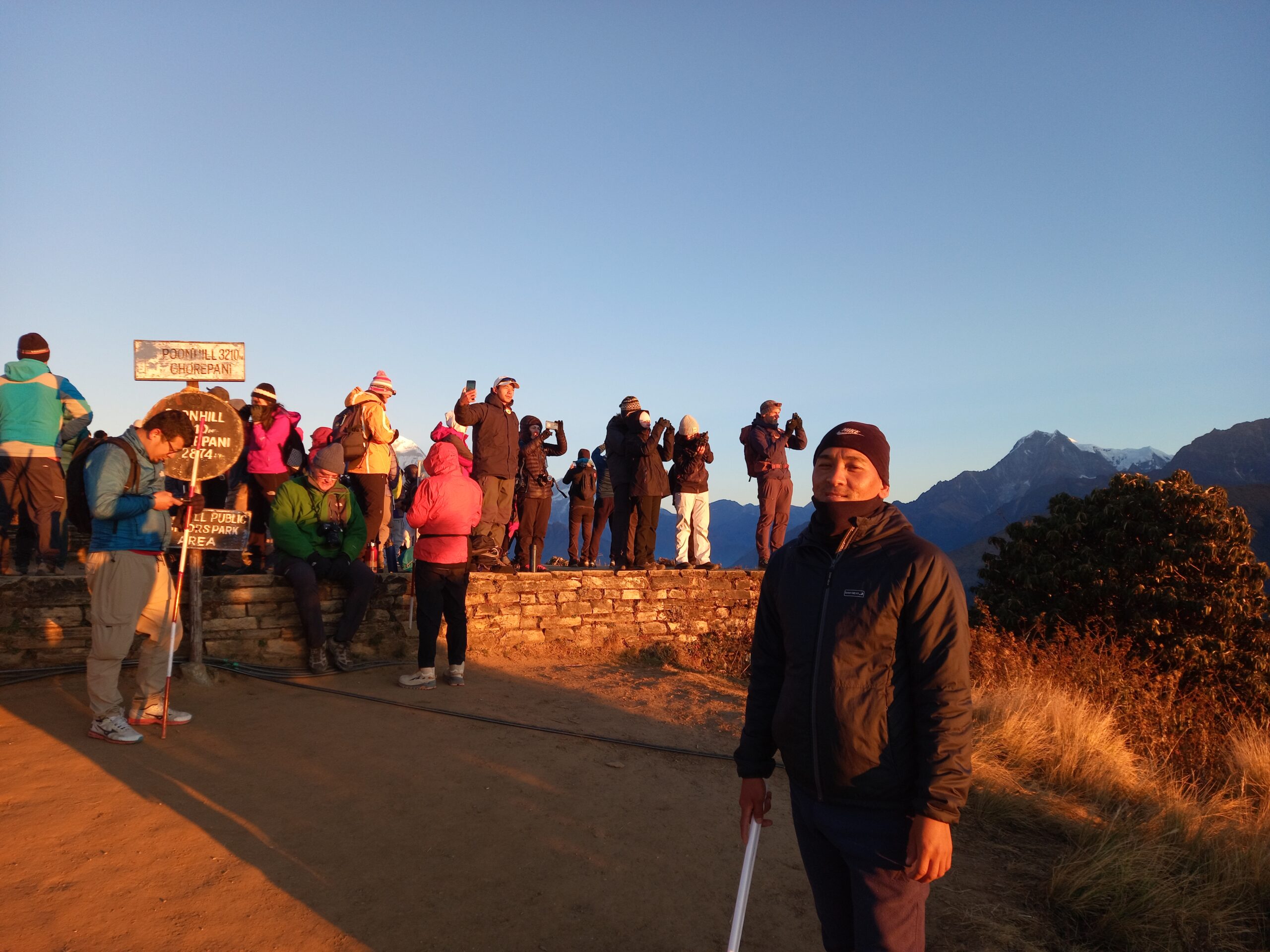
Patan and Bhaktapur are equally remarkable in their beauty and architectural splendor. Well, for now, I conclude my travelogue of Kathmandu, the city yes with traffic and chaos but with equal beauty, rawness, character, and culture.