Latest Posts

Talk to Trip Expert
+977 9704823980 (Whatsapp)


Talk to Trip Expert
+977 9704823980 (Whatsapp)A trek to Mera Peak is a life changing experience. It’s not only about reaching the top of the mountain, it is about the adventuring through the remote valleys and the quiet forests of the Sherpa villages. The view of the high Himalayas is breathtaking.
Standing at 6,476 meters, Mera Peak is Nepal’s highest trekking peak. It is an adventure that is not only trekking, but also has beginner mountaineering. For those who want to experience a real summit climb but don’t want to deal with the daunting task of extreme technical difficulty, this is one of the best adventures in Nepal.
The Mera Peak Climbing/trek feels like an authentic trekking experience, deep in the heart of the Himalayas, away from the crowds and busy trekking routes, with the most stunning views of the mountains and an authentic climbing experience. For example, the trek to Mera Peak, unlike the Everest base camp trek, which is busy during the trekking season, is quiet and gives a feeling of solitude and tranquility to the trekker.
Trekking Mera Peak will reward you with some of the most stunning and varied scenery from the lush green hills to the snowy Alpine valleys and to the icy, towering glaciers. It is a once in a lifetime trek that isn’t just about seeing the mountains, but also about feeling the mountains.
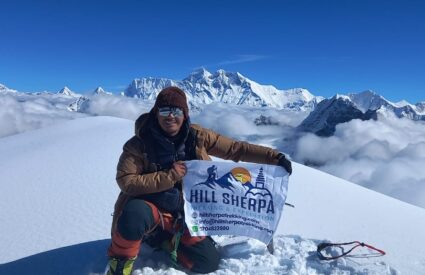
Mera Peak is located in the Solukhumbu region, although the trek leads to the less frequented Hinku Valley, which offers a wilder, more untouched trekking experience than the more famous valleys in Nepal.
Most adventurers start this journey with a short, yet scenic, flight from Kathmandu to Lukla, which adds to the thrill of the adventure. The trail from Lukla leads away from the main Everest trail and through a series of more remote villages and unspoiled woodlands. Because of this, the trek to Mera Peak provides a sense of real exploration in which the trekkers experience different vistas and landscapes each day.
Trekking Experience – Forest Trails, Remote Villages, and Sherpa Culture. The trek itself is one of the highlights of travelling to Mera Peak. The early days of the trek take you from stunning rhododendron forests and bamboo groves to quaint farming villages. Here, monks and locals practice simple and traditional ways of life.
Along the path, you will see colourful prayer flags, mani walls, and the small monasteries that are scattered throughout the deep Buddhist region of the Himalayas. Along the trail, the people you meet will be warm and welcoming. Enjoy a short conversation, and you will encounter a moment that is sure to be a highlight of your trek. A sensation like no other to be slowly pulled into the granitic heights of the Himalayas.
Managing altitude is one of the biggest challenges during the Mera Peak Trek, and the smartest way to overcome this challenge is to walk slowly and give yourself the opportunity to acclimatize. When it comes to altitude, your body needs time to adjust, and this is especially true when moving above 3000m and then 4000m and then 5000m.
This is why most itineraries have acclimatization days built in, especially around Khare, where climbers take time to rest, walk around to nearby ridges, and get ready for their summit push. If you are hoping to make a safe and successful climb to Mera Peak, it is critical to respect the altitude and have a clear focus on steady and sustained progress as opposed to rushing.
Provided there is a good balance of pace, hydration, and rest, you will feel increasingly stronger as each day of the trek passes. Making Your Way to Khare. For climbers, Khare is the perfect opening base for an exhilarating summit push. Having trekked for days through valleys and alongside rivers and taking in the sights, the true summit feels almost tangible.
There is snow on the peaks, and the air is getting super crisp. The mountains are almost within arm’s reach. Guides give a short introduction on crampon and axe use here, so don’t worry too much if you don’t have any climbing experience. There are, of course, a few real mountain and climbing experiences along the Mera Peak trail, and this is one of the first ones.
Prior to visiting High Camp, most climbers take a day, before the first show, in Khare to acclimatize and train. This day is a great opportunity to get familiar with the equipment and climbing techniques in a flexible atmosphere. Your guide will cover how to walk safely on snow and ice, properly use a jumar, stay balanced with crampons, and use ropes if they are needed. None of these are advanced climbing techniques, but they are essential for your safety and the safety of the group.
This makes the trek to Mera Peak feel more streamlined, particularly for climbers on their first challenge in the Himalayas.
The journey from Khare to Mera High Camp is one of the most beautiful and emotionally charged parts of the journey. It is here, for the first time, that you really feel the environment of the high Himalayas, the glaciers, the snow-covered slopes, and the vast open views that extend for miles. When you reach High Camp, you feel as though you are standing on the top of the world.
Downslope to the West the world is far below and all of the remaining mountains on earth are above you. High Camp is known for its sunsets. The peaks glow gold and the temperature drops dramatically. Sleeping at High Camp is difficult because of the altitude, but the excitement of tomorrow’s summit push makes it all worth it. It is at this moment in the Mera Peak trek that you know you have earned the title of climber.
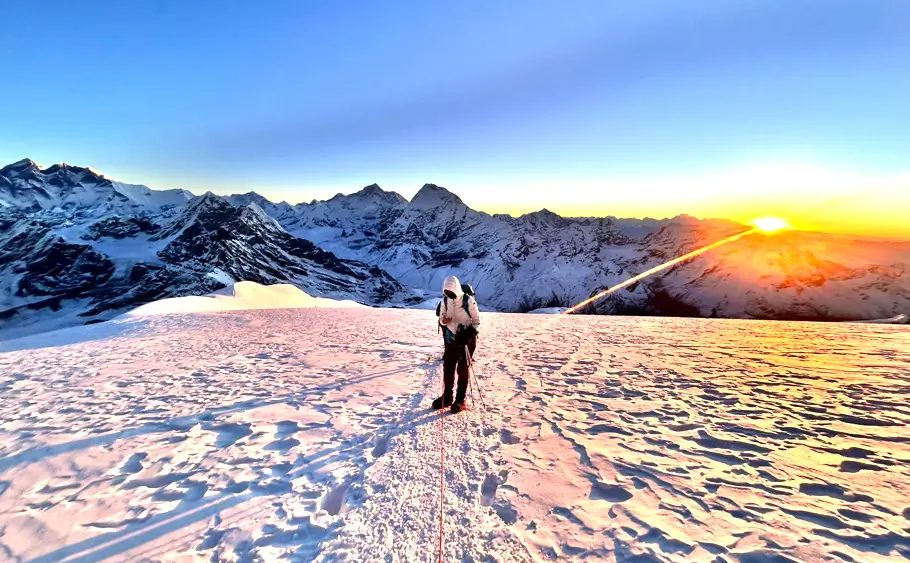
Summit Day is the most challenging and most rewarding aspect of the trek to Mera Peak. Most groups leave around midnight to around 2 AM, and you will trek under the stars and have to use a headlamp to navigate the snow. The trek is long and cold, but because of the gradual slope, it is possible to steadily gain altitude while walking.
When the sunlight finally breaks, and the Himalayas begin to glow, the vista will be one of the most breathtaking views in the world. It will be a moment of pure achievement, as you will have stood on the roof of Nepal’s trekking peaks, with peaks like Everest, Makalu, Lhotse, Cho Oyu, and Kanchenjunga, surrounding you.
From the summit, you head back to High Camp then down to Khare. While descending takes less effort in terms of breathing, it can be really tough on the legs after a long and strenuous day. However, the success of summiting Mera Peak Climbing makes every step down feel lighter.
The return trek goes back the same trail and even through the same Hinku Valley, but it does not feel the same. This time, you are not racing to the summit, instead, you enjoy the journey. You are not alone with this feeling, many trekkers feel the return journey is the time they realize what they have accomplished. There is a special feeling of self-confidence that you bring back with you after completing the trek to Mera Peak. This feeling accompanies you long after the trek is over.
There are no major obstacles of a technical climbing nature on the Mera Peak trek, however is still considered challenging due to the altitude and the length of the trek. You can make the trek with enough physical fitness, a positive attitude, and some previous trekking experience.
You are likely to think a challenge is something like extreme climbing and having to turn back. For most trek guides and peak summits, Mera Peak is a true Himalayan summit. The summit itself requires the use of some basic mountaineering tools and walking on snow, but no extreme skills are necessary. Just be prepared to keep a stable energy level.
Spring (March to May) and autumn (September to November) are the best seasons to trek to Mera Peak. You can enjoy the warmer temperatures and incredible scenery during spring. As for autumn, you can enjoy the crisp, clear views of the mountains and enjoy the stable weather. These seasons increase the chances of getting the summit. Although winter can be brutally cold, the heavy monsoon rain can make the trails even muddier.
You will need to acquire a few permits to trek to Mera Peak. These are the Makalu Barun National Park permit and the climbing permit for Mera Peak issued by the Nepal Mountaineering Association. These permits also help support and maintain the trekking ecosystem in the region. Most trekking companies/bookers take care of the permits, so you won’t need to deal with that.
The trek to Mera Peak will be accompanied by teahouse accommodation, wherein you will be sleeping in local lodges during the trek. Accommodation is basic, but the rooms are comfortable. The communal dining rooms are cosy, especially in the evenings. They offer hearty meals created for trekkers, which include dal bhat, noodles, soups, fried rice, pasta, and ultimately eggs.
The trek upwards does mean the menu is quite limited, and the prices, particularly above the tree lines, are escalated due to the transportation cost but the food is, to everyone’s surprise, still quite good. The trek upwards does mean the menu is normally quite limited, to everyone’s surprise. Eating and drinking plenty of water ensures that you remain strong during the trek to Mera Peak
When preparing for the trek to Mera Peak, packing comes first, since you have to anticipate a variety of weather conditions, from warm, lower valleys to freezing high altitude camps. Suitable trekking boots, warm layers, a down jacket, and gloves are essential. Also, bring a good quality sleeping bag, and for summit day, some equipment that your guide should provide, like crampons, harness, ice axe, and helmet.
Lastly, pack efficiently- not so heavy as to weigh you down but including everything necessary to stay warm, safe, and comfortable. Having the right equipment will make your trek to Mera Peak a smoother and more enjoyable experience.
The most important factor on any trek to Mera Peak is safety. The best way to stay safe on the Mera Peak trek is to take the trek at a slow and steady pace and to stay properly hydrated. Always listen to your body to stay safe during the trek. If you are feeling unwell, always communicate with the trek guides how you are feeling to ensure you can turn around.
The trek guides are trained to deal with altitude sickness and other trek safety concerns. They can formulate a safe and effective route to ensure everyone on your trek stays safe. As a rule, always try to stay safe and avoid altitude sickness. Trekking Mera Peak with a customer, guided team, good acclimatization, and smart decisions is what makes the trek to Mera Peak successful and enjoyable.
The Mera Peak trek is one of the most unforgettable walks one can ever encounter in Nepal. It is a trip that is full of nature and cultural experiences of tranquil trails and ends with a mountain top that looks like a lifetime success.
Mera Peak trek is one and the same experiences, which end up leaving a sense of pride, happiness, and long-term memories. Mera Peak is an ordeal that awaits you. Explore the forgotten Himalayas and be on the summit of an overview of the highest mountains in the world.