Govt. Tourism License 3195/080/81







US$ 1449 per person For a group of 17-24 pax.
- 1 personUS$ 1785
- 2 - 2 personUS$ 1685
- 3 - 6 personUS$ 1599
- 7 - 12 personUS$ 1549
- 13 - 16 personUS$ 1499
- 17 over 9999 US$ 1449
- Best Price Guarantee
- Secure Online Booking
- Flexible booking dates
- Owner operated company
- Decades of experience
- Dedicated sherpa team
- 100% success rate
- 5/5 ratings by travelers


Highlights of EBC Gokyo Chola Pass Trek 15 Days
- Top of Kala Patthar and admiring opportunity of the highest peaks in the world, including Everest, Lhotse, Nuptse, Kusum Kangaru, Kongde, Ama Dablam, Taboche, Cholatse and others
- Visit the very same base camp, which is one of the main strongholds for climbers setting off to conquer the highest peak on Earth
- Find yourself on the top of the great Cho La Pass, Nagarjung Hill, and Gokyo Ri
- Soul searching in the Gokyo Lake
- Walk across on the world-famous Hillary Suspension Bridge
- See Pangboche Monastery- one of the main shrines of the Himalayas
- Experience authentic Sherpa culture, hospitality, and life in remote mountain villages
- Discover the abundant flora and fauna of Sagarmatha National Park, a UNESCO World Heritage Site.
- Ideal for experienced trekkers seeking both classic Everest highlights and off the beaten path
Trip Overview
There is probably nowhere that ties adventure, culture, and nature together like the famous EBC Gokyo Chola Pass trek in Nepal. The 15 days journey will make you see Nepal in a way you have never seen before.
This unprecedented Everest Gokyo Chola Pass trek is split into two distinct sections. The first part will let you immerse in the beauty of the Dudh Koshi Valley, where you will stop by the celebrated Everest Base Camp (5364 m).
Then, you will progress to scale the majestic Kala Patthar peak (5550 m) for bedazzling sights of Everest, Pumori, Nuptse, Ama Dablam, and more.
The second part will then challenge you to cross the formidable 5420 m high Cho La Pass – one of Everest’s most difficult yet rewarding three passes.
The track then leads to the radiant Gokyo Valley and its three tranquil and sacred lakes. You will also surmount the 5357 m high Gokyo Ri before completing the journey in a circular route back to Namche and Lukla.
Our EBC Gokyo Chola Pass Trek thus follows a counterclockwise path, which we have intentionally designed for its shorter distance and reduced level of difficulty.
Containing most of what an adventurous trek should contain, this trip is also recognized and acclaimed for the equally great experience of the Sherpa people and their villages, their culture and their artistic Gompas, their unique dialect, and attire, and their companionship and courageousness.
On the other hand, the Everest Gokyo Chola Pass trek also offers nature making it the one and only journey where you will release all your unused strength to see the warm sun shining over the green hills and blue icy mountains, to hear the gushing rivers crashing onto the rocky shore and the waterfalls falling through the groves.
The EBC Gokyo Chola Pass trek, 15 Days in summary, is in pure Hill Sherpa country and offers perhaps the most beautiful Himalayan views. We won’t deny that climbing the high mountains will not be easy, but the harsh beauty of these places will easily overshadow all the inconveniences and pay off your efforts.
So cast aside your doubts and JOIN US on our incredibly panoramic and effortless journey of the EBC Gokyo Chola Pass trek today.
How does our journey begin?
Our Everest Gokyo Chola Pass trek is similar to the classic Mount Everest trek, which starts with a mountain flight to Lukla. The walking track then leads through the traditionally styled classic Sherpa villages of Namche, Dingboche, and Lobuche, ending at Gorakshep.
The following days see us soaring to the Everest Base Camp and Kalapatthar. Next, the gigantic Cho La Pass triggers us to pass over it to reach the breathtakingly attractive Gokyo Valley and its Lakes.
The small peak of Gokyo Ri entices us to reach to its top, after which we will make our way home in Kathmandu through Namche and Lukla.
EBC Gokyo Chola Pass Trek 15 Days Itinerary
01
Day 01: First Day in Kathmandu (1350 m)
Tashi Delek from Kathmandu- the primary location from where you will go on an adventure of the EBC Gokyo Chola Pass trek. As an organizer of this trip, our Hill Sherpa team will greet you at TIA and tag along to your hotel.
We will make sure you have a good time and everything is provided during our Everest Gokyo Chola Pass trek.
In the evening, you will join our tour guide for a group meeting where you will go over the itinerary for the next few days. And if you need any gear, make sure to grab it today.
Grab some sleep early as the night will be short for you.

Duration
35 mins
Max Altitude
1350m
Meals
Excluded
Accommodation
3-Star Hotel 02
Day 02: Off to Lukla , Walk to Phakding
We will depart for Tribhuvan International Airport (TIA) and embark on a scenic and short flight to Lukla, home to one of the world’s most iconic airstrips. Once we land at Tenzing-Hillary Airport, we will see stunning sights of Mount Kongde Ri (6,187 m) and the nearby Himalayas. After we meet the local trekking team and take the baggage to the porters, we will have breakfast in Lukla. Then we will continue on our gentle three hours trek to the beautiful Phakding Village.
The first section of the trek runs alongside the Dudh Koshi River, and through the vibrant stone-paved streets of Lukla town. At the Lukla last checkpoint, our guide will take care of the necessary Sagarmatha National Park and Khumbu Rural Municipality permits for the Everest Base Camp trek.
After that, the route descends through Chheplung and Chaurikharka, stopping at several beautiful settlements, with stunning views of Mount Kusum Kangaru (6,367 m). After that, we will continue the trek past large boulders and reach Ghat, where we will get our first view of the sacred Mt Khumbila (5,761 m). The last stretch to Phakding runs along the eastern bank of the river and is the final stretch for the day.
Notice
During the busy trekking months of spring (March–May) and autumn (October–November) seasons, flights to Lukla may be redirected from Kathmandu (TIA) to Ramechhap/Manthali Airport which is also a 4 hours drive from Kathmandu. In these situations, we will organize private ground transport for you to arrive on time. Please be mindful that all flights may be rescheduled based on the prevailing weather and airline operational factors.
Helicopter Option
For trekkers who wish to avoid the long drive to Ramechhap and prefer to have a comfortable night of sleep before the trek, we can organize a direct helicopter transfer from Kathmandu to Lukla at a rate of USD 500 – 600 per person based on a group of 5 flying together. This option is most ideal for trekkers who wish to save time and organize a Lukla helicopter transfer for the peak months and busy trekking seasons.
Trek Preparation
We suggest laying out your trekking items the night prior to your flight to Lukla. Assemble your primary gear, along with the luggage for the porters, who will carry up to 15 kg per person (this is shared between two trekkers) so that you only have your daily necessities to carry in a small daypack. When you reach Lukla, you will meet your porters, have breakfast, and begin the first day of trekking to Phakding.
The trail is easy and a pleasant start to the Everest region. That night you will stay in Phakding and rest for your next day’s hike to Namche Bazaar.
Duration
35 mins / 3 to 4 hrsMax Altitude
2655 m
Activity
TrekkingMeals
Breakfast, Lunch, DinnerAccommodation
Guesthouse 03
Day 03: March to Namche Bazaar
We will resume marching into the Dudh Koshi Valley where the track winds in and out through the alternating pine and rhododendron thickets. We will quickly come to Toktok and Benkar where Thamserku towers against the sky.
In the early afternoon, we will be at Monjo marking our admission in the Sagarmatha Park. After passing Jorsalle, we will go out for about 40 minutes to the most beautiful and famous high-suspension bridge named after Hilary over the meeting points of Imja Khola, Bhote Koshi, and Dudh Koshi Rivers.
We will walk up for the next 1 hour to the top of Topdanda/Everest Viewpoint. You can see Everest rising up behind the gigantic Nuptse and Khotse walls. Another rising stretch will take us to Namche – Nepal’s most-known mountain town.
Duration
5 to 6 hoursMax Altitude
3445mActivity
TrekkingMeals
Breakfast, Lunch, DinnerAccommodation
Guesthouse 04
Day 04: Day off at Namche, short march to Everest View Hotel
Today is a day off so we will have time to adapt to the higher altitude in the best way. However, a rest day in Namche does not mean lying on your back unless you really feel that you need to rest properly.
So we will use the day to go up to a nice lookout point called Everest View Hotel. Here, we will have a nice cup of tea and breakfast and enjoy the view of Everest, Lhotse, Thamserku, Cholatse, Tawache, Nuptse, and Ama Dablam among others.
After the hotel visit, if you are extra energetic, you can also walk to other sites of the market.
Duration
2 hoursMax Altitude
3880mActivity
HikingMeals
Breakfast, Lunch, DinnerAccommodation
Guesthouse 05
Day 05: March to Phortse village
First, an easy downward track takes us to Sanasa, then the beautiful sloping path rises for about 1.40 hours towards Mong La Ridge (3973 m). The view of the Gokyo Valley, Tawache, Cholatse and not least Ama Dablam is in a special class.
A dizzying downward climb from the Pass through the gorge takes us to Phortse Thanga. The track now slowly climbs up into the terrain and through the rhododendron forest.
After approximately 2 hours, the fabulous Phortse village is reached with Khumbila, Tawache looming behind the scene.
Duration
6 to 7 hoursMax Altitude
3,860mActivity
TrekkingMeals
Breakfast, Lunch, DinnerAccommodation
Guesthouse 06
Day 06: March to Dingboche
A mix of rhododendrons and cypress trees slowly escort us towards the Upper Pangboche. A small attractive monastery with 400 years of history is worth exploring. Next, the walking path rises to Shomare denoting our entrance into the Imja Valley.
The trekking path is now easy guiding us to Dingboche settlement spectacularly settled in a small gorge.
Duration
5 to 6 hoursMax Altitude
4410mActivity
TrekkingMeals
Breakfast, Lunch, DinnerAccommodation
Guesthouse 07
Day 07: Day Off, climbing the Nagarjung hill
We have another day off at Dingboche which we will use to our advantage and go to the higher peak of Nagarjung Hill aka Nangkartshang in the local dialect. If you prefer, you can also take a rest in the lodge.
The 3-hour hard climbing of the Hill gifts us with stunning views of Island Peak, Ama Dablam, Baruntse, Cholatse, Makalu, Tawache, Khankaru, Nirukhang, and Thamserku among others.
Duration
3 to 4 hoursMax Altitude
5083mActivity
HikingMeals
Breakfast, Lunch, DinnerAccommodation
Guesthouse 08
Day 08: March to Lobuche
The landscape slightly becomes harsher from here as we move on to Dughla. In the first half, we will climb the stone blocks of the Khumbu Glacier and reach a monument dedicated to the alpinists who died on Everest.
The location is locally called the Dughla Pass (4830 m) known for the excellent panorama of Lobuche Base camp, Lobuche Peak itself, Pumori, and Ama Dablam.
The delicate high alpine route will take us to Lobuche next to the Lobuche Glacier.
Duration
4 to 5 hoursMax Altitude
5030mActivity
TrekkingMeals
Breakfast, Lunch, DinnerAccommodation
Guesthouse 09
Day 09: March to Gorakshep continue to EBC , hike back to Gorakshep,
A short 3-hour climb along the Khumbu Glacier will guide us towards the Lobuche Pass famous in the region as Thangma Riju. The bedazzling views of Changri, Mahalangur, Lingtren, Nuptse, Everest, and Pumori open up in the pass.
Slowly the Changri glacier appears as we wind our way in and out. Now our hike will become easy and after a while, we will be eating our lunch at Gorakshep.
After resting our exhausted feet, we will once again march along the Khumbu Glacier towards the Everest Base camp. After 20 minutes we will pass several memorial stones, erected for those who had to give their lives in the struggle to reach the top of Everest.
Taking the yak path, we will pass several beautiful ice towers and get to the EBC. We can also cross over towards the famous and infamous Khumbu Icefall from the camp.
The barren alpine land again takes us back to Gorakshep where we will enjoy the late afternoon tea.
Duration
7 to 8 hoursMax Altitude
5364mActivity
TrekkingMeals
Breakfast, Lunch, DinnerAccommodation
Guesthouse 10
Day 10: Advance to the top of Kalapatthar, march to Dzongla 4,830 m
Shortly before sunrise, we will be awakened to climb towards the panoramic peak of Kalapatthar. The track from the lodge first goes steeply upwards, then gently, until the last block field that pulls out its teeth.
The very last meters are a snorting battle, but standing on top of the Kalapatthar and looking down at EBC along with the towering mountains of Everest, Pumori, Changtse, Khumbutse, Lhotse, Lingtren, Ama Dablam, Nuptse, among others is truly special.
The lofty arid landscape will walk us back down to Dzongla via Lobuche.
Duration
2-3 hrs Climb Kala pathar / 6-7 hrs trekMax Altitude
5550mActivity
TrekkingMeals
Breakfast, Lunch, DinnerAccommodation
Guesthouse 11
Day 11: Cross Cho La Pass , march down to Gokyo Lake via Thangnag
We will once again have an alpine start before sunrise to walk over the humungous Cho La Pass. The pass is not technically difficult, but definitely harder hiking, steeper and cold.
We will walk approximately five hours upwards to the height of the pass in Cho La, which in the local Sherpa language is called Chhugyuma La. From the height of the pass, we get terrific views of the Lobuche Peak and behind them, Everest, Nuptse, Lhotse, Makalu, and the mountains towards Rolwaling.
We will now slowly walk downward towards Thangnag where we will take a break for lunch. Usually, the village will be an overnight stop but the Gokyo Lake is only 2 hours far from the village so we will push ourselves and make it to the lake today.
The big main lake of Gokyo and the small lakes of Taujung and Longponga Lake will meet us here. We will discover the spelndid Gokyo Village at the boundary of the big lake of Gokyo. There is a little internet place here for those of you who want to send a quick greeting home.
Duration
7 to 8 hoursMax Altitude
5420mActivity
Trekking at high passMeals
Breakfast, Lunch, DinnerAccommodation
Guesthouse 12
Day 12: Advance to the top of Gokyo Ri, march down to Dole
Immediately behind Gokyo is the great peak, Gokyo Ri. The track starts with a vertical climb for about 1 to 3 hours that will finally end up at the top of Gokyo Ri.
From the top, there is an incomparable sight of a variety of mountains such as Everest, Lhotse, Makalu, and Cho Oyu along with Renjo La Pass, Gyachung Kang. Below us, we have the longest glacier in Nepal, Ngozumpa, which starts at Cho Oyu. The view here is considered to be among the best in Nepal so it is well worth the effort to climb all the way up.
For extra energetic individuals, there is also the option of going beyond the Gokyo Ri to visit the fourth and fifth lakes of Gokyo and the extra hike to the small peak of Ngozumpa Ri at 5,553 m.
We will next return to Gokyo for a meal and get ready to march down to Dole. The again highland flora rhododendron guides us towards Macchermo town. The kharka of Sunpati will then escort us to the Gyele finally leading us down to Dole.
Duration
6 to 7 hoursMax Altitude
5357mActivity
TrekkingMeals
Breakfast, Lunch, DinnerAccommodation
Guesthouse 13
Day 13: March down to Namche Bazaar
The Sherpas’ sacred mountains of Khumbila and Tawache will direct us through the cypress and rhododendron jungle to Phortse Thanga. The path now steely rises to Mong La Danda. A long beautiful descending path will usher us to Kumjung and Kunde ending at Namche Bazaar.
Duration
6 to 7 hoursMax Altitude
3443 mActivity
TrekkingMeals
Breakfast, Lunch, DinnerAccommodation
Guesthouse 14
Day 14: March down to Lukla
The last bit into Lukla this day which can be long but not hard. First we go down to the beautiful bridge and then check out of Sagarmatha National Park at Jorsalle.
Then continue through Monjo, Toktok, Benkar, and Phakding before the long and somewhat tiring and final climb on the trek – the road up to Lukla.
Late afternoon we will arrive in Lukla for the last night of the Everest Gokyo Chola pass trek.
Duration
6 to 7 hoursMax Altitude
2800 mActivity
TrekkingMeals
Breakfast, Lunch, DinnerAccommodation
Guesthouse 15
Day 15: Kathmandu Return
The early morning will see us going to Lukla’s small airport terminal and check in. We will wait for the plane to arrive so that we can properly get back to Kathmandu and have a hot shower at the hotel.
You will have the afternoon and evening at your disposal where you have the chance to do some shopping and/or sightseeing with what you didn’t have time to do before we flew up to Lukla.
In the evening we will find a cozy and pleasant restaurant where we will have our dinner and will reflect on our weeks up in the mountains.
Max Altitude
1300 mActivity
Flight back to KathmanduMeals
Farewell DinnerAccommodation
3-Star HotelIncludes & Excludes
What is included?
- International Airport pickup and drop-off by private car and transfer to hotel.
- Domestic airport pick up and drop off, or Kathmandu-Manthali-Kathmandu ground transformation by sharing Hiece or jeep.
- 3 star hotel twin sharing room accommodation 2 nights in Kathmandu with breakfast.
- Domestic flight 2 ways from Kathmandu-Lukla-Kathmandu, or Ramechhap – Lukla – Ramechhap including 10-15 kg.
- Permit of Sagarmatha National Park entry Everest region.
- Permit of Khumbu pasang Lhamu rural municipality.
- Breakfast, Lunch, and Dinner, 3 meals in a day, choose from the menu.
- Complementary daily fresh fruit after dinner.
- Accommodation, a local tea house during the trek.
- Government-licensed holder, speaking English, and experience guide
- All staff wages, food, drinks, accommodations, transportation, and insurance
One strong sherpa helper for carrying your baggage (1 porter for 2 clients) - Hill Sherpa Trekking provides a first-aid kit during the trek.
- Water purification tablets for tap water
- Helicopter Rescue service will be covered by your travel insurance in the event of an emergency.
- Nepal government tax and company’s official charge
- Down jackets, duffel bags, sleeping bags, and trekking poles are provided by Hill Sherpa
- Trekking but should be returned after the trek (if you need them).
- An oxy meter is provided to check your pulse and oxygen level (AMS) (acute mountain sickness)
- An assistant guide will be provided if groups are larger than 7 people
- Hill Sherpa Trekking provides trip certificates (after completing the trip).
- A Complementary sunblock cap of Hill Sherpa Trekking
What is excluded?
- International airline tickets.
- Nepal entry visa fee and visa will be obtained on arrival at the international airport in Kathmandu.
- Additional accommodations, food, and drinks in Kathmandu (if staying an extra day)
- Any sort of dessert, sweet item, chocolate, cake, Tea, coffee, pie, pudding, mineral water, or bar bills, for any extra personal expenses during the trek and city
- During the trek, hot showers, mobile, camera, power bank, any battery charging, Wi-Fi Internet,
- Kathmandu sightseeing, and entrance fees of wherever you will visit temples
- Your personal medical and travel insurance, and personal first aid kit.
maximum excess baggage weight of more than 10-15 kg - Tips for Guides and Porter (Tipping is most expected)
Note:
We also operate private trips.
Trip Information of EBC Gokyo Chola Pass Trek 15 Days
Best Time to EBC Gokyo Chola Pass Trek 15 Days
It is best to be a part of the EBC Gokyo Chola Pass trek in spring (March to May) and autumn (September to November). The weather will not throw up any special surprises and they are also a good time for solitary contemplation of natural beauty by the Gokyo Lake.
A huge number of tourists flock to the EBC and Gokyo Lake especially in autumn to celebrate their new journey to the new world. However, it is worth considering that prices for accommodation and entertainment can sky rocket this time.
The rainiest and hottest time is from June to August when the days will be suffocated by stuffiness and clouds. While in winter (December to February), it is frosty and snowy.
Elevation and Distance
EBC Gokyo Chola pass trek will firstly take us about 200 to 300 km from Kathmandu to the famous and infamous Everest Base Camp which towers at 5364 m above sea level. The journey as usual starts from Lukla separated by 135 km from Kathmandu.
The second major destination on our trek is Gokyo Lake at 4700 m which sits restfully 136 km from Kathmandu. We will have to travel 17.6 km from the Everest Base Camp to the tranquil Gokyo Lake and 32.6 km from Lukla.
Kalapatthar Peak will be the top point of our Everest Gokyo Chola pass trek at 5550 m while Gorakshep will be the highest stop where we will rest our fatigued feet for two nights.
Maximum/Minimum walk per day
The 15 days of the Everest Gokyo Chola pass trek has allocated 13 days for a hiking trip. These 13 days will see us walking for at least 4 to 7 hours most of the days enclosing 15 km on average each day.
However second day and the tenth day of our trek will be different when we will have the shortest and longest walks respectively. The trek from Lukla to Phakding on day 2 mainly goes down and takes only 3 hours to complete.
However, on day 10, we will set off to find ourselves at the top of Kalapatthar and by the end of the day in Dzongla which will take 10 to 11 hours- not to be taken lightly.
EBC Gokyo Chola Pass Trek 15 Days Difficulty and Acclimatization
A trip to the EBC Gokyo Chola pass trek is surprisingly of average difficulty and it is short comprising only two weeks in the mountains. The daily walking stage is only 4 to 7 hours but the days of EBC and ascent of Kalapatthar need 10 to 11 hours.
But we also suggest you not to underestimate this trek as it is quite high and cold. And here the adaptation to altitude is extremely important, no less.
That’s why we will take a day off at Namche and Dingbiche before progressing to EBC and Kalapatthar. These two rest days will also prepare our bodies to well adapt for our climb to Cho La Pass.
We will also have another day off at Gokyo Lake that will prepare our bodies to climb Gokyo Ri. Thus, our acclimatization will be gradual and sufficient with slightly increasing overnight altitude that is so decisive for the good and, not least, safe experiences in the high mountains.
Can a beginner do this trek?
If you do not have previous experience with trekking trips and hiking holidays, do not despair, because everyone can participate in our Everest Gokyo Chola pass trek without previous trekking experience from the Himalayas.
It is because the trails are good and well sign-posted, and we hike and trek in the morning and afternoon, with a solid lunch break in the middle. There is also time to stop to rest and take photographs along the way as we do not walk non-stop in a long line.
Fitness always improves along the way, but it should still be emphasized that you should be in reasonable shape right from the start of the trip.
Preparation and training
Although a moderate hike, for the EBC Gokyo Chola pass trek, you can’t be in too good shape. The top days of crossing the EBC, Kalapatthar, and Gokyo Ri with the overcoming of Cho La Pass is no doubt a difficult day so you must be well prepared in advance.
Please introduce yourself to the harsh environment of the Solokhumbu region by watching some relevant documentaries on YouTube. This will help you prepare mentally in advance while the long walks before departure, running, cycling, sports and an active lifestyle will help you for lengthy walks.
An intensified and good portion of training before departure is therefore absolutely recommendable.
Alternate routes for EBC Gokyo Chola Pass Trek 15 Days
Another possibility for this trek is to take the clockwise route that differs after you get up to Namche. From Namche, you will walk in a circle to the turquoise blue Gokyo lakes and further over the fine Cho La pass and towards Everest Base Camp and Kalapatthar. On the way home, you will take in Dingboche and Tengboche, among others.
You can also add a indelible journey to the base camp of Ama Dablam to your itinerary. The initial trekking track will escort you to Tengboche and Deboche from where your walking route advances further to the Ama Dablam base camp. On the return path, you can move on to Pangboche thus merging the trail to Dole and Gokyo Valley.
Altitude Sickness
It is undeniable that there is a fear of altitude sickness on our EBC Gokyo Chola pass trek because we will be climbing to the high mountain heights. We will spend the majority of time above 3500 m. so some of us certainly encounter the mild symptoms of altitude sickness, but this usually does not affect the success of the tour.
Eventually, we will get used to the dry air of Khumbu and our bodies will acclimatize. However, you should never ignore even the simplest signs such as headache, digestive complaints, diarrhea, loss of appetite, dizziness, sleep problems, and fatigue.
Be sure to watch for these symptoms, and report them to the tour guide, and take Diamox. Our guide will observe your condition and accordingly may take you to a lower level.
Transportation, Accommodation, Meals and Drink
We will furnish you with all transfers in Nepal in private transport to and from the airport including transport to and from the hotel as well. The price of the Kathmandu-Lukla-Kathmandu flight ticket is also included in our Everest Gokyo Chola pass trekking package.
You will stay in 3-star hotels in downtown Kathmandu with rooms to be divided two by two. If you want to sleep alone, expect an extra charge. During the walking part, your nights will be spent in modest teahouses located next to the path.
Meals in Kathmandu (except for breakfast) are not included in our trip participation fee while during the hike, all meals (breakfast, dinner, and lunch) with fresh fruits every night will be available.
Hot soups, pasta, fried potatoes, potato pie, egg dishes, rice dishes with vegetables, sandwiches, dal bhat, tarkari, aachar, curry, fried rice, and momo will be the typical choices.
Communication, Gadgets charging, and Internet/wifi
Stable electricity is available in the lodges from the Nepal Electricity Authority or solar panels so you can charge your phone, electrical devices, and power bank conveniently.
For stable mobile communication throughout the Everest region, the private NCELL provider is better than the government-licensed NTC networks. Purchase the SIMs in Kathmandu for the continuous conversation from the beginning of the Everest Gokyo Chola pass trek.
The WIFI available in the lodges will not come for free and they may not be stable as well. So opt for the individual Everest Link Wifi Prepaid Card that can connect you with the world even when you are at the EBC.
Permits for EBC Gokyo Chola Pass Trek 15 Days
Permits for entry into Sagarmatha National Park and Khumbu Pasang Lhamu Rural Municipality are essential for the EBC Gokyo Chola pass trek. Our trip participation fee covers the cost of the permits, and our guide will handle their acquisition in Lukla town.
What to Expect for EBC Gokyo Chola Pass Trek 15 Days
For the EBC Gokyo Chola Pass Trek of 15 Days, the traveller will experience a journey of a lifetime that is a high altitude trek in the Himalayas. The walk leads to the world-famous trek of the Everest Base Camp along with the splendid Gokyo Valley that is connected to the Gokyo Cho La Pass. There is a different walk to be taken on each day that is different from the other, with each day providing a different scene that is to be enjoyed.
On every other day, there are to be around 4 to 7 hours of hikes, on two of the more difficult days there will be the possibility of more than 7 hours of hikes due to the nature of the climb, specifically in the Kalapatthar and Cho La Pass region. The traditional Teahouses will bring comfort and security, with a variety of meals to be selected from, while the trek is completed in a combined experience of culture and different beautiful scenes that may have mountainous views. This trek brings together, in finishing a complete journey through the Khumbu region.
Do I Need Travel Insurance for the EBC Gokyo Chola Pass Trek 15 Days?
Yes, travel insurance is essential for the EBC Gokyo Chola Pass Trek 15 Days, as it must include trekking at heights above 5,500 meters. The route traverses remote high-altitude areas, including Everest Base Camp, Kalapatthar, Cho La Pass, and Gokyo Ri, which all pose a higher risk of altitude-related issues. Since there is no road access, the only reliable emergency escape route is via helicopter, which is very expensive.
This is why your insurance must include helicopter rescue, medical coverage, trip cancellation, coverage for delays (especially for Lukla), and lost luggage. Trekking companies and rescue teams will require valid insurance details before the trek begins. If you have the right insurance coverage, you can tackle the entire EBC Gokyo Chola Pass trek with confidence and peace of mind.
Why Choose the EBC Gokyo Chola Pass Trek 15 Days?
The EBC Gokyo Chola Pass Trek 15 Days is the most ideal option for trekkers who are in search of a beefed up alternative trek to the classic Everest Base Camp trek. This route gives you the rare opportunity to hike the base camp of the world’s tallest mountain and the effervescent Gokyo lakes at the same time. Crossing the Chola Pass adds more adventure and connects both the Khumbu and Gokyo valleys, showcasing incredible views of the lakes, glaciers and the raw land of the Himalayas.
This trek takes you to Kalapatthar for the closest view of Everest at sunrise and then the Gokyo Ri for a 360° panorama of Everest, Lhotse, Makalu and Cho Oyu. This trek is as culturally rich as it is naturally beautiful, from the ancient monasteries of the Sherpas to the wildlife. It is one of the most lucrative high-altitude treks to the Himalayas and it is all possible in just 15 days, thanks to the well thought out itinerary designed for acclimatisation and safety.
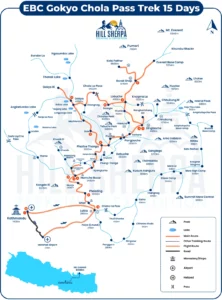
Trip Map of EBC Gokyo Chola Pass Trek 15 Days
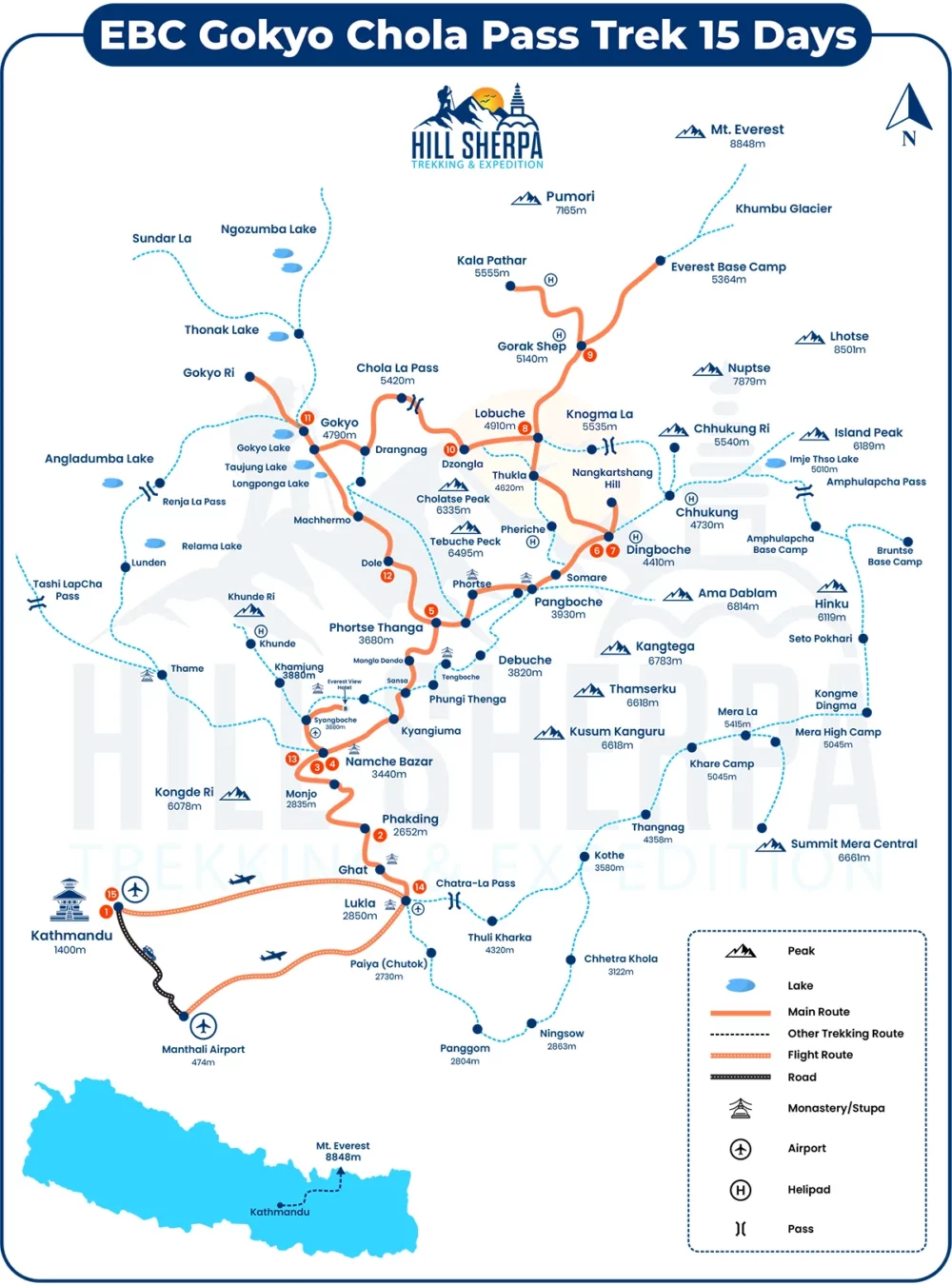
Altitude Chart of EBC Gokyo Chola Pass Trek 15 Days
Equipment List

General Information
- The company provides a feather sleeping bag, a feather down Jacket, but they should be refunded after the trek.
- Hill Sherpa Trekking provides a duffle bag during the trek, but it should be refunded after the trek.
- We mostly recommend for morning and evening, the windproof and waterproof thin-layered jacket above 3450m.
- We mostly recommend for Daypack bag 35-45 Ltr.
- Headlamp & extra batteries during the trek

Daily Use Essentials
- A Sun Block Cap & Fleece hat
- Sunglasses 100% snow uv protection
- A muffle (full cover mask)
- Sunscreen (30+ to 60 SPF, depending on age)
- A pair of thin & warm gloves
- A pair of Trekking poles
- Water bottle & filter
- Water purified tablets
- lips guard

Upper Body Essentials
- Warm hat
- A pair of t-shirts
- Thermal tops
- Sports bras for ladies
- windproof & fleece jacket
- waterproof jacket

All Lower Body
- waterproof trouser
- warmer & fleece trousers
- A pair of Comfortable trekking pants
- Extra comfortable sports pants
- A pair of sports shoes
- Thermal underwear
- A pair of comfortable waterproof trekking boots
- Pair of light sandals
- Some Thick (woolen) socks
- Sock liners
- Light shoes

Personal Medical and First Aid Kits
- Diamox (125mg to 250mg tablets for AMS)
- Adhesive bandages and pocket masks
- Non-stick pad W/ Adhesive
- Ibuprofen & paracetamol tablets IP
- Some Assorted adhesive bandages
- Warps, splints, and wound coverings, butterfly bandage
- Blister treatment cream or similar
- Insect / anti-itch ointment
- Moves in case sprain any body
- pain-relief medication
- Sinex, & Eye Drops etc.
- Gauze sponge
- Saline solution

Important Things
- passport-size photos with original passport scan copy
- Travel and medical insurance
- Flight details (to pick you up & transfer to hotel)

Extra Essential Things
- Energy gel or dry foods (that’s your desire)
- A power bank is most important for a backup device (if you have one)
- Camera, chargers, extra batteries, memory card)
- Most important for ladies’ essential things (if you are a lady)
Frequently Asked Questions
What insurance will you recommend for your EBC Gokyo Chola Pass trek?
For your insurance on this trip, we highly advise you to take a closer look at your insurance company’s offer. Ensure your insurance covers the costs of helicopter rescue and is valid above 5000 m.
Is there a way to make the Everest Gokyo Chola pass trek shorter?
Yes, you can bypass either the hike to EBC or Gokyo.
Is my departure confirmed after I have booked this trip?
After you confirm the trip with an advance deposit, you will be guaranteed to go on this trek even if other participants decide to cancel.
What is the suitable age for the EBC Gokyo Chola pass trek?
This trek is open to all individuals who are physically fit and can walk for 6 to 8 hours each day.
Can our children accompany us to EBC and Gokyo?
We have organized numerous tours to EBC and Gokyo Valley for families with children of 12 to 17 years of age. In fact, this will be an excellent opportunity for teenagers to understand that the real world is far more superior than the virtual one found on mobile devices.
Reviews on EBC Gokyo Chola Pass Trek 15 Days


US$ 1449 per person For a group of 17-24 pax.
- 1 personUS$ 1785
- 2 - 2 personUS$ 1685
- 3 - 6 personUS$ 1599
- 7 - 12 personUS$ 1549
- 13 - 16 personUS$ 1499
- 17 over 9999 US$ 1449
US$ 1449

Talk to Trip Expert
+977 9704823980 (Whatsapp)
✖
Free Travel GuideGet Expert Guidance from Experienced Sherpas