Govt. Tourism License 3195/080/81





- Best Price Guarantee
- Secure Online Booking
- Flexible booking dates
- Owner operated company
- Decades of experience
- Dedicated sherpa team
- 100% success rate
- 5/5 ratings by travelers


Highlights of Gokyo Lakes Trek 9 Days
- Visit the beautiful Gokyo Valley and glacial lakes of a blue color.
- Feel the peaceful charm of Sherpa villages and Himalayan culture.
- Reverse international hotels and local food and hospitality.
- Travel over exquisite rhododendron trees, elevated glaciers and hanging bridges.
- Moving moderate level hiking, good preparation required among beginners.
- Professional trekking with highly qualified, expert, and supportive trekking guides.
- Alternative routes. Renjo La Pass, Everest Base Camp, Kala Patthar and Everest Three Passes.
- Scale the Gokyo Ri (5, 357 m) to have a close-up view of all of Everest, Lhotse, Makalu, and Cho Oyu.
Trip Overview
Gokyo Lakes Trek 9 Days is one of the most memorable treks in the Everest region, alongside its incredible views of Mount Everest, enriching Sherpa culture, and positioning alongside beautiful high-altitude landscapes. It is an alternative trek to Everest Base Camp, which is known for its glacial lakes, diverse mountain views, and the impressive climb to Gokyo Ri, which has better views of Everest than Kalapatthar.
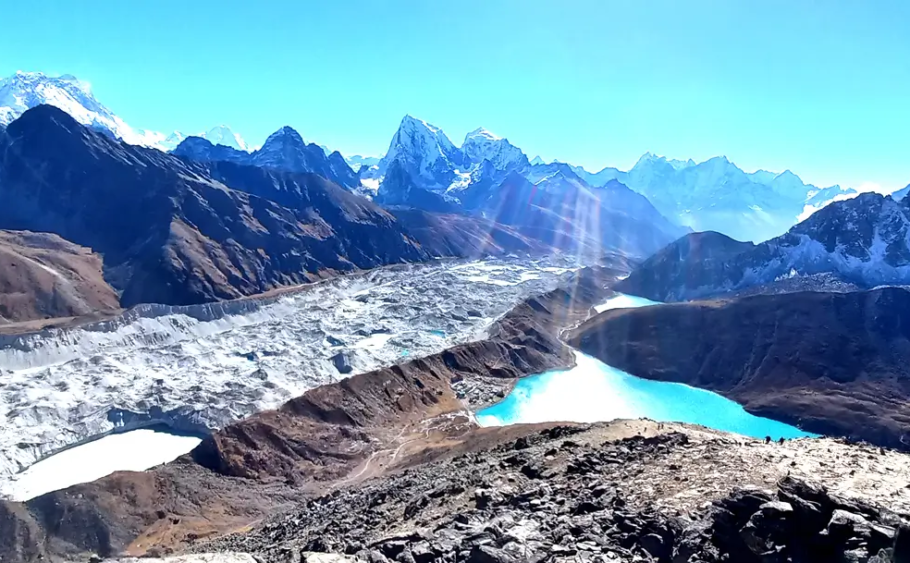
In addition to Gokyo Ri, the trek takes you through classic Sherpa settlements, alpine forests, pastures of grazing yaks, and old monasteries as it unfolds views of Everest, Cho Oyu, and Lhotse, as well as Makalu, Ama Dablam, Pumori, and Thamserku. One of the highlights of the trek is Ngozumpa Glacier, which is longest glacier in the Himalayas in Nepal.
Gokyo Lakes Trek begins with a scenic flight to Lukla, and subsequent treks to Phakding, and then Namche Bazaar, the gateway to Everest. An acclimatization day in Namche lets trekkers immerse themselves in Sherpa culture and get views of Everest and the surrounding mountains. The trail continues through Dole village and Machhermo to Gokyo Village, set alongside the stunning glacial lakes with peaks. One of the greatest parts of this trek has to be the climb to Gokyo Ri, and the breathtaking views of Everest and the Khumbu Range, as well as the Gokyo Lakes, which make for an unforgettable sunrise.
The entirety of this itinerary has been constructed with rest and acclimatization in mind, making this trek suitable for people with an average level of fitness. Hill Sherpa Trekking has an excellent reputation in Nepal as a trekking company and has experienced, professional guides. Gokyo Lakes trek takes 9 days, and you get to make the trek at a very affordable price in 2026/2027. Bookings are always open, and you get to have a trekking experience in the Himalayas.
Gokyo Lakes Trek 9 Days Itinerary
01
Day 01: Flight to Lukla then trek to Phakding
The Gokyo Lake Trek, 9 Days, commences with a majestic flight to Lukla from Kathmandu. This flight is a thrill, offering all passengers a chance to see the majestic and towering peaks of the stunning Himalayas, their valleys, and other topographical variegations. It is going to be an adventure for sure and is a perfect introduction for trekkers to the unrivaled views of the Himalayas.
After eating breakfast in Kathmandu, you will meet your trekking guide who is with you for the trek, and head to the airport for your flight to Lukla (2,800 m / 9,184 ft). The flight will arrive at the renowned Tenzing-Hillary Airport, which is going to be a wonderful experience, albeit with a little anxiety and a few clouds, as the airport is located right in the midst of the snowy peaks and has a very limited runway.
After the plane lands and you disembark, the trekking part of the Gokyo Lake Trek 9 Days begins, as you are now officially part of the Khumbu region. Once arriving in Lukla, you will meet the trekking porters who will help carry some of your luggage through the trek.
This will keep you from having to walk with a heavy pack. After a short break and lunch in Lukla, the last adjustments to your gear are completed and the trek starts officially with a gentle downhill walk to Phakding. This part of the trek will be the most relaxed and will help you ease into the trekking routine.
Trek from Lukla to Phakding
On the Gokyo Lake Trek 9 days, the first trekking day from Lukla to Phakding is also short. This is so trekkers can gain acclimatization to the altitude. This trek follows the Dudh Koshi River and streams through forests and small Sherpa villages. On the way, you will find prayer flags, mani stones and stupas. These are some examples of the cultural heritage of the people of the mountains.
Further along the trek, you will find many other suspension bridges, including the popular Chheplung Bridge, where you will have a view of the river and the mountains. This section of the trek is especially well appreciated after the long wait to earn the trek and the trekking routine. The fresh mountain air and gentle inclines will be a welcome treat to the trekkers.
After about three to four hours of walking, you will arrive in beautiful Phakding, a riverside village. Here you will settle into a traditional teahouse. Phakding offers the first overnight stop on the Gokyo Lake Trek 9 Days and provides the best authentic Sherpa hospitality. Relax and enjoy a warm meal before the trek continues to Namche Bazaar.
Guides in Lukla take time to prepare the necessary permits, so the trek can go smoothly and avoid needing to stop for logistical concerns.
Important information
During the peak trekking seasons in Autumn and Spring, flights to Lukla get delayed and diverted. Weather conditions and busy air traffic cause these delays, and should be expected when planning the trek.
Private road transport is arranged to smooth the transfer when flights go from Kathmandu to Ramechhap (Manthali) Airport. Ramechhap is about a 4-5 hour drive from Kathmandu.
For those seeking a quick and convenient method, we can arrange helicopter transfers from Kathmandu to Lukla for an extra $500-600 USD per passenger on a shared flight (5 passengers maximum). While this method is more costly, it provides a good opportunity to see the Himalayas.
Trek Preparation
All personal gear, as well as trekking equipment, needs to be organized and packed the day before departure. Lukla provides the last opportunity to get a substantial meal and do any remaining logistical tasks before the trek begins, as it is the last major settlement with a good range of services.
To make the trekking experience more enjoyable, we include porter services. Every two trekkers will share one porter, so we encourage you to enjoy the hike without the concern of heavy carrying.
The trek to Phakding is of great significance, as it aids in the acclimatisation process. The gradual terrain means that your body is able to make adjustments in a more natural way to the altitude. Teahouse accommodations provide simple and basic lodgings, but with scrumptious meals and hospitable service, you will be more than happy.
Trekking through Khumbu Valley’s stillness allows adventurers to establish their journey cadence while reveling in the beauty of nature during day one of their excursion. Phakding marks the commencement of your expedition into the Himalayas and Phakding preps you for the thrilling climb to Namche Bazaar and the dazzling blue lagoons that wait during the Gokyo Lake Trek 9 Days.

Duration
30 minutes flight/ 3 hours walk
Max Altitude
2600 m
Activity
trekking
Meals
Breakfast, Lunch, Dinner
Accommodation
Local Teahouse 02
Day 02: Phakding To Namche Bazaar Trekking
The Gokyo Lake Trek 9 Days’ second day hiking trip commences from Phakding to Namche Bazaar, an important and proud climb into the very core of the Khumbu. This day features a notable altitudinal increase in addition to a rich presentation of newly acquired features and formations. Excited trekkers will experience even more pronounced mountain majesty, creamy green dense thickets, and the ever lively Sherpa populace.
The journey becomes more exhilarating and challenging, and the main request will be a little more self-restraint and the creation of a personal, enjoyable cadence.
The path of the previous day is, for the most part, repeated and descends close to the banks of the Dudh Koshi River. Adventurers proceed through conifer and rhododendron thicket, cross small Sherpa settlements and range of the Himalayas. The Dudh Koshi and the majestic view won’t allow the trekkers to miss the freshest elements as altitude is gained.
During their travels, trekkers encounter many magnificent suspension bridges, which are built over gushing rivers and deep gorges. On clear days, trekkers can catch their first spectacular view of Sagarmatha (Mount Everest) while navigating this section of the trek. The first sight of the world’s tallest mountain is a one-of-a-kind experience, and it is a moment that every traveler relishes.
The trekker’s journey continues through the tiny settlement of Monjo Village, which is also the official entrance to Sagarmatha National Park (a UNESCO World Heritage Site). Here, the park officials verify the trekking permits that trekkers had previously obtained, and this gives them access to the restricted zone. After Monjo, trekkers are faced with the first and, most likely, the most difficult uphill trek of the day toward Namche Bazaar.
Trekkers must conquer a steep ascent, which is interrupted by a succession of switchbacks, to reach Namche Bazaar. Namche Bazaar is the most sizable Sherpa town in the Everest region and is a trove of high-altitude history. Sights such as the bustling town, which over the years has transformed into a fully furnished mountain town complete with bakeries, restaurants, and cafes, will impress most trekkers.
For many, the town will be a welcome change from the trail. Historically, it was a pivotal trading point between Tibet and Nepal, where the barter trade of salt, wool, and tea was exchanged. Now it has integrated banking services and internet access.
Many trekkers choose to spend extra time in Namche Bazaar to adapt to the altitude, rest and experience the local culture. Namche has great views of the surrounding mountains and has a rich Sherpa culture.
Namche also has a great local market, a couple of museums, and a variety of stores where trekkers can get last minute higher altitude trekking gear. For Gokyo Lake Trek 9 Days, a stop in Namche Bazaar is an important step in acclimatization and helps prepare for the next sections of the trek.
Duration
5-6 hoursMax Altitude
3440 mActivity
trekkingMeals
Breakfast, Lunch, DinnerAccommodation
Local Teahouse 03
Day 03: Hiking to hote Everest view & rest day
This is a rest day in Namche Bazaar on this day of the Gokyo Lake Trek 9 Days as trekkers enter into altitude acclimatization. The day starts after a hearty breakfast with the possibility to see the breathtaking views of the Everest, Lhotse, and Nuptse in the town itself. To the energetic ones, a hike of 2 hours tops will get one to the Everest View Hotel, the highest luxury hotel in the world in which there is a panorama of all the iconic peaks.
The trekkers encounter great mountains such as Kongde Ri, Khangtega, Pachermo Peak, Tangerito Peak, and Samdur Peak, on the trail. On the hotel terrace, guests are also able to have coffee or tea and the inspiring Himalayas scenery that includes Ama Dablam, Thamserku, Taboche, Cholatse, and Nuptse. Once satisfied with the sightseeing, trekkers come back to Namche Bazaar to recline and this is a vital factor of acclimatizing with the high-altitude conditions.
The reduced oxygen concentration in the atmosphere at altitudes above 3,000 meters increases the risk of altitude sickness that may affect the safety and performance during the trek. This rest day helps the body to acclimatize and the chances of altitude related issues are minimized during the next parts of the Gokyo Lake Trek 9 Days. Trekker may spend day in Namche Bazaar which is lively, go and visit the neighboring villages, or do some easy exercises to make the body active.
The guide will also give recommendations on keeping track of the symptoms of altitude sickness and make sure that any symptoms of discomfort are taken care of in time. Relaxation, gentle exercise, and acclimatization are the ingredients that make the rest day in Namche Bazaar an enjoyable and necessary experience that equips the trekkers with physical and mental preparation of high-altitude activities that await them on their way to the Gokyo Lakes.
Meals
BreakfastAccommodation
Local Teahouse 04
Day 04: Trek to Dole from Namche bazar
After Namche, newly rested and acclimatized trekkers can proceed to Dole Village, which marks the next step of the Gokyo Lake Trek 9 Days. From now trekkers will avoid the Everest Base Camp route and will stay in the Khumbu’s quiet outer region. Trekkers will once again get to enjoy the views from the Everest Base Camp trail to begin the trek which is highly regarded.
After reaching the important trail junction at Sanasa, the route diverges from the main Everest Base Camp trail. From here, the trek turns toward Phortse Thanga, bypassing the heavily trafficked EBC route and gradually entering the less crowded Gokyo Valley. This transition marks a noticeable change in atmosphere, as the trail becomes quieter and more serene.
The more difficult challenges the trek has to offer become more apparent with the progression of the trek. The Sherpa sacred mountain Khumbila has hills and valleys and will require the trekker to go up and down constantly. The Sherpa play an important role in the community and help the trekkers. Having made it to a higher elevation will mean that there is less air. This will mean the trekker is likely to begin to feel the air and it is vital to maintain a steady trek and stay hydrated.
The views are offers are a great reward for the challenges the trek has to offer. The base of the mountain is very soothing and will require the trekkers to adjust their mentality to reach a higher base of the mountain. The view of the mountain will begin to be more and more rugged the higher the trekkers go.
The view will become more and more rugged as the trekkers move further and further up the mountain. The view will start to go down more steeply as the trekkers move further up to get to Dole Village. The trekkers can begin to appreciate the view of Dole Village as it offers a more remote and quiet view.
Dole Village will offer a greater contrast to Namche Bazaar, where the trekkers would find themselves in a busier view. The remote view will allow trekkers to appreciate the more authentic view of trekking in the Himalayas. The trekkers will be able to appreciate the amenities of the view more as they will become more lacking at this high elevation.
The Gokyo Lake Trek perfectly encapsulates the remote and wondrous nature of the Gokyo area. Less busy trails mean a more tranquil communion with nature. The stay in Dole is a perfect stop to adjust to the altitude and prepare for the stunning landscapes that lie ahead at the Gokyo Lakes.
Duration
5-6 hoursMax Altitude
4,030 m / 13,225 ftActivity
trekkingMeals
Breakfast, Lunch, DinnerAccommodation
Local Teahouse 05
Day 05: Trek from Dole to Gokyo Valley
The Gokyo Valley and Dole trek takes you deeper into the grand and stunning landscapes of the upper Khumbu region. After leaving the isolated village of Dole, the trail begins to climb through the stone rubble and juniper bushes. During this segment, you may encounter stone shelters and even Yaks. As you gain altitude, the trail opens up to a rugged wilderness that provides expansive views of the Khumbu valley and the towering peaks of the Himalayas.
The trail follows the western bank of the Dudh Koshi river, with more placid surroundings and far fewer trekkers than the busy Everest Base Camp path. The gentle but steady incline allows trekkers to acclimatize properly and highlights the natural splendour and remoteness of the Gokyo valley. Seasonal mini settlements appear along the way, showcasing traditional high altitude settlements of the herding Sherpa peoples of this region. They use these areas for summer pasturing of livestock.
Further on, the straight trail gains altitude with a rising dramatic alpine landscape of snow dusted far peaks and of forsaken moraines and glaciers. The dry air of the altitude encourages trekkers to maintain a slow, steady pace for the highest enjoyment of the most scenic and impressive mountain views, growing more closer with every curve on the path.
As the most critical way point along the path, the village of Machhermo affords trekkers the most important opportunity of a final rest and more acclimatization. The trail beyond Machhermo is the most scenic on the trek, with the first of a sequence of four stunning turquoise glacial lakes, and then the wondrous open valleys with glacial rivers of this Gokyo region. The first lake is the most important and most trail defining of the trek, for it is also the first point to the Upper Gokyo Valley and marks the most important portion of the journey.
The path ahead consists of rocky and glacial terrain and subsequently arrives at the main settlement of Gokyo Valley, located beside the third and largest of the Gokyo Lakes. It is located across from the breathtaking azure waters of the largest Gokyo Lakes, framed by Cho Oyu, the world’s sixth-highest mountain. This area is in stark contrast to the noise and congestion of the other trekking routes in the Everest region.
Trekkers are rewarded with one of the most stunning high-altitude landscapes in the Himalayas. The Gokyo Lakes region is truly one of a kind. The shimmering glacial lakes and towering, all around quiet peaks are in stark contrast to the populated trekking routes. Gokyo Lakes is truly one of a kind and an incredible masterpiece of nature and truly an incredible contrast to the populated trekking routes.
Duration
5-6 hoursMax Altitude
4,790 m / 15,715 ftActivity
trekkingMeals
Breakfast, Lunch, DinnerAccommodation
Local Teahouse 06
Day 06: Gokyo Ri Hike (5,357 m / 17,576 ft) and Return to Machhermo
Ascending to Gokyo Ri (5,330 m / 17,483 ft) is an essential part of the Gokyo Lake Trek 9 Days, and is an early day start to revel in one of the most incredible panoramic views the Himalayas has to offer. This view is one of the most celebrated moments in the trek and enjoys an early morning start to assist in a climb during clear weather with no obstructions.
The trek to Gokyo Ri is demanding and steep, and undertaken at a slow and steady pace to mitigate safety and altitude issues. This trek is as much a journey of physical and mental well-being, and the well-being of each hiker is a priority for the crew. Summits of mountains are often an obnoxious goal, and many are frequently satisfied with views along the trail from Gokyo to Machhermo, so don’t feel obliged to push yourself or your crew too hard.
Trekking Gokyo Ri is a mesmerizing experience, giving trekkers views of quad 8000 meters peaks such as Sagarmatha (Mount Everest), Lhotse, Makalu, and Cho Oyu. Trekkers are also rewarded with views of the Ngozumpa Glacier (the longest glacier in the Himalayas) and the emerald colored Gokyo Lakes. Trekkers are rewarded with views of such spectacles and more, making this experience unforgettable on the Gokyo Lake Trek.
Once trekkers are done enjoying the views and have taken all necessary pictures, they carefully make their way down to the Gokyo Valley. After returning to the Gokyo Valley, there is some time to relax and enjoy a well deserved lunch.
In the afternoon, the trek continues, following the same route to Machhermo, which encompasses the upper Gokyo area and finally down to Gokyo Valley. Unlike the first part of the trek, this time is a long downward trek and is more relaxed, giving trekkers some time to enjoy the mountainous valleys once again.
Once reaching Machhermo, trekkers are able to reflect and relax in a teahouse for the night after a long and strenuous day of trekking. This day is considered one of the main highlights of the 9 day Gokyo Lake Trek due to the combination of mesmerizing views, adventures, and acclimatization.
Duration
6-7 hoursMax Altitude
4,470 m / 14,665 ftActivity
trekkingMeals
Breakfast, Lunch, DinnerAccommodation
Local Teahouse 07
Day 07: Trek from Machhermo to Namche Bazaar
Before the Gokyo Lake Trek continues to Namche Bazaar, Machhermo must be visited again, as the trek includes an out and back section to the Gokyo Valley and Gokyo Ri.
This stretch of the trek involves re-navigating sections of trail that were encountered on the trek in and will likely be recognized again, including the village of Dole. While it may seem at first that going downhill on a trek is easier than going uphill, a number of trekkers will experience considerable fatigue and soreness in the leg muscles from high altitude walks. Rocky, uneven terrain and careful head-down walks will need to be navigated in order to avoid the injuries that can result from settlements that make this descent in its own right an arduous trek.
Before trekkers can once again experience the towering heights and vast elevation of the Khumbu Region, the skies and the terrain will be collected slowly around alpine meadows, dense piles of conifer trees, and old yaks. They will be greeted by sections that were previously uphill on the trek out, and sections that will be downhill on the trek out, both of which will provide a new experience and relative concept.
When the trek is nearing the end, the breathtaking views and smooth trekking will once again provide the Khumbu Region. Trekkers will once again have multiple opportunities to take photos and view the natural beauty of the Himalayas.
As one moves closer to Namche Bazaar, the trekkers get excited as they get to enter the biggest Sherpa town in the region. Namche Bazaar is a designated place of rest and resupply since the trek has fewer facilities, such as cafes and restaurants on the more isolated parts of the Gokyo Lake Trek.
There is a wide range of food, and local markets and trekking equipment/souvenirs available in the town. The trekkers are also able to take the time to reflect on the scenic journey that they had on the Gokyo Valley and the stunning high altitude scenery. Namche bazaar gives a nice resting place after the amenities before proceeding to Lukla. Trekkers are able to rejuvenate and reminisce about the memorable trek to take others along to Lukla.
Duration
5-6 hours walk downMax Altitude
3,440 m / 11,286 ftActivity
trekkingMeals
Breakfast, Lunch, DinnerAccommodation
Local Teahouse 08
Day 08: Trek from Namche Bazaar to Lukla
The last day of the Gokyo Lake Trek is the most eventful, as it takes trekkers from Namche Bazaar to Lukla and is full of memorable moments that capture the essence of the Himalayas. This final descent from Lukla is always longer than the previous downhill sections of the trek, but it is less strenuous because it is simply an easy downhill hike instead of a high-altitude climb. After a hike through the lush greens of the Khumbu region and a trek through small villages, suspension bridges, and trails along the river, trekkers will arrive at Lukla.
On the 9 Day Gokyo Lake Trek, trekkers will be retracing parts of the trail from the start of the trek. This final descent will allow and encourage your legs to recover and will offer spectacular views surrounding you. On this portion of the trek, trekkers will arrive at Monjo Village which is the entrance point to Sagarmatha National Park. This is where park officials will be checking and validating permits one final time.
After this, trekkers will travel through Phakding. The views and suspension bridges of this stretch will be familiar but it is simply a nostalgic end to your trek. From the view of the Khumbu Valley and other surrounding villages, you will reflect on your last couple of days and the trek. These final few moments capture the essence of the Himalayas and will always be memorable.
As trekkers arrive in Lukla, they are greeted by the small town of the airport which serves as the starting point of the trek. This last stop provides a moment to relax and eat a meal before the return flight back to Kathmandu, the stop where the adventure ends.
Completing the trek from Namche Bazaar to Lukla is not only a physical accomplishment but an emotional one, as trekkers reflect on the memories of the Gokyo Lake Trek. Trekking through the high-altitude lakes and the magnificent mountains, the quaint Sherpa villages, and the stunning landscapes of the Himalayas is an adventure of a lifetime.
Duration
5-6 hours walk downMax Altitude
2,800 m / 9,186 ftActivity
trekkingMeals
Breakfast, Lunch, DinnerAccommodation
Local Teahouse 09
Day 09: Fly to Kathmandu/Ramechhap
On the last day of the Gokyo Lake Trek 9 Days, after a filling breakfast in Lukla, trekkers get ready for the last part of the Gokyo Lake Trek 9 Days, a flight back to Kathmandu. Once more, participants do a round of checks on their belongings to confirm that nothing is left behind. Our staff assists with all airport duties at Tenzing-Hillary Airport.
Leaving Lukla is just as exciting as arriving. The mountainous terrain, short airport runways, and extensive views of the Himalayas make the flight an experience to remember. Skilled aviators are able to deal with the tough landings, and because of their experience, the flight is safe and leaves an unforgettable impact.
Air traffic is particularly busy in the peak trekking seasons (March to May and September to November), so flights from Lukla to Kathmandu may be full or diverted. When this happens, flights may go through Ramechhap (Manthali) Airport, where travelers will have to take a flight from Lukla to Ramechhap and then drive for 4-5 hours to Kathmandu.
The upside is that trekkers can take in the breathtaking mountain views from the plane. Off-peak season offers travelers direct flights from Lukla to Kathmandu, providing a more efficient and uncomplicated journey.
Trekkers once they arrive in Kathmandu Valley will be welcomed by our staff to transfer them to the hotel. This brings an end to the Gokyo Lake Trek 9 Days. It gives trekkers time to enjoy a few minutes and reflect on the stunning experience of Gokyo Valley, its high altitude lakes, and the awe inspiring mountains of the Khumbu.
The expedition is a journey to be appreciated and it will provide trekkers with the memories of magnificent views of the Himalayas, calm alpine lakes and huge, snow covered mountains. It is something that is unforgettable even after tourists have left Nepal.
Duration
30 minutesMax Altitude
1350 m/5,143 ftActivity
FlightMeals
BreakfastAccommodation
Local TeahouseIncludes & Excludes
What is included?
- Free airport pickup/drop-off by private car
- Tourist standard hotel, 2 nights twin sharing room in Kathmandu with breakfast
- Domestic flight Kathmandu-Lukla-Kathmandu or Ramechhap-Lukla-Ramechhap including 15 kg baggage
- Necessary permit for Sagarmatha National Park entry permits
- Khumbu Pasang Lhamu Rural Municipality fee
- Full board 3 meals, like breakfast, lunch, and dinner during the trek & one item choice from the menu
- Complementary daily fresh fruit after dinner
- Accommodation provides mountain tea house and twin sharing room during the trekking
- Experienced and speaking english guide
- All staff wages, food, drinks, accommodations, transportation, and insurance
- Company provide a normal first aid kid with guide
- Your travel insurance will cover helicopter service in the event of an emergency during the trek
- All necessary government taxes and the company’s official charge
- Down jackets, duffel bags, sleeping bags, and trekking poles are provided by Hill Sherpa Trekking but should be returned after the trek (if you need them).
- An oxygen meter to check your pulse and oxygen level (AMS) (acute mountain sickness)
- Assistant guides provide (if groups are larger than 6 people).
- Hill Sherpa Trekking provides trip certificates (after completing the trip)
What is excluded?
- Your international airfare tickets
- Nepal’s entry visa fee and visa will be obtained on arrival at the international airport in Kathmandu.
- Additional accommodations, food, and drinks in Kathmandu (if staying an extra day)
- Porter for carrying your baggage
- Any kind of dessert, sweet item, chocolate, cake, special coffee, pie, pudding, mineral water, bar bills, or any extra personal expenses
- During the trek, hot showers, mobile phone, camera, power bank, any battery charging, Wi-Fi Internet,
- Kathmandu sightseeing and entrance fees
- Your personal medical and travel insurance
- Personal first aid kit during travel
- maximum baggage weight of more than 15 kg, including hand carry
- Tips for Guides and Porters (tips are most expected)
Note:
We also operate private trips.
Trip Information of Gokyo Lakes Trek 9 Days
Best Season for Gokyo Lakes Trek 9 Days
Gokyo Lakes Trek 9 Days can be done at any time of the year, but spring and autumn are the most optimal. Spring season (March to May) has stable weather and clear skies, with rhododendron forests that can beautify the trail. Autumn (September to November) has views of the mountains (as the monsoon would have cleared), has dry trails, and pleasant temperatures. These seasons are great for trekking, as they provide good views of Everest and other mountains, as well as comfortable trekking conditions.
Can Beginners Join the Gokyo Lakes Trek?
Beginners can complete Gokyo Lakes Trek 9 Days, but need to be fit and prepared. The trek does not require any technical climbing skills, but does have long walking days and an elevation gain above 5,000 meters, as well as walks to Gokyo Ri. With training, a good attitude and guidance with the right people, new trekkers can have a safe and enjoyable experience.
Gokyo Lakes Trek Difficulty
The Gokyo Lakes Trek is considered a moderate trek, meaning that it requires trekkers to be in good physical shape, to begin with. There are very demanding ascents and descents, as the trek is at a high altitude. This is why the Gokyo RI’s climb is the most difficult; however, it is a necessary climb for proper acclimatization. Most trekkers should complete the trek successfully if they are able to take proper rests and do so at a comfortable pace.
Altitude Sickness on Gokyo Lakes Trek
One of the biggest concerns on the Gokyo Lakes Trek 9 Days is the potential for illness due to altitude sickness. 5,000 meters is an extremely high altitude reached during the trek, and without proper acclimatization, trekkers may begin to develop headaches, fatigue, dizziness, and more. To lower the risks as much as possible, the guides have formulated the trek with low-for-high altitude days, in addition to days set to aid in acclimatization. Walking at a consistent pace, staying hydrated, and listening to your guides will go a long way in keeping the trek safe and enjoyable.
Food, Drinks, and Accommodation
Trek participants traveling to Gokyo Lakes for 9 days will spend the night in local mountain lodges and tea houses at different points on the trail. These lodges offer high altitude trek suitable meals and provide clean accommodations. Menu items include soups, rice, and noodles. Potato and other vegetarian options are also available, which are easier to digest at altitude. Extra snacks and drinks can also be purchased at tea houses.
Transportation for Gokyo Lakes Trek
Trek participants will also enjoy one of the Gokyo Lakes 9 days treks highlights, the stunning flight from Kathmandu or Ramechhap to Lukla, which is the primary gateway to the Everest region. These treks are some of the most popular in the world, and the short flight is one of the most memorable sections, with views of the mighty Himalayas. Ground transport for all airport transfers is included, but international flights and the cost of a visa to enter Nepal are not included
Permits Required for the Gokyo Lake Trek
Every trekker will need to acquire two domestic permits in order to accomplish the Gokyo Lake Trek. A Khumbu Pasang Lhamu Rural Municipality Permit and Sagarmatha National Park Permit. These permits are necessary since the trekking is carried out in restricted places. All the required permits and other related paperwork are also included before the commencement of the trek in order to facilitate smooth trek among the participants.
Trip Preparation and Fitness
Good physical fitness and mental preparation are essential for the Gokyo Lakes Trek 9 Days. In preparation for the trip, trekkers are encouraged to do a little bit of cardio exercise, some hiking practice, and a bit of strength training. In addition to physical preparation, mental preparation is important, as the cold, the altitude and the remoteness can be tough. Preparation is the best way to make the trip safer and more enjoyable.
Electricity and Internet Availability
During the Gokyo Lakes Trek 9 Days, the availability of electrical and internet services is limited, especially as you gain altitude. Some teahouses have charging and internet services for an additional fee. Because the teahouses can be isolated due to a limited power supply, trekkers should carry power banks and spare batteries to make electrical services available to themselves.
Trekker’s Routine & Daily Activities During the Gokyo Lakes Trek
Every day of Gokyo Lakes Trek 9 Days starts with the peaceful stillness of the Himalayas. Trekkers enjoy magnificent mountain views, the gentle sound of tea kettles in the lodges, and the calm atmosphere of the Gokyo Valley. A big and warm breakfast provides both the energy and opportunity to appreciate the towering mountains before hitting the trail.
Trekkers, after breakfast, usually around 7 to 8 in the morning, are expected to pack their essentials, fill their water bottles, and lace their hiking boots. The path takes trekkers through the heart of the Khumbu region and includes a few uphill climbs and downhill descents. There are also famous suspension bridges, and the trekkers will walk through a few valleys and beside some rivers while the surroundings change with every step.
Most of the time the treks consist of 4-5 hours of steady walking. This is enough time for the walkers to take in their surroundings and enjoy the nature around them. Though sometimes longer treks are needed to be done and are around 6 to 7 hours in time. This is the case for the climb to Gokyo Ri or the descent to Namche Bazar and Lukla. On the treks, there are mid breaks that include longer breaks for lunch, which provide chances to relax and take photos of the mighty peaks of the Himalayas. They also provide opportunities to interact with and take photos of the locals.
The Gokyo Lake trek is best known for the great variety of scenery. Trekkers are treated to new sights like the clouds obscuring the peaks and the new glacial rivers with new sets of mighty valleys. The greatest highlight of the trek is the Gokyo lakes. The color of the water and the peaks that surround are amazing. These sights make new memories with the greatest views.
In the evenings, trekkers stay in the Sherpa lodges. The trekkers experience the warmth and coziness of the lodges. There trekkers relax and around the stoves enjoy meals and heat. They share their stories and listen to the music of the Sherpas. The take in the services of the Sherpas and their hospitality. These moments are cultural moments and they provide deep experiences and moments that are memories of the Himalayan way of life.
Various Trekking Routes to the Gokyo Lakes
The peaceful trek to Gokyo Lakes through the Gokyo Valley and the holy glacial lakes is the classic Gokyo Lakes Trek. This trek is the perfect alternative to the Everest Base Camp trail for both beginners and experienced trekkers. The Everest Base Camp trail can be very crowded. The Gokyo Lakes Trek offers several variations to lengthen the adventure and to challenge trekkers.
Gokyo Lake Trek with Everest Base Camp and Kala Patthar
The Gokyo Lakes Trek 9 Days is for trekkers wanting to have the most complete Everest experience. This includes the treks to Everest Base Camp (5,364 m) and Kala Patthar (5,644 m). This route is a perfect combination as it allows trekkers to experience the tranquility of the Gokyo Valley and the iconic highlights of the Everest region. This offers one of the best views of the Himalayas, one of the best glacial viewpoints, and the experience of being close to the world’s highest mountain.
Gokyo Lakes Trek with Renjo La Pass
Trekkers willing to test their limits to climb higher than 5,360 m Renjo La Pass offer great opportunities to explore more than just Gokyo Lakes and enjoy a breathtaking view of the Gokyo Valley, Everest, Lhotse, Makalu, and Cho Oyu. It is truly a magnificent sight to behold. Renjo La is a fantastic option to build your confidence and get prepared for the more adventurous treks in the Himalayas.
Gokyo Lakes Trek with Everest Three Passes
The Everest Three Passes Trek is the most difficult of all treks. It consists of three high mountain passes: the Kongma La (5,535 m), Cho La (5,420 m), and Renjo La (5,360 m), and a visit to Everest Base Camp and Kala Patthar. It also allows you to traverse the highest regions of the Dudh Koshi, Imja, Gokyo, and Bhote Koshi valleys, which are all home to unique landscapes. These experiences are reserved for the most elite nation in the classic Himalayan adventure and will leave a lasting impression on the minds of all the trekkers who take part in this adventure.
Extra expenses on Gokyo Lakes Trek
Although most essential services are covered in the trek package, there are still some additional expenses to plan for. For example, food and drinks may be purchased along the trail, and you may wish to bring souvenirs back home. You may also buy or rent personal trekking gear along the way, for additional comfort and convenience.
Tips for your guide and porters are optional, but appreciated. The company provides a basic first aid kit for minor injuries; however, emergency services you request, like medical treatment or evacuation, will be at your own expense.
Please note that the trek cost does not include international airfare, visa fees, and personal travel documents, which need to be arranged and paid for on your own.
Travel Insurance
Participants on the Gokyo Lakes Trek are required to obtain travel insurance. Proper insurance will ensure that you are covered against any unexpected or unforeseen situations while traveling in the mountains.
While climbing Gokyo Ri, you could slip and injure an ankle or tear a ligament. While walking through the forest, you could become separated from your group, and this could require search and rescue assistance. In the higher elevations like Gokyo Valley, you can get Acute Mountain Sickness (AMS) and this could require helicopter evacuation.
This isn’t saying the trek is dangerous. The trek is in fact quite safe and is supported by trained Sherpa guides, who offer assistance at all times. However, the nature of the mountains is that they are unpredictable, and in spite of taking the best of precautions, injury and illness could occur.
Because of this, it is essential that your travel insurance covers all the risks associated with high altitude trekking, like accidents, illness, injury, and emergency rescue and evacuation at altitudes higher than 5,000 meters. Ensure your policy covers medical expenses and provides a means of quick care.
We highly recommend that your insurance policy include protection against lost or stolen gear, coverage for delay or loss of baggage, and protection against cancellations of the trip or flights, along with coverage for high altitude trekking.
Equipment List

General Information
Personal Wearing Gear List & Recommendations by Hill Sherpa Trekking
- The company provides a feather sleeping bag and a feather down Jacket, but they should be returned after the trek.
- Hill Sherpa Trekking provides a duffle bag & trekking poles during the trek, but they should be refunded after the trek.
- Mostly recommended for morning and evening, the windproof and waterproof thin-layered jacket above 3450m.
- Mostly recommended for a Daypack bag 35-45 ltr.
- Headlamp & extra batteries during the trek

Daily Use Essentials
- A Sun Block Cap & Fleece hat
- Sunglasses with 100% snow UV protection
- A muffle (full-cover mask)
- Sunscreen (30+ to 60 SPF, depending on age)
- A pair of thin & warm gloves
- A pair of Trekking poles
- Water bottle & filter
- Water-purified tablets
- lips guard

Upper Body Essentials
- warm hat
- A pair of t-shirts
- Thermal tops
- Sports bras for ladies
- windproof & fleece jacket
- waterproof jacket

All Lower Body
- waterproof trouser
- warmer & fleece trousers
- A pair of Comfortable trekking pants
- Extra casual sports pants
- A pair of sports shoes
- Thermal underwear
- A pair of comfortable waterproof trekking boots
- A pair of light sandals
- Some Thick (woolen) socks and Sock liners
- Light shoes

Personal Medical and First Aid Kits
- Diamox (125mg to 250mg tablets for AMS)
- ibuprofen & paracetamol tablets IP
- Some Assorted adhesive bandages
- Warps, splints, wound coverings, butterfly bandages
- Blister treatment cream or similar
- Insect / anti-itch ointment
- Moves in case sprain anybody
- pain-relief medication
- Sinex, Eye Drops, etc.
Note: first aid kits & medicine will be carried with our company’s guide during the trekking. However, Hill Sherpa Trekking recommends you bring your personal first-aid kit.

Important Things
- passport-size photos and original passport copy scan
- Flight details (to pick you up & transfer to the hotel)
- Travel and Medical insurances

Extra Essential Things
- Quality energy dry foods (up to you)
- A power bank is most important (if you have one)
- Camera (memory card, chargers, and extra batteries)
- Toilet Paper and important ladies’ things (if you are ladies)
Frequently Asked Questions
 General
What is the highest point of the Gokyo Lakes Trek?
The highest point of the trek is Gokyo Ri (5,357 m), and it is also the highest point of the trek. From there, expansive views of Everest, Lhotse, Makalu, Cho Oyu, and the surrounding Himalayan peaks can be taken in.
How long does the Gokyo Lakes Trek take?
The Gokyo Lakes Trek 9 Days takes nine days in total as it takes you through the Everest region, including the trek to Gokyo Ri, the exploration of the glacial lakes, and the return to Lukla.
Can the trek be combined with Everest Base Camp?
Yes, for trekkers who want a fuller Everest experience, Gokyo Lake Trek can be combined with Everest Base Camp and Kala Patthar.
 Preparation & Fitness
What is the trek difficulty level?
Moderate is the level of difficulty that is assigned to Gokyo Lake Trek. While it does not require any technical climbing skills, walking does need to be done and it must be completed for 4-7 hours a day, and it must be done on high-altitude trails. This is why a sufficient amount of basic fitness and preparation is necessary.
Is Gokyo Lakes Trek 9 Days suitable for beginners?
With the right preparatory work, beginners can join. As long as the trek is completed gradually, there is sufficient water, and the guide’s instructions are followed, a safe and enjoyable experience can be had, even for first-time trekkers.
 Permits
Do I need permits for the trek?
Yes. You need a Sagarmatha National Park Permit and along with the Khumbu Pasang Lhamu Rural Municipality Permit is included in most trek packages.
 Accommodation and Facilities
What type of accommodation is provided?
Trekkers stay in local lodges and tea houses. They are clean and include basic amenities and traditional meals for high altitude trekking.
 Weather & Seasons
What is the best time to do Gokyo Lakes Trek?
The most ideal times to do the trek are during spring (March-May) and autumn (September-November) in order to experience the most stable weather, the prettiest landscapes, and the clearest skies.
 Health & Safety
Is altitude sickness a concern?
Yes, but it is manageable. Gokyo Ri Trek is a little over 5,000m. One of the best forms of prevention is to trek gradually, while ensuring to hydrate and follow guide instructions.
 Packing & Gear
What should I pack for the Gokyo Lakes Trek 9 Days?
The most important items include trekking clothes like supper down jacket, comfortable trekking pants and boots, a sleeping bag, a water bottle, trekking poles, personal first aid kid and a power bank. The weather is likely to change in high altitudes so bring layers.
Reviews on Gokyo Lakes Trek 9 Days



✖
Free Travel GuideGet Expert Guidance from Experienced Sherpas