Govt. Tourism License 3195/080/81







US$ 2499 per person For a group of 7-12 pax.
- 1 personUS$ 2699
- 2 - 2 personUS$ 2599
- 3 - 6 personUS$ 2549
- 7 over 9999 US$ 2499
- Best Price Guarantee
- Secure Online Booking
- Flexible booking dates
- Owner operated company
- Decades of experience
- Dedicated sherpa team
- 100% success rate
- 5/5 ratings by travelers


Highlights of Island Peak Climbing Via EBC Trek 18 Days
- Island Peak Climbing with EBC Start the journey with the most panoramic flight over mountains
- Two nights at the bustling Sherpa town of Namche with the opportunity to dine in the highest altitude Everest View Hotel
- Two nights at Dingboche with the chance to climb the remarkable Nagarjung Hill.
- Standing in front of the giant Khumbu Icefall and in between the colorful camps at the Everest Base Camp
- Experience the Himalayan realm from the world’s most beautiful lookout Kala Patthar
- Register your name as an official climber after pushing the Island Summit
- A Hill Sherpa trip certificate as proof of your accomplishment.
- Experience the culture shock in Kathmandu and Himalayas Sherpa during the Island Peak Climbing.
Trip Overview
Climbing is the ultimate adventure in Nepal, a reflection of the fact that the Himalayan giants are the ultimate challenge for mountaineers anywhere in the world. For those who want to experience such an exhilarating experience, we offer our 18 days Island Peak Climbing via EBC Trek.
This 6165 m giant settled in the eastern part of Everest/Sagarmatha National Park in the Khumbu Valley is one of the best climbs available to trekkers. What makes this climb even more worthwhile is the bonus of visiting Everest Base Camp (5364 m) and climbing Kala Patthar (5548 m) along the way.
Island Peak climbing via EBC Trek 18 Days or a maximum of 20 days is possible either from the base camp or the High Camp along a natural loop that leads over a narrow ridge to the summit. Standing on its top, and looking out over the magnificent panorama, you will dive deeper into the realm of the high Himalayas of Everest, Makalu, Ama Dablam, Lhotse, Lhotse Shar, Baruntse, Thamserku, Pumori, Cholatese, and Nuptse.
While trekking to the highly esteemed Everest Base Camp and Kala Patthar, you will find an oasis of peace along with the admiring opportunity of beautiful landscapes and mountains of Everest, Lobuche, Lingtren, Changtse, Khumbutse, Ama Dablam, Nuptse, Lhotse, Pumori and numerous others.
On the other hand, our Island Peak climbing via EBC Trek journey will also give you the chance to explore the pristine surroundings of the Everest National Park and experience the charm of various Sherpa monastic villages. This expedition promises a close encounter with the diverse plant and animal life in the area, while also providing a deep dive into the vibrant Sherpa culture and customs.
So if you are a fan of mountaineering, hiking, and, in general, outings in nature, sign up now for our Island Peak climbing expedition that is intended for all ages.
How does our journey begin?
Our 18-day Island Peak Climbing via EBC Trek or a maximum of 19-20 days journey begins from Lukla and will take you deep into the Dudh Koshi Valley Villages of Phakding, Namche, Phortse, and Pangboche. Then from Shomare, the guiding route takes us further into the Imja Khola Valley from where we will go to Everest Base Camp and Kala Patthar via Dingboche and Lobuche.
After completing the initial stretch of the journey, we progress to the final leg proceeding towards Island Peak Base Camp via Chhukung. We will assault the Island summit directly from the base camp.
On our return journey, we will travel through the Tengboche monastery, where our route merges with the starting trail to Namche and Lukla.
Island Peak Climbing Via EBC Trek 18 Days Itinerary
01
Day 01: Arrival in Nepal
Tashidelek! Embrace the delightful reception from our team at the International Airport of Kathmandu. Enjoy the half-hour drive through the spirited streets of Kathmandu with the snow-powdered Himalayas in the distance.
At the hotel, you will check into the room and can rest to revitalize yourself. After some time, our tour guide will greet you and arrange a short meeting program to describe to you the Island Peak climbing program we have strategized for you.
He will also check if you have any equipment, if not, he will help in securing them at Thamel. The remaining time is at your own will, you can go to a restaurant where good Nepali and other international dishes will be served to you.

Duration
30 drive to hotel
Max Altitude
1300 m
Meals
Excluded
Accommodation
3-Star Hotel 02
Day 02: Lukla (2800 m) Flight from Kathmandu, 35 min, Walk begins to Phakding
We will get up early to meet our guide, and then drive to TIA. As we fly in the sky in a small plane, we can see the high Peaks of Manaslu, Kanchenjunga, and Sagarmatha (Everest) soaring to the sky. Certainly, this flight will remain with us for life.
When we get off the plane, we will move into another world- the soil of the great Sherpas and the great Alps. Mount Kongde Ri (6187 m) is one such sight that from now on will follow us.
At the Lukla Airstrip, the guides and porters will organize the luggage, while we will eat our breakfast. Then we will move towards Phakding on foot. The journey is mostly downward so it is comparatively an effortless walk.
The fierce Dudh Koshi River migrate us the way to the border of the Lukla Village. At its edge, our climbing guide will procure the permits (National Park of Sagarmatha entry permit and Khumbu Pasang Lhamu Rural Municipality permit) for us.
Then going through the endearing hamlets of Chheplung, and Chaurikharka, we will get to Thadokoshi. The illuminating rocky hill of Kusum Kangaru (6367m) shines brightly on the horizon.
The trail now descends steadily guiding us toward Ghat where the fascinating spectacle of 5761 m Khumbila Himal greets us. The Dudh Koshi River still acts as our guide ultimately taking us to Phakding
where we will have our first overnight stay.
Duration
3 hrs.Max Altitude
2650 m
Activity
TrekkingMeals
Breakfast, Lunch, DinnerAccommodation
Local Teahouse 03
Day 03: Walk from Phakding to Namche Bazaar
A beautiful start to a beautiful day with Thamserku Himal in front. Strolling along the Dudh Koshi River, the quaint hamlet of Benkar guides us toward Monjo which serves as the gateway to the iconic Everest National Park.
We will then go up to Jorsalle village, a perfect site for our lunch. Next, we will navigate through the rhododendrons and pine trees toward the historical Hilary Suspension Bridge. We will move over the airy bridge for about 30 to 40 minutes simultaneously enjoying the picturesque vista of holy Mount Taboche standing tall at 6495 m.
After we come out of the bridge, we will walk for approximately one hour until we reach Topdanda, which sits at an elevation of 3140 m. Referred to as the Everest View Point, this spot provides a bewitching view of the Lhotse and Nuptse walls while we will see for the first time the mighty Everest wall.
The last leg of today’s hike will take us up sharply till we step into the Namche Bazaar. One of the blue-topped houses will be our accommodation for two nights.
Duration
5-6 hrsMax Altitude
3,443 mActivity
TrekkingMeals
Breakfast, Lunch, DinnerAccommodation
Local Teahouse 04
Day 04: Acclimating walk to Everest View Hotel at Namche
Today we will get our bodies used to the Khumbu Air for the next few days ahead. The best way to do that is to go high during the day and then come down to sleep lower. We will eat breakfast, pack a light rucksack, and head up towards the Everest View Hotel.
We will go up around 400 m today all the time encircled by the sparkling summits of Kongde Ri, Pacchermo, Samdur, Kangtega, Tangerito, and many others.
A beautiful spellbinding view awaits us at the hotel terrace where we will have a view of what is referred to as the world’s most beautiful mountain, Ama Dablam. If the visibility is clear, we can also see Lhotse, Thamserku, Nuptse, Taboche, Cholatse, and Everest.
Duration
3-4 hrsMax Altitude
3880 mActivity
HikingMeals
Breakfast, Lunch, DinnerAccommodation
Local Teahouse 05
Day 05: Walk up from Namche to Phortse
Following the mountainside into the Dudh Koshi Valley, the steady trail will take us to Sanasa. Then, the steeply inclined path will lead us to 3973 m Mongla Danda in approximately 1 hour 40 minutes.
The summit of the ridge offers some bewildering views of Taboche, Cholatse, and the vast Khumjung Settlement. After eating our afternoon meal here, we will descend for approximately 35 minutes towards Phortse Thanga.
Then moving across the largely spread Dudh Koshi River over a bridge, the onward trail will rise up sharply for about 2 hours taking us to Phortse.
Duration
6-7 hrs.Max Altitude
3,860mActivity
TrekkingMeals
Breakfast, Lunch, DinnerAccommodation
Local Teahouse 06
Day 06: Walk up from Phortse to Dingboche
The landscape opens up and we move further up the hill through the rhododendron trees. A challenging three-hour ascent will bring us to the quaint Sherpa village of Upper Pangboche which houses the oldest Monastery of over 4 centuries long history. The Yeti scalp preserved here was stolen in the 1990s but the relic has been returned to the Lamas.
We will eat lunch at Shomare, have a good drink, and get ready for the last part of today’s stage. The last leg will enter us into the Imja Khola Valley where slowly the vegetation seems to be disappearing. The effortless climb will eventually take us to Dingboche. From the guest house, we can also see Island Peak, Ama Dablam, Nuptse, and Sagarmatha.
Duration
5-6 hrs.Max Altitude
4,410 mActivity
TrekkingMeals
Breakfast, Lunch, DinnerAccommodation
Local Teahouse 07
Day 07: Ascend the Nagarjung hill (Nangkartshang Hill
We will take a little extra time in the morning before we calmly go up towards Nangkartshang Peak. The three-hour climb will be rewarded with a fantastic view towards Ama Dablam, Island Peak, Baruntse, Chopola, Khankaru, Cholatse, Amphu Lapcha, Ambigetshen, Lobuche, Makalu, Thamserku, Taboche, and Nirukhang.
After an hour at the top, we will go back down to Dingboche where card games and popcorn await.
Duration
3 hrs.Max Altitude
5100 mActivity
HikingMeals
Breakfast, Lunch, DinnerAccommodation
Local Teahouse 08
Day 08: Walk up from Dingboche to Lobuche
Today is a short and beautiful hike with a view of many new mountains that we have not seen before on this trip. After a few hours along the stony trail, we will reach Thukla where we will eat lunch.
After Thukla we will go up a hill and reach the Everest memorial (a memorial site for people who have died on Mount Everest) known as Thukla Pass sitting at 4830 m. The greatness of Lobuche and its base camp along with Ama Dablam can be felt here.
The journey onwards is relatively flat with a gentle climb before we reach Lobuche in the early afternoon.
Duration
4-5 hrs.Max Altitude
4,910 mActivity
TrekkingMeals
Breakfast, Lunch, DinnerAccommodation
Local Teahouse 09
Day 09: Ascend from Lobuche to Gorakshep (5,180m) and continue trek to EBC (5364m) then back to Gorakshep
Today we will journey across the Khumbu glacier moraine, beholding the northern face of Everest, Khumbutse, Mahalangur, Pumori, Lingtren, Nuptse, and other prominent peaks.
We will then briefly ascend to Lobuche Pass locally known as Thangma Riju. Following this, a sharp vertical climb through the Changri Glacier will present us with our first glimpse of Kala Patthar.
We are in the sandy rocky desert area of Gorakshep which also serves as the final human settlement in Khumbu. We will check in and eat a bit before we go on to Base camp.
Passing by the once-majestic Gorakshep Lake, the route rises sharply towards the ridge. The Everest Base Camp awaits our footprints where fearsome Khumbu Icefall stands in front and behind Lhotse, Khumbutse, Nuptse and Pumori smile at us.
An experience is overwhelming! We will now go back to our simple lodge for rest at Gorakshep.
Duration
6-7 hrsMax Altitude
5,364 mActivity
Trekking DestinationMeals
Breakfast, Lunch, DinnerAccommodation
Local Teahouse 10
Day 10: Ascend the Kala Patthar (5,548m) early morning and descend back to Dingboche
Today, Kala Patthar is our target. We will spend 3 hours from Gorakshep to the top and we will start at night to get sunrise from the top. We will zigzag up the gravel pile with light from headlamps. The panoramic view we get from the top is hard to describe.
The snowy walls of Everest, Lobuche, Lingtren, Changtse, Khumbutse, Ama Dablam, Nuptse, Khotse, and Pumori show us the incredible beauty at the wonderful Viewpoint.
After a little while we will turn around and return back to Gorakshep. We will have breakfast, start the return trip, and walk all the way back to Dingboche via Lobuche, Thukla Pass, and Thukla.
Duration
7-8 hrsMax Altitude
4410 mActivity
TrekkingMeals
Breakfast, Lunch, DinnerAccommodation
Local Teahouse 11
Day 11: Ascend from Dingboche to Chhukung
We are getting ready to meet our next big goal on the trip, Island Peak. We will calmly walk towards Chhukung, which is the last village before the mountain. We will head east and follow the stream, passing by the moraines of the Imja and Lhotse glaciers.
After approximately 2 hours, we will step into the Chhukung Village where we will share a room and eat lunch with the bewildering backdrop of Ama Dablam and Island Peak.
Once we have rested and regained our strength, we can walk up to Chhukung Ri at an elevation of 5546 m. The ascent will take around 3 to 4 hours, offering stunning panoramas of Makalu, Nuptse, Ama Dablam, and Island Peak.
Duration
2 hrsMax Altitude
4,730 mActivity
TrekkingMeals
Breakfast, Lunch, DinnerAccommodation
Local Teahouse 12
Day 12: Ascend from Chhukung to Island Peak Base Camp
We are almost facing Island Peak and calmly walk towards Base camp. Changing our course to the south, we will climb over the rugged path toward the east. Then, we will walk carefully along the slippery glacial path of the Lhotse and Imja glaciers and come out to the broad valley situated in front of the southwest side of the Island Peak.
We will share tents and eat lunch prepared by the base camp cook. In base camp we will train on the use of climbing equipment and our skilled Sherpa Guide will show us techniques that will help us during tomorrow’s ascent of Imja Tse. We will go into our sleeping bags early to get some rest before the peak night.
Duration
3-4 hrsMax Altitude
5,200 mActivity
Trekking / Training at base campMeals
Breakfast, Lunch, DinnerAccommodation
Tented Camp 13
Day 13: Push Island summit (6165 m) and return to Chhukung,
We will wake up at midnight! The equipment and rucksack were already packed last night, so we will get dressed and go to the food tent for a light meal and hot drink.
We will depart at 01:30 and we will slowly walk up the mountain. Our headlamps will illuminate the path ahead. The path veers toward the west and ascends steeply for approximately 800 meters across the rocky landscape.
The path then traverses the unstable sandy ground for a moment before reaching the Advance Camp. Now the route transitions to to icy and rocky terrain that needs a three-hour ascent.
Once we reach the glacier, we will put on our climbing gear and get some extra energy for the last part of the climb before we enter the rope layer over the glacier. Depending on the conditions, we also have to cross ladders over crevasses, and in some places, the ice ax will be of great help.
When we reach the foot of the Island Peak headwall, we will enter fixed ropes, and step by step we strive towards the top. The last 200 meters of altitude are tiring with a 45-degree angle that may need the usage of jumar.
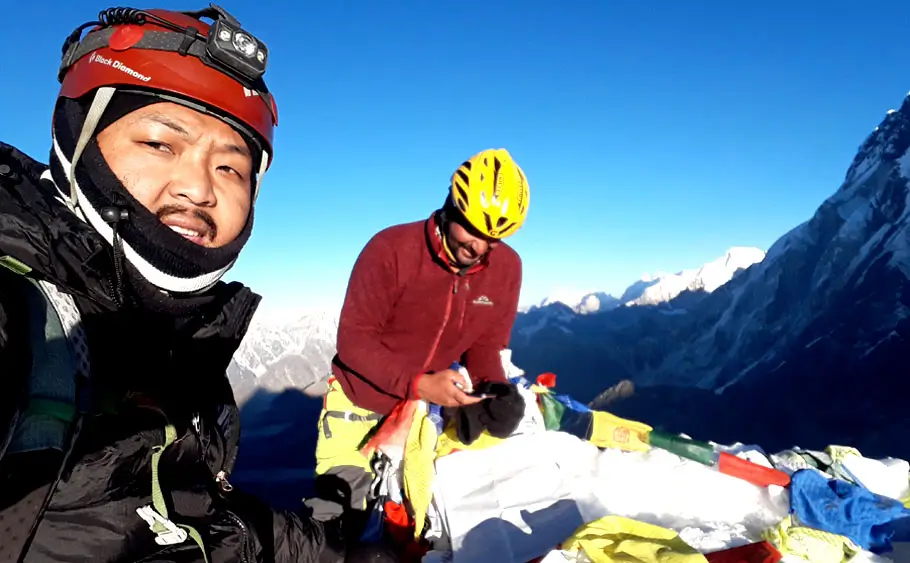
We get a reward for our efforts when we reach the top, and get to experience the sensational 360-degree view of Everest, Ama Dablam, Baruntse, Pumori, Makalu, Lhotse, Cholatse, Thamserku, and many more.
After taking pictures, we will go back down to base camp, eat quickly, and then go all the way back to Chhukung.
Duration
9-10 hrs.Max Altitude
6,189 mActivity
ClimbingMeals
Breakfast, Lunch, DinnerAccommodation
Local Teahouse 14
Day 14: Descend from Chhukung to Deboche or Tengboche
We are tired, but we will gain strength as we descend into the Imja Khola Valley once again. We will proceed through the Dingboche and Shomare villages until we arrive at Pangboche. At this point, the landscape gradually transitions back to greenery with the presence of pine, fir, and deciduous trees.
Moving across the Imja Khola over a steel bridge, we will continue our journey towards Debuche. We can take a night’s rest here and if our energy permits, we may push forward towards Tengboche to shorten our walk for the following day.
Marching through conifer and rhododendron trees, we walk down to Tengboche Gompa. We will then settle in one of the village’s lodges for the night.
Duration
5-6 hrs.Max Altitude
3,870 mActivity
TrekkingMeals
Breakfast, Lunch, DinnerAccommodation
Local Teahouse 15
Day 15: Walk down to Namche Bazaar
After a delicious breakfast, the trail descends from the peaceful monastery village of Tengboche, winds through rhododendron forests, passes through Phungitanga, Sanasa, and Kyanjima village, and crosses the Dudh Koshi River. Along the way, you’ll be treated to breathtaking views of Ama Dablam and Everest. Ascending the final stretch, you are greeted by the vibrant energy and expansive mountain views of Namche Bazaar, a vibrant Sherpa town.
Duration
5-6 hrs.Max Altitude
3443 mActivity
TrekkingMeals
Breakfast, Lunch, DinnerAccommodation
Local Teahouse 16
Day 16: Walk back to Lukla
We will follow the same path back as we went up through Top Danda, Jorsalle, and Benkar, and we will keep a completely different pace today.
We will exit the national park and leave the spectacular landscape we have been lucky enough to have experienced for the past week. Climbing down and traversing through Phakding, Thadokoshi, Chaurikharka, and Chheplung, we go to Lukla. Enjoy the last night in the Himalayas. Tomorrow we fly back to civilization!
Duration
5-6 hrsMax Altitude
2800 mActivity
TrekkingMeals
Breakfast, Lunch, DinnerAccommodation
Local Teahouse 17
Day 17: Return Flight from Lukla to Kathmandu
We will get up early for a return flight to Kathmandu. It is not unusual for there to be delays or cancellations in the mountains. Hopefully, we will be on the wings and land in Kathmandu early in the morning.
Once back at the hotel, a well-deserved and long shower awaits, with good beds and food from the restaurant. We will gather in the evening to have a joint dinner in one of the delightful Nepali restaurants forgetting ourselves in the wonderful cultural show.
Duration
35 flightMax Altitude
1300 mMeals
BreakfastAccommodation
3-Star Hotel 18
Day 18: Departure
Today the course is heading home. You will be driven to the airport well in advance of departure. You can plan your next trip to maybe Lobuche East, Mera Peak, or Ama Dablam.
Max Altitude
1300mMeals
BreakfastAccommodation
ExcludedIncludes & Excludes
What is included?
- Free airport pickup and drop-off by private car and transfer to hotel
- Tourist standard hotel twin sharing room accommodation (2 nights in Kathmandu with breakfast)
- Domestic flight Kathmandu-Lukla-Kathmandu, or Ramechhap-Lukla-Ramechhap including 15 kg of baggage
- Entry permit of Sagarmatha National Park
- Rural Municipality fee of Khumbu pasang Lhamu
- Climbing permit for Island Peak ( Imja Tse)
- All base camp setup tents, kitchen, dining, matrix, and food
- Full board meal, breakfast, lunch, and dinner in a day, one item choose from the menu
- Complementary daily fresh fruit after dinner
- Accommodation, Mountain tea house during the trek
- Experienced sherpa climbing guide, government-licensed holder, speaking English
- All staff wages, food, drinks, accommodations, transportation, and insurance
- One strong sherpa helper for carrying your baggage (1 porter for 2 clients)
- Your travel insurance will cover helicopter service in the event of an emergency.
- Nepal government tax and the company’s official charge
- Down jackets, duffel bags, sleeping bags, and trekking poles are provided but should be returned after the trek (if needed)
- Oxygen meter to check your pulse and oxygen level (AMS)
- Assistant climbing guides provide (if groups are larger than 3 people)
- Achievement certificate 6,189 M by NMA after summit island peak
- Hill Sherpa Trekking provides trip certificates (after completing the trip)
What is excluded?
- International airfare tickets (both ways)
- The Nepal entry visa fee will be obtained upon arrival at the Kathmandu International Airport.
- Additional accommodations, food, and drinks in Kathmandu (if staying an extra day)
- Any dessert, sweet item, chocolate, cake, special tea, coffee, pie, pudding, bar bills, mineral water, or any extra personal expenses
- During the trek, hot showers, mobile, camera, power bank, any battery charging, Wi-Fi Internet,
- Your personal medical and travel insurance during the trekking and climbing
- Personal first aid kit and personal climbing gear
- Excess baggage weight is 15 kg maximum
- Kathmandu sightseeing, entrance fees, and Tips for Guides and Porters
Note:
We also operate private trips.
Trip Information of Island Peak Climbing Via EBC Trek 18 Days
Best Time to Island Peak Climbing 18 Days
The two seasons of autumn (September to November) and spring (March to May) are the ideal periods to climb Island Peak and trek to Everest Base Camp. The autumn days glorify with the pleasant atmosphere with temperatures ranging from 5 to 15 degrees Celsius. The forests transform into vibrant shades of orange and yellow, offering mystifying views of the majestic Himalayan peaks.
The spring days also open the window for the Island Peak climbing via EBC trekking as the days showcase the flourishing Himalayan flora accompanied by mild temperatures averaging around 16 to 17 degrees Celsius. The landscape is adorned with hues of pink and green, while the chilly air gradually gives way to warm and dry conditions.
Elevation and Distance
The Island peak climbing with the EBC trek involves a total distance of approximately 150 km. On the first leg of the expedition, we will cover 137 km by air to Lukla from Kathmandu and travel 65 km on foot to reach Everest Base Camp at 5364 m. Additionally, we will climb the black pyramid of Kala Patthar at 5548 m. The Everest Base Camp is 200 to 300 km far from Kathmandu.
During the final leg of the Island Peak climbing expedition, our goal is to reach the summit of the peak at 6165 m, the highest point of our entire journey. The peak is 160 km afar from the Nepal capital and 41 km afar from Lukla.
We will sleep at the highest altitude of Island Peak Base Camp at 5200 m elevation, 20 m high from Gorakshep which will be the second-highest overnight stop in our journey.
Maximum and Minimum Walk
Our Island Peak climbing via EBC Trek is appropriate for all individuals as we have planned moderate walking duration for each day lasting between 5 to 7 hours, covering a distance of 10-15 km.
The 13th day of our expedition however proves to be more challenging as we ascend Island Peak from the base camp, and then descend to Chhukung which requires us to travel for a duration of 9 to 10 hours.
On the other hand, the 11th day of our journey as we travel from Dingboche to Chhukung will be significantly more manageable and shorter, with a pleasant walk lasting only 2 hours.
Island Peak Climbing 18 Days Difficulty and Acclimatization
The Island Peak is grouped under the 2B category based on the alpine classification system while the Everest Base Camp trek and climbing Kala Patthar are considered moderate trekking adventures.
Climbing the Island Peak involves overcoming the long slippery rocky sections and crevasses. Additionally, there are short rock walls and icy areas with gradients of up to 50°. The final 200 meters are particularly challenging, requiring the use of a Jumar and a walk along a glacial path.
Despite these difficulties, it is categorized as a trekking peak that demands basic technical skills. Overall, the Island Peak climb combined with the Everest Base Camp trek is a beginner-friendly climbing expedition suitable for mountain enthusiasts.
The primary risk, aside from the challenging terrain, during the ascent of Island Peak is the high altitude. To solve this issue, we have planned two nights in Namche and two nights in Dingboche for acclimatization to the dry, low-oxygen environment of the Khumbu region.
Can a beginner join this trek?
Our Island Peak climbing via EBC trek is available to anyone in good physical shape. You do not need experience from heights to participate, but it can be an advantage.
To successfully complete the trip, you should possess above-average physical and mental fitness, as well as good health. The journey involves traversing challenging sections, and rugged mountainous terrain, and utilizing climbing equipment such as crampons, harnesses, ropes, and ice axes.
Therefore, before attempting the climb to the Island Summit, it will be beneficial if you acquire some training sessions in rock climbing. Alternatively, you can also engage in easy mountain hiking in local areas of your country or in Nepal, such as Ghorepani, Annapurna Base Camp, or Everest Base Camp.
Preparation and training
If you are not yet an experienced hiker or climber, then we suggest you do some training and preparation before attempting the climb to any summit be it Island Peak, Mera Peak, or Lobuche Peak.
To start with, you can improve your stamina by starting with a shorter (8-10 km) hike and gradually working your way up to a mountain hike of 20 kilometers or more. In fact, the domestic terrain is perfectly suitable for beginners to learn their way around the hiking trails.
In addition to hiking, you can also improve your physique, endurance, and performance by running. Initially, when completing smaller and then longer distances, you increase your lung capacity and the condition of your heart.
Then, gradually, you can participate in programs such as the domestic summit attack tour series. In such a program, you will first learn to tackle the mountain in the setting you are already familiar with. In addition, you will also learn what high-altitude mountains really present other than the extraordinary views.
Alternate Routes
As an alternative approach for the Island Peak climbing via EBC trek, you can bypass the trek to Everest Base Camp and Kala Patthar, focusing solely on the ascent of the peak. This alternate adjustment will not only shorten the duration of your trek but also minimize your time at high altitudes.
After deciding to reach the summit only, you may change your route from the typical approach via the south ridge to the northern ridge. Please keep in mind the northern approach will be more technical and challenging.
Or, you can stick with our itinerary and add three more days to travel across the beautifully serene Gokyo Valley.
Altitude Sickness
Generally, when anyone travels to 3000 m or above altitude, he or she may be at risk of altitude sickness. It is also one of the primary concerns in our Island Peak climbing expedition. However, due to the planned acclimatization of our trip, our participants usually adapt early to the atmosphere of Khumbu.
Some have gone through only minor symptoms including insomnia, nausea, vomiting, rapid heartbeat, loss of appetite, malaise, stumbling gait, and possibly confusion. These unpleasant symptoms generally disappear without any consequences if you seek advice from our guide early and take Diamox- the altitude sickness symptoms treatment drug.
In case of serious altitude problems, you will be evacuated to lower altitudes which is the best treatment for altitude sickness. It is a requirement that everyone has taken out valid travel insurance that includes evacuation by helicopter as well as transport home before the start of the expedition.
Transportation, Accommodation, Food and Drink
As a part of our Island Peak climbing with EBC trek tour package, we will handle all logistical matters including the arrangements and expenses of transportation, accommodation, and meals.
We offer you all the airport transfers inside Kathmandu and ground transportation services, as well as round-trip airfare between Kathmandu and Lukla.
Accommodation in Kathmandu includes shared rooms in a 3-star tourist standard hotel. During the trek, your sleeping shelter will be in the best lodges available in the overnight villages. The morning and evening meals with coffee or tea will be served at the overnight shelter, while lunch will be provided at the lodge or teahouse along the track. Additionally, fresh seasonal fruits will be offered after dinner for your enjoyment.
Our company will supply tents, mattresses, and kitchen utensils for your stay at the base camp, while our team will be responsible for setting up the camp and preparing meals for you.
Communication, Gadgets charging, and Internet/WIFI
Namaste and NCELL provide good coverage in the Khumbu region. Obtaining their SIM cards in Kathmandu is convenient, requiring only a passport copy, and the cost is minimal. These networks offer reliable 4G services for efficient internet connectivity in most villages, with the exception of Island Peak base camp and summit.
WIFI is accessible in lodges along the route but at an additional fare. 1. Everest Link WIFI is available throughout the trail and operates at the base camp under favorable weather conditions.
The lodges also provide charging services for your gadgets at an extra fare. The expenses for WIFI usage and device charging are not included in our service.
Permits of Island Peak Climbing 18 Days
Our team will acquire the climbing permit for the Island summit from the NMA (Nepal Mountaineering Association) in Kathmandu. The other two permits of Khumbu Pasang Lamu municipality permit and the Sagarmatha National Park permit, will be secured by our guide at the border of Lukla town. The company provides the certificate after completing the Island Peak Climbing trip.
Why Island Peak is called a popular trekking peak climbing
Island Peak (6189m), also known as Imja Tse, is one of the most well-known trekking peaks in Nepal and its reputation comes from its blend of challenging and accessible climbing, beautiful scenery, and a rewarding climbing experience. Below is a detailed description of why Island Peak is so well known.
Perfect transition from trekking to mountaineering
For many adventurers and climbers, Island Peak is their first proper step into the world of high-altitude mountaineering. While nothing about the technical climbing required to get to the summit is advanced, climbers experience the use of crampons, ice axes, harnesses, and ropes for jumars. This makes the peak especially enticing for trekkers who wish to experience summiting a peak without the commitment of a full scale expedition.
Officially classified as a trekking peak
The Nepal Mountaineering Association (NMA) recognizes Island Peak as a trekking peak, which means it is suitable for climbers who are fit to trek. This means climbers do not have to have the skill of an alpinist. This means that trekkers, with climbing training and guided, are able to summit the peak.
Location of Island Peak in the Everest (Khumbu) region
Island Peak stands tall in the Imja Valley of the Everest region, a remarkable and well developed trekking region in the Himalayas. The Imja Valley offers stunning views while trekking along the classic Everest routes that take you to Namche Bazaar, Tengboche, Dingboche, and Chhukung. The lodges along the trails provide comfortable stays, and the rescue infrastructure and service along the trails are reliable. All of these things make it extremely popular.
What is the origin of the name Island Peak
British members of the Everest expedition in 1953 were the first people to call it “Island Peak.” The peak stands like an Island in the sea of glaciers to the southwest of Dingboche and is surrounded by the Imja glacier, the Lhotse glacier, and the Ani Dablam glacier. These glaciers and the peak create a sea of ice that looks striking and is postcard worthy.
Non-technical/physically demanding
Even though Island Peak has less technical and non threatening challenges, it is still very physically demanding. These challenges are usually attributed to the summit day duration, cold temperatures, and altitude. The challenges that climbers will face on the Island Peak expedition are navigating through a glacier, ascending and crossing snow covered slopes, and head wall which is climbed using fixed ropes and can take ladders. These challenges are very adventurous and make the climb extremely achievable. The climb can be a great achievement for every climber on the Island Peak expedition.
Outstanding summit views
Among trekking peaks, Island Peak has one of the finest summit views. From the top, climbers have the pleasure of taking in the breathtaking 360-degree panorama of the world’s tallest peaks, including Mount Everest, Lhotse, Nuptse, Ama Dablam, Makalu, Baruntse, and Pumori. The reward-to-effort ratio is one of the highest in Nepal.
High success rate with proper Itinerary
The success rate for the Island Peak program of 14 Days is often high due to the number of acclimatization days scheduled, along with the pre-climb training. The gradual climb to Dingboche and Chhukung is designed to help climbers to comfortably adjust to the altitude, which makes the summit accessible to fit trekkers.
Strong Sherpa support and infrastructure
Khumbu is a mountain with a long history of mountaineering and Island Peak must bank on its huge Sherpa support, strong base camp and well established climbing routes. Novice climbers have a greater level of safety and confidence in this type of support.
Altitude Chart of Island Peak Climbing Via EBC Trek 18 Days
Equipment List

General Information
- The company provides a feather sleeping bag and a feather down Jacket, but they should be refunded after the trek.
- Hill Sherpa Trekking provides a duffel bag during the trek, but it should be refunded after the trek.
- We mostly recommend the windproof and waterproof thin-layered jacket for morning and evening, above 3450m.
- We mostly recommend for daypack bag 35-45 Ltr.
- Headlamp & extra batteries during the trek

Daily Use Essentials
- A sun block cap & fleece hat
- Sunglasses 100% snow uv protection
- A muffle (full cover mask)
- Sunscreen (30+ to 60 SPF, depending on age)
- A pair of thin & warm gloves
- A pair of Trekking poles
- Water bottle & filter
- Water purified tablets
- lips guard

Upper Body Essentials
- Warm hat
- A pair of t-shirts
- Thermal tops
- Sports bras for ladies
- windproof & fleece jacket
- waterproof jacket

All Lower Body
- waterproof trouser
- warmer & fleece trousers
- Extra comfortable sports pants
- A pair of sports shoes
- Thermal underwear
- Pair of light sandals
- Some Thick (woolen) socks
- Sock liners
- Light shoes
- A pair of Comfortable trekking pants
- A pair of comfortable waterproof trekking boots

Essential Climbing Gears
- Helmet
- Harness
- Ascender
- Descender
- Carabiners 4 locks, 2 unlocks
- Tape celling 120 cm
- Alpine Boot good condition & fitsthe side
- Crampon in good condition for an alpine boot
- Ice-axe Normal
All the climbing equipment is available in Kathmandu, you can rent everything.

Personal Medical and First Aid Kits
- Diamox (125mg to 250mg tablets for AMS)
- Adhesive bandages and pocket masks
- Non-stick pad W/ Adhesive
- Ibuprofen & paracetamol tablets IP
- Some Assorted adhesive bandages
- Warps, splints, and wound coverings, butterfly bandage
- Blister treatment cream or similar
- Insect / anti-itch ointment
- Moves in case sprain any body
- pain-relief medication
- Sinex, & Eye Drops etc.
- Gauze sponge
- Saline solution

Important Things
- passport-size photos with original passport scan copy
- Travel and medical insurance
- Flight details (to pick you up & transfer to hotel)

Extra Essential Things
- Energy gel or dry foods (that’s your desire)
- A power bank is most important for a backup device (if you have one)
- Camera, chargers, extra batteries, memory card)
- Most important for ladies’ essential things (if you are a lady)
Addons & Options for Island Peak Climbing Via EBC Trek 18 Days
Addons
Price
Upgrade 4 star hotel in Kathmandu
US$
180
Upgrade 5 star hotel in Kathmandu
US$
340
Kathmandu - Lukla by helicopter sharing
US$
500-600
Lukla - Kathmandu by helicopter sharing
US$
500-600
Extra Assistant climbing guide for whole trip
US$
825
Extra porter for whole trip
US$
350
Horse on rent for whole trip
US$
1490
Stay one night Hotel Everest View
US$
410
Yeti Mountain Home
US$
250-390
Frequently Asked Questions
Should I take out travel insurance?
When you travel to remote settings and high elevations such as Island Peak, you must take out full travel insurance before departure, which should also cover any evacuation and transport home. You must submit proof of travel insurance after you confirm our trip. It is your own responsibility to take out insurance that is valid for the entire journey.
Can I join you alone on your group trip?
Yes! On our group tours, almost 50% travel alone. In addition to unique experiences, there is a good chance that you will end up with friends for life after a trip with us.
Is the flight ticket included in the price?
On our almost all journeys, domestic tickets are always included in the price. We have clearly explained all this in our included list on each trip.
What is the minimum age for climbing Island Peak?
You must be at least 17 years of age to ascend any trekking peak in Nepal.
Can I climb both Mera and Island Peak at the same time?
Yes, in fact, you can ascend Mera, Island, and Lobuche all in one climbing journey.
Reviews on Island Peak Climbing Via EBC Trek 18 Days


US$ 2499 per person For a group of 7-12 pax.
- 1 personUS$ 2699
- 2 - 2 personUS$ 2599
- 3 - 6 personUS$ 2549
- 7 over 9999 US$ 2499
US$ 2499

Talk to Trip Expert
+977 9704823980 (Whatsapp)
✖
Free Travel GuideGet Expert Guidance from Experienced Sherpas