Govt. Tourism License 3195/080/81





- Best Price Guarantee
- Secure Online Booking
- Flexible booking dates
- Owner operated company
- Decades of experience
- Dedicated sherpa team
- 100% success rate
- 5/5 ratings by travelers


Highlights of Lumbini Tour
- Visit the birthplace of Lord Gautam Buddha
- See a bunch of monasteries
- Visit the sacred buildings where Buddha spent his childhood
- Visit the site where Buddha achieved Nirvana
- Experience a spiritual journey.
- Explore the UNESCO world heritage site with serene surroundings, lush greenery, and historical significance, perfect for reflection and spiritual peace in Lumbini.
- Discover the ancient Maya Devi Temple which is dedicated to Buddha’s mother, and which houses the exact spot where Buddha was born, complete with a sacred marker and running history.
- Visit where the Buddha’s footprints are preserved, adding a sense of reverence to the pilgrimage a lifetime experience.
Trip Overview
The famous holy Lumbini tour takes visitors to historical locations including the site of Lord Buddha’s birth. Situated in the southwest region of Nepal, it is recognized as a UNESCO World Heritage Site. It is among the major destinations on the global Buddhist pilgrimage circuit.
The world’s most popular pilgrimage site is the place of birth of the supreme Buddha, the Enlightened One. The Buddhist literature from the 7th and 6th century BC identifies it as pradimakshya-van endowed with a garden of lovely flowers, a blossoming sal (Shorea robusta) woodland, and humming multicolored bees.
Followers of the Lord Buddha have erected several foreign temples as a sign of devotion to him. They have exquisite artwork and exquisite architecture. The Lumbini tour also involves a stop at the Japanese-constructed pagoda devoted to global peace.
One of the most interesting locations in Lumbini is the Garden. With several monasteries and temples around it, it is revered as a sacred site. A few of them date back to the Middle Ages. The great monarch Ashoka erected the Ashoka Pillar in the garden in 250 BC, and it has an inscription detailing the Buddha’s birth.
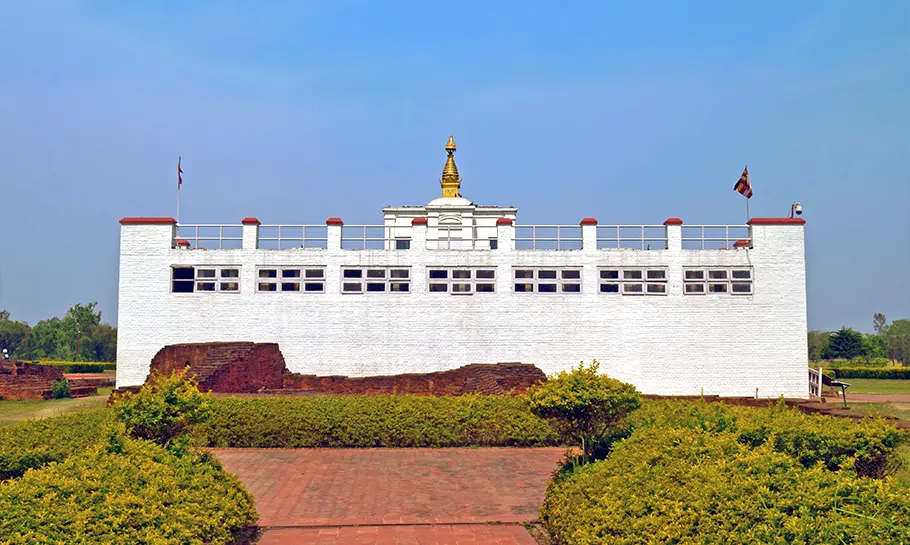
The mother of Lord Buddha, Mayadevi, is the subject of the Mayadevi Temple. It has drawn all tourists and pilgrims who are interested in learning more details. When the German archaeologist found it in 1895, it had a rich architectural appearance. It is recognized as an important location in Buddhism as well.
The Mayadevi temple is situated in front of Pushkarni Pool. The pool was the location of the royal baths that the monarch and queen once relied on. The Lumbini Museum is a living archive of historical artifacts, including clothing, currency, and wooden and brick artifacts that have been unearthed. It displays the materials and old civilizations that were in use.
The birthplace of Lord Buddha is covered on the Lumbini tour. The distance of our main site from Lumbini is 27 kilometers. His birth tale has an intriguing backstory. While Buddha’s mother was traveling back to Lumbini from her parents’ home, the Buddha was born. On our Lumbini tour, you will visit all of these sites.
From ancient times to the present, Lumbini has been visited by Buddhist pilgrims, archaeologists, historians, and regular people. It is acknowledged that Lumbini is a sacred site for adherents of religion, a site of cultural significance for the conservation of history, a popular destination for pilgrims, and a symbol of national culture. Lumbini’s resources are extremely valuable due to their many features.
Lumbini Tour Itinerary
01
Day 01: Kathmandu
Arriving in Kathmandu counts as the first day of the Lumbini tour, you will land at the Tribhuvan International Airport where you will also get your tourist visa. After you arrive at the airport, the airport officials will guide you to the immigration booth where you have to fill out a tourist visa application.
If you decide to fill out an online form, you will receive a barcode after filling out the form which you have to print out and bring along to present at the immigration booth. This is a better alternative to filling out physical application forms during the busy travel seasons.

Duration
30 mins
Max Altitude
1300m
Meals
Breakfast
Accommodation
Hotel 02
Day 02: Kathmandu to Lumbini
On the 2nd day of the trip, you will travel to the holy site of Lumbini via a short 45-minute flight. From Kathmandu, we will move after having a tasty morning breakfast at the hotel you stayed at.
Our Lumbini tour guide will make sure that you have carried all your belongings and also ensure timely departure so as not to miss the flight due to any issues.
Meals
BreakfastAccommodation
Hotel 03
Day 03: Lumbini Heritage site tour
Finally, the day has arrived, you will travel to the holy site of Lumbini. The 3rd day of the Lumbini tour will fully be comprised of walking around the Lumbini Heritage site, here’s detailed information about the day.
Mayadevi Temple
The center of Lumbini is the Mayadevi Temple. The Nativity Sculpture, the remnants, and the Marker Stone associated with Lord Sakyamuni Buddha’s birth are housed there. The Marker Stone shows the exact birthplace and the Nativity Sculpture shows the birth event of the Lord Gautam Buddha.
The structural remnants of the Mayadevi Temple date back to various stages of the temple’s construction and renovation over the ages, according to archaeological findings. Collecting the burnt bricks from his journey to Lumbini in 249 BC, Emperor Asoka constructed a platform to protect the Nativity Tree, which was the spot where Prince Siddhartha was born to Mayadevi.
The Maya Devi temple has a different entrance and ticketing than the other parts of the Lumbini temple site. There is a brief security check as well, but nothing overly thorough. Since this is the most important Buddhist site in the world, a little security is needed.
The ruins of an old tree shrine dating back approximately 550 BCE were found in November 2013 by a global group of archaeologists excavating beneath the temple. The location may represent the first examples of Buddhist buildings as well as the earliest archeological proof of Lord Gautama Buddha’s life, according to the experts’ theories.
Coningham, one of the lead excavators, claims that the temple is the world’s oldest Buddhist shrine. The researchers’ assumptions received extensive coverage all around the globe.
Bodhi Tree
Under an old pipal tree to the west of the main temple, the Buddha sat for seven days following the Enlightenment. Only the current tree is regarded as a direct descendant of the ancient tree. Originally grown from seeds produced by the ancient Bodhi tree, many holy trees can be found in India and other nations.
As per the history of Buddhism, the Bodhi tree—which is closely associated with the Buddha’s accomplishments—became the main object of devotion, even though the Vajrasana was the precise location of the enlightenment. The Bodhi Tree’s parts such as the leaves and seeds were sought after by pilgrims as good fortune for their residences and monasteries.
Also, guests are welcome to stay around for a little while to experience the serene and spiritual atmosphere created by the large, old tree, which is thought to have calming properties. Additionally, one has the option to express prayers and make wishes. Wishes expressed while tying a vibrant prayer flag are frequently granted, according to local belief.
The image of Gautama Buddha sitting in meditation beneath a robust peepal tree comes to mind when anyone thinks about the sacred Bodhi tree. Buddha gained nirvana and was freed from illusions, rage, and self-indulgence beneath one of the aforementioned trees.
Mayadevi Pond
The Sacred Pond, also called Puskarini, is 25 paces southwest of the Marker Stone. It is here that Mayadevi is said to have taken a bath prior to having Prince Siddhartha. This is where the first purifying wash was given to the young prince.
In their travelogues, the ancient Chinese explorers Fa-Hsien and Hiuen Tsang, both mention the Sacred Pond and the sacred bath where the infant Prince Siddhartha was bathed.
The pond was there before Prince Siddhartha was born, most likely in the form of an oval. It was renovated in size and shape with a brick embankment during the excavations conducted by Keshar Shumsher in 1933–1939 AD. The current pond is 24.90 meters by 24.85 meters by 4.83 meters in size.
Maya Devi Pond is a rather straightforward but aesthetically pleasing square-shaped construction with steps all around to reach the water’s surface. The site of Lord Buddha’s birth is now home to a magnificent temple, with the Maya Devi Pond directly in front of the shrine. The temple complex offers tourists a peaceful atmosphere and is kept up fairly nicely.
It is thought that these remnants are the ruins of historic stupors and temples that were covered in brick pavilions. The Ashok Pillar, constructed by Emperor Ashoka as a tribute to Gautama Buddha’s path to enlightenment and his words of wisdom, is another noteworthy landmark in this area.
Ashoka Pillar
Although the exact date of Buddha’s conception is unknown, it is known that the pillar was built by the emperor Ashoka in 249 BCE, which was roughly 300–400 years following the birth of Buddha. As the leader of the Mauryan empire, Ashoka reigned over the majority of modern-day India.
As per history, Ashoka’s predecessors took the path of violence and savagery to conquer other regions. However, it is reported that after learning the full depth of his savagery from the widow of one of the defeated, he embraced Buddhism and began living a life devoid of violence.
After such an eye-opening event, Ashoka went on a building spree, erecting many pillars in the name of Buddha. Out of the 19 pillars, the most significant one is obviously the one in Lumbini as it holds the information on Buddha’s birth. Most of the other pillars lie in India.
Numerous historical documents make reference to the pillar, which is thought to have been restored and reconstructed in the eleventh or twelfth century. After being rediscovered in 1896 by archaeologists from Nepal, it has undergone additional renovations. The script on the pillar, which is thought to be the earliest in Nepal, contains text in Brahmi writing and states that Ashoka paid a visit to this holy site when he was 29 years old.
When it was discovered that this was the birthplace of the Buddha, a stone pillar and railing were constructed. The Emperor got the residents of Lumbini Village released from certain taxes and granted them exclusive access to the eighth section since the holy Buddha was born here.
Lumbini Museum
It was thought that a pillar discovered in Rupandehi in 1896 by Alois Anton Führer and General Khada Samsher Rana marked the location of an Ashoka visit to Lumbini. Ashoka was a renowned Indian emperor who controlled nearly the whole Indian subcontinent from approximately 268 to 232 BC. The pillar’s inscription stated that Ashoka traveled to Lumbini in order to observe the site of the Buddha’s birthplace.
A global panel commissioned distinguished Japanese designer Kenzō Tange to design a masterpiece for Lumbini at the beginning of the 1970s. His goal was to transform Lumbini into a place where people may envision world peace while also honoring the teachings of the Buddha and his path to enlightenment.
The International Research Institute and the Lumbini Museum were situated at the gateway to the Sacred Garden, marking the beginning of the pilgrims’ walk.
Tange’s modernity and traditional Japanese architecture combined to create the museum’s unique curved design, which sought to integrate buildings into their natural surroundings and reflect the identities of its people.
The museum is situated at the gateway of Lumbini’s Sacred Garden Area, the most famous archeological, cultural, and spiritual destination in all of Nepal. The Gautam Buddha display is housed in multiple rooms and features important Buddha imagery, artifacts, statues, and photographs. The museum has a section dedicated to traditional clothing and ceremonial wear that draws inspiration from Lumbini culture.
Even though there isn’t much signage at the museum, efforts are being made to transform it into a modern learning environment by 2022. You can pause to look at the gorgeous sight of Tange’s museum in front of the pool.
It can be quite difficult to walk for half an hour from the entrance to Maya Devi Temple in the sweltering summer heat of Nepal due to the vast size of the complex. When visiting sacred places, we recommend you put on easily removed shoes or slippers.
Meals
BreakfastAccommodation
Hotel 04
Day 04: Fly from Lumbini to Kathmandu (Sightseeing)
After an exciting day in Lumbini, we will travel back to Kathmandu, to indulge in a day sightseeing tour. Today, our tour guide will take you to a bunch of different sites in and around Kathmandu.
The sites we will visit today include historical and religious places such as Bouddhanath, Swayambhunath, Royal Palace, Patan Durbar Square, Pashupatinath, and more. We will recommend you a bunch of sites from which you can choose the ones you want to visit. Or you can add your own sites to the day sightseeing itinerary.
During your sightseeing trip in Kathmandu, some of the sites we will visit requires tickets. These tickets are in place as a source of funding for the maintenance of those sites. Our travel package will not cover this expense.
Meals
BreakfastAccommodation
Hotel 05
Day 05: Departure
On the 5th day of the trek, you will depart from the amazing land of Nepal, and back to your home. One of the best things you can do on your last day is to leave us with constructive feedbacks that help us get better.
After everything has been done, we will drop you off at the airport as per your flight schedule.
Meals
BreakfastAccommodation
Hotel Note:
We also operate private trips.
Trip Information of Lumbini Tour
How does our trip start?
Our trip starts in Kathmandu, the capital city of Nepal. Kathmandu itself is one of the best cities in Nepal, to roam around. But we will get to it later. After we are done with Lumbini, we will get back to Kathmandu and do a day sightseeing tour, visiting a number of attractions that will surely get you interested in Nepalese history.
On day 2, we will get to Lumbini via a flight. We will not rush to visit the birthplace on the same day. It is the 3rd day when we will roam around the Lumbini heritage site. On day 4, we will get back to Kathmandu for a sightseeing trip and depart back home the following day.
Best seasons for the Lumbini Tour
The best season to travel to Lumbini is definitely the season of autumn and spring. These seasons offer the best travel conditions such as clear weather, temperate climate, and bright days. It can get a bit too hot during the summer season and hence it is not a good option to travel during the months of June, July, and August.
It is also not a good idea to travel to Lumbini in the monsoon season as rain in plain lands can often cause trouble. The same can be said for winter months. It can be very cold and misty during the winter months which will definitely affect your trip experience. Since it is an easy tour, you can travel to Lumbini in any season.
Can anyone join this trip?
Yes, anyone can join this trip. Our Lumbini tour is done all by vehicle with a little bit of walking during the day tour in Lumbini. It’s an easy tour and the only thing you need to worry about is keeping yourself together as this is going to be an interesting trip. This tour is perfect for all ages; you can bring your kids along as well as aged people.
Accommodation, Food, and Drink for the Lumbini Tour
Accommodations for this include hotels with all the modern amenities you can get in the region we are staying at. Your accommodations will be covered by the tour package along with 3 meals per day (breakfast, lunch, and dinner). You will be staying at mid-range hotels, but you can also opt for luxury hotels which will increase the price of the tour package.
One of the best things about this tour is the food you can taste along with way. There are a lot of dishes you can try during this tour. For instance, the Kathmandu Valley offers a range of Newar dishes such as Choila, Chatamari, Newari Curry, Juju Dhau, and more. Newari dishes are well-known and enjoyed throughout the country.
Similarly, Lumbini has a lot of dishes that you can try including Bhakka, Bagiya, Sidhra, Dhikri, etc. These dishes are famous in the region and closely related to the people of Terai.
Throughout the tour, there are a lot of drinks available. The Newari people of Kathmandu are also famous for their alcohol made from wholegrain millet brewed in clay and brass pots. The Newari people call it “Aila” and it can be a bit potent for some people. Be careful not to get hooked to it as we have a tour to complete.
Unlike food, our Lumbini tour package does not cover any drinks-related expenses.
Lumbini Tour Transportation
You will be picked up from the airport and dropped off at the end of the tour. Other than that, you will travel to Lumbini via a flight and back. During your Kathmandu sightseeing tour, you will travel in a private vehicle around the city. All the transportation required during the tour will be covered and provided by us.
Alternative Routes of Lumbini Tour
There are a lot of alternative routes for this tour. You can add Pokhara as an additional destination along with Chitwan. Pokhara and Chitwan are one of the most visited cities in Nepal and offer an exciting tour. You can indulge yourself in a bunch of extreme sports in Pokhara such as bungee jumping, paragliding, parachuting, and more. In addition to that, you can visit numerous sites that offer lovely scenes of the valley.
As for Chitwan, it’s a tropical jungle where you can spend the day doing jungle safari, kayaking, elephant bathing, and more.
Your Extra expenses for the Lumbini Tour
Your extra expenses include visa fees, additional accommodation, tickets required for sightseeing sites in Kathmandu, travel insurance, medical insurance, tips for the tour guide and drivers, international flight fares, and anything not mentioned to be inclusive.
Frequently Asked Questions
Can we spend an extra day in Lumbini?
Yes, you can spend an additional day in Lumbini, and you will be charged for it accordingly.
Can the trip be canceled after booking?
Yes, the booking can be canceled after the reservation. Please check our booking policy page for more info.
What is the best season for this tour?
The best season for this tour is the season of Autumn.
How many people can go on this tour?
We will take a group of 10 people (maximum) while the minimum number of people is 2.
Is there anything I need to know before traveling to Lumbini?
Please do not click photos of the sacred sites unless you are permitted to do so. There are a lot of sites that are sacred and importance to the people of Nepal and Buddhism as a religion.
Reviews on Lumbini Tour



✖
Free Travel GuideGet Expert Guidance from Experienced Sherpas