The Most Complete Travel Guide to Mount Everest: Location, Height, and More
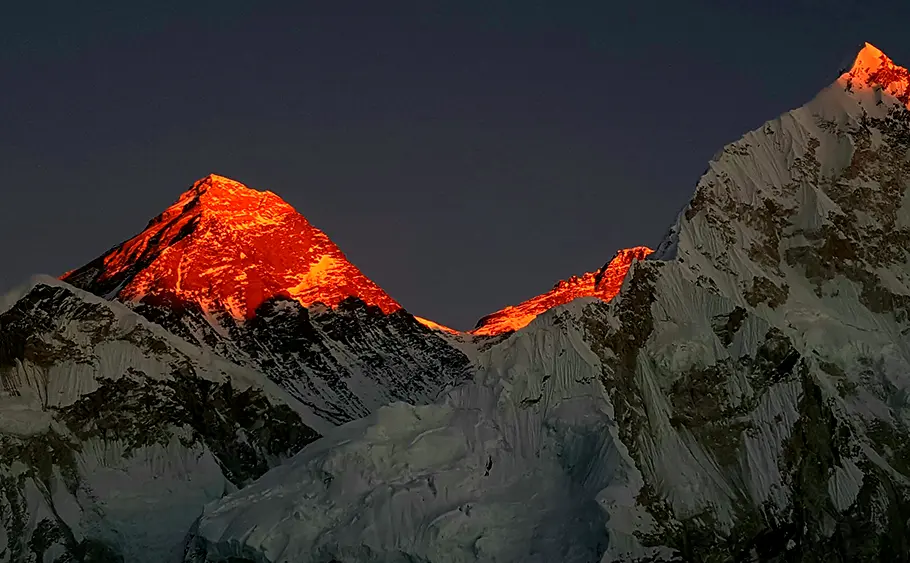
Mount Everest is the tallest mountain in the world. It is one of the greatest natural sights or phenomena on Earth. It rises dramatically above the Himalayas. Not only does Everest provide an opportunity to showcase and prove one’s adventurous spirit, but it also requires courage, determination, and fortitude. Most importantly, Everest is the ultimate goal for many mountaineers and trekking enthusiasts.
People who appreciate and enjoy mountain trekking from around the world visit Nepal every year to admire the wonderful sight that Everest provides, either by trekking to the Everest Base Camp, taking a helicopter sightseeing trip, or attempting to conquer the height challenge Everest provides.
Mount Everest is called Sagarmatha in Nepal and Chomolungma in Tibet. It is of great spiritual and cultural significance to many people and communities that live around the base of Everest. It is not just a mountain; it is a representation and symbol of the great lengths humanity will go to in order to continue exploring the many unknowns that are waiting to be discovered. This blog is inclusive of everything you might want to know regarding Mount Everest, the location, the height, the history of climbing it, the history of trekking to its base, the culture and the wildlife, as well as the environmental importance it provides.
Where is it located Mount Everest?
The Geographic Co-Ordinate Location of Mount Everest. Mount Everest is geographically located in the Mahalangur Himal within the sub-range of the Himalayas that is between Tibet and the country of Nepal. The height of the peak is also coordinately located at 27.9881 N and 86.9250 E. Sagarmatha National Park, a UNESCO World Heritage Site, which is famous for its diversity of plants and animal species as well as its mountain scenery, incorporates Mount Everest on its Nepal side.
Everest’s southern face is in the Solukhumbu District of Nepal and the northeastern face is in Tibet’s Tingri County. With Nepal’s developed trekking facilities and lower relative costs, most of the world’s Everest expeditions and treks follow this route.
Is Mount Everest in Nepal, China or India?
One of the most frequently asked questions from a traveler’s perspective is in which country does Mount Everest REALLY lie, Nepal, China, or India? The answer lies in the fact that Everest rests on the borderline of Nepal and Tibet (China). Mount Everest is also not in India, even though part of the Himalayas is in northern India. Most of Everest’s tourism is in Nepal because the world’s most popular trekking and climbing routes start from the Nepalese side.
The southern route is also easier and more scenic and the northern Tibetan side has a drier and more remote climbing experience. Geographically, Everest is in both countries, but for tourism, Nepal is the ultimate destination for Everest adventures.
Mount Everest on the World Map
Everest is in the continent of Asia and part of the regions of the Himalayas that span Nepal, Tibet, Bhutan, India, and Pakistan. Everest is in a group of many other towering peaks of the giant Himalayan range, such as Lhotse, Makalu, and Cho Oyu.
The Everest region is one of the most beautiful landscapes on the Earth, filled with glaciers, profound valleys, icefalls, and peaks with frozen snow that draw photographers, nature lovers, and climbers of all kinds across the world.
Mount Everest Height and Dimensions
Mount Everest reaches a staggering height of 8,848.86 meters (29,031.7 feet) tall and is the tallest mountain in the world. This height is the result of a 2020 survey performed by both Nepal and China. For the first time, modern GPS and radar technology were used to survey the Everest region. In the past, surveys have never included the snow cap at the summit, making this the most accurate height recorded.
Mount Everest is considerably taller than every other mountain in the world and is an extraordinary 8.85 kilometers high. Everest is one of the tallest mountains in the Himalayan range and is one of the most remarkable geological features on the planet.
How Everest’s Height Changes Over Time
Mount Everest’s height is continuously changing as the mountain itself continues to grow. The Himalayan mountains are tectonically active, with both the Indian and Eurasian plates continually colliding against one another. This causes the Everest mountain range to grow by about 4 millimeters a year. Additionally, the mountain’s size can alter from the effects of erosion, earthquakes and the changing snow.
When the severe Nepal earthquakes occurred in 2015, many in the community began to wonder what might have changed in terms of Everest’s height. Nepal and China collaborated to survey the region in 2020 and provided a detailed assessment.
Comparing Everest to Other Structures
Burj Khalifa, the tallest structure ever built, has a height of 828 meters. Considering this, Mount Everest is therefore taller than the tallest man-made structure by more than ten times! In addition to being the tallest feature on Earth, Everest is also taller than all other mountains, including the 2nd and 3rd tallest mountains, K2 and Kangchenjunga respectively. Therefore, Everest is truly the mountain above all others.
History of Mount Everest
Discovery and Naming of Everest, in the 19th century, the Great Trigonometric Survey of India listed what is now known as Mount Everest as “Peak XV”. In the same decade, an Indian named Radhanath Sikdar performed the first calculations of the height of this mountain and was, therefore, among the first to conclude that Peak XV was the highest mountain in the world.
In the year 1865, this mountain was named Mount Everest by the Royal Geographical Society after Sir George Everest. However, the local communities have long had names for the mountain, which is culturally and spiritually significant, Sagarmatha and Chomolungma.
First Successful Everest Ascent
The first successful ascent of Mount Everest occurred on May 29, 1953, through the Southeast Ridge route originating in Nepal, by Sir Edmund Hillary and Tenzing Norgay. This ascent is considered by many as one of the first great advancements in the field of mountaineering.
The first successful ascent proved that with preparation and teamwork, some of the most extreme climates on Earth, including the summit of the tallest mountain in the world, can be successfully traversed.
Major Everest Records and Milestones
Thousands have taken on various events to stake their claim to a historic first atop Mount Everest. In 1975, Japanese climber Junko Tabei claimed the honor of being the first female climber to ascend Mount Everest. There were two more historic climbs in 1978 when Reinhold Messner and Peter Habeler completed Mount Everest without the assistance of supplemental oxygen. Jordan Romero became the youngest climber to ascend the world’s tallest peak at 13, while many Sherpa climbers now claim the record for the most summits.
These feats drive the conquest of new frontiers across the world.
Geological Formation of Mount Everest
How Everest was formed, the collision of the Indian and the Eurasian tectonic plates formed Mount Everest and the Himalayas. Mount Everest is around 60 million years old and rises from the continued collision and uplift of the Earth’s crust.
The pressure from the tectonic movement gave shape to craggy peaks and sculpted the most dramatic of the earth’s spirited places.
Rock Composition and Geological Layers
The rocks on Everest’s ridges reveal sedimentary as well as metamorphic layers. The top of the climb is made of limestone that was once the bottom of an ocean. The lower half is schists and gneisses which were once molten rock, fused and now deformed from pressure and heat.
Everest’s most famous geological feature is the “Yellow Band,” limestone and marble lying right before the summit.
Everest’s Glaciers and Icefalls
Bigger glaciers than most of those found in neighbouring countries would be found in the Everest region. On the Nepal side would be the Khumbu Glaciers, and on the Tibet side would be the Rongbuk Glaciers. These glaciers supply major rivers in the Himalaya and contribute to the formation of the terrain.
The Khumbu Icefall presents one of the major hazards when climbing Mt. Everest. Blocks of ice that are always moving and cracking can create large gaps and difficult terrain to pass.
Climbing Routes of Mount Everest
The South Col Route from Nepal is the most popular route to the summit of Everest. Starting from the base camp, climbers would go through the Khumbu Icefall, then pass the Western Cwm, the Lhotse Face, the South Col, and the summit. Compared to the Tibetan side, this route has the most infrastructure, aid, and protection, not to mention the many Sherpas experienced enough to assist.
Although the standard route, this climb is by all means one of the most perilous experiences one can embark on, due to fickle weather, the effects of the elevation, and the challenging Khumbu Icefall.
North Col Route from Tibet
The North Col Route originates in Tibet and takes climbers along the northern side of Mount Everest. This path leads through the Rongbuk Glacier and the Northeast Ridge before reaching the summit. Climbers using this route will encounter stronger winds, lower temperatures, and extremely difficult terrain.
The Northeast Ridge also has the Second Step, which is one of the most difficult parts of this route and requires technical rock climbing.
How Difficult is it to climb Mount Everest?
Climbing Mount Everest is one of the most difficult things to do physically and mentally in the entire world. It is extremely difficult to endure the extreme high altitude, freezing temperatures, and strong winds that make this climb all the more difficult. The air is also very thin to the point where the gas levels are about one third of what they are at sea level, which makes moving that much more difficult and exhausting.
People who have reached the summit and finished climbing Mount Everest have to endure months of training, be properly acclimatised, and have skilled techniques at climbing and at a mental level, be strong enough to endure.
How Long Does it Take to Climb Mount Everest?
A lot of Mount Everest expeditions take about two months to complete. This is due to the fact that climbers have to acclimatize to the thin air. The climbers have to spend a lot of time moving between camps and resting before they attempt the summit. They try to attempt the summit during the short time window of optimal weather in late spring.
Mount Everest Climbing also requires a lot of rest and weather observation, rope fixing, and preparing to ensure they are as safe as possible and increase their likelihood of reaching the summit.
Challenges and Dangers of Everest Climbing
Altitude Sickness and the Death Zone sit above 8,000 meters, where there is a critical lack of oxygen for humans. Death from pulmonary and cerebral edemas as well as severe exhausion becomes a risk from prolonged stay. Fatality risks become real without oxygen, along with acclimatization.
Harsh Weather Conditions
It can become below -40°C. Everest has extremely dangerous weather with powerful winds creating severe conditions that can become lethal. It is common for an unexpected storm with a whiteout to become the reason to abandon the summit for climbers.
Overcrowding on Everest
Attributing accidents to thinning oxygen levels and severe frostbite is a common contributing factor to extreme overcrowding during climbing season on Everest. Increased traffic has placed more burdens on environmental protection management and rescue operations.
Bodies on Mount Everest
This is the main reason the more than 200 cadavers littering Everest remain there. It is extremely dangerous to try to recover a body from the Death Zone, where there is a critical lack of oxygen for climbing. Extreme weather is also a problem for body recovery.
Trekking Adventures Around Mount Everest
Everest Base Camp Trek, the most famous of the trekking activities is the Everest Base Camp Trek. It provides access to view the landscapes of the Himalayan range and the Forests of the Alps, and also passes through suspension bridges and through multiple Sherpa villages.
Landmarks such as Namche Bazaar, Tengboche Monastery, and Kala Patthar, the latter of which is known for arguably the best close-up view of Everest, attract trekkers year-round. The trek can take anywhere from 12 to 16 days, depending on climbers’ acclimatisation schedules.
Gokyo Lakes and Three Passes Trek
The Gokyo Lakes Trek is famous for its azure, glacial lakes and outstanding panoramic views of the surrounding mountains. This journey offers a remote and more adventurous experience when combined with the Three Passes Trek, which includes Kongma La, Cho La, and Renjo La passes.
Everest Helicopter Tours
For travellers who have less time to experience the adventurous northern Himalayas, Everest helicopter tours offer a luxurious, scenic flight option to see Everest, the many valleys, surrounding peaks, and other glacial features. Long treks are made obsolete with the convenience afforded by helicopter tours.
Sherpa Culture and Himalayan Lifestyle
Who Are the Sherpas?
Although the Sherpas, who are the indigenous peoples of the Everest region, are not the only trekking guides, they are certainly the most famous, and for good reason. Not only are Sherpas remarkably motivated and fully capable of climbing/ guiding on Everest, but their naturally evolved, well-suited bodies also make them even more effective at assisting travellers in Himalayan tourism.
Sherpa Traditions and Spiritual Beliefs
The culture of the Sherpa people is heavily instilled with Tibetan Buddhism, which has a great influence on the numerous monasteries, mani walls, chortens, and prayer flags that can be found throughout the region of Everest. Heavy respect is given to the mountains, and blessing ceremonies for the expeditions are often partaken in by the climbers beforehand.
Mani Rimdu and other festivals focus on preserving Sherpa heritage through the presentation of traditional dances, rituals, and the performance of spiritual celebrations.
Sherpa Hospitality in the Everest Region
Travellers in the Everest region are provided with hearty and welcoming Sherpa service, thanks to the numerous tea houses and lodges that populate the area. Visitors are likely to experience traditional meals of the Himalayas, mountainous customs, and the tenacity and culture of the local people.
Flora and Fauna of the Everest Region
Himalayan Vegetation
The timberline that roughly demarcates the upper boundary of the forests varies and depends on the geography of the area. The lower valleys of the Everest Region possess forests of rhododendrons (the national flower of Nepal) and junipers. The alpine meadows in the higher elevations are decorated with wild flowers, which are complemented by a sprinkling of lichens and mosses. Hardy lichens and mosses that are able to survive the harsh conditions at such elevations are found.
Wildlife Around Everest
The Everest Region has a variety of rare and endangered animal species and includes the snow leopard, Himalayan thars, red pandas, musk deer, and birds, including the Himalayan monal and the bar-headed goose.
These animals have all adapted to the harsh mountain environment and are capable of surviving in these easily changing conditions.
Environmental Issues and Conservation Efforts
Climate Change Impact on Everest
The impact of climate change in the Everest region is uncontrollable. With the rise in average global temperatures, this has resulted in more ice and glacier melt and in turn increases the chances of avalanches and glacial lake floods. With the results of climate change, there will be less snow and more ice on Everest, making it more dangerous for climbers than ever before.
Waste and Pollution on Everest
With a huge increase in climbers, trekkers, and adventurers, many waste management issues have arisen. Everest has been littered with thousands of discarded oxygen canisters, climbing gear, and trash.
Responsible tourism is one of the goals of the new initiatives, including protecting the environment to prevent further damage.
Conservation Programs
The cleanup campaigns and planned eco-tourism programs that have been started by many organizations and local authorities would help protect the Everest region more. More strict environmental laws and the promotion of sustainable trekking have been pushed by UNESCO and the Sagarmatha National Park authorities.
Why Mount Everest Is So Famous
Being Earth’s highest mountain gives Mount Everest a place in history as the highest point to reach for climbers. Everest is more than just a mountain. For climbers and visitors, it can hold cultural or spiritual values or connections to the natural world. Because of its beauty and danger, Everest is considered a destination that is world renowned.
To climbers, trekkers, and world travelers, Mount Everest is even more. It is of the highest value as a destination to accomplish and has the highest value of human endeavors.
Best Time to Visit Everest
Spring Season
Of all the seasons, spring is the best time to visit Mount Everest from March to May. At this time, the weather is most stable and clear and the Rhododendron tree forests bloom on the hiking trails.
Autumn Season
From September to November, it is the most popular time to visit Everest. It offers enjoyable weather for hiking and the clearest views of the mountain.
Winter and Monsoon
Although winter and monsoon offer poor weather and dangerous trails, it is the time of year for an adventurous experience on Everest with a less crowded hiking experience.
Travel Tips for Visiting the Everest Region
Travelling to the Everest Region is no small feat. The weather and atmosphere pose many hardships. Proper acclimatization and physical fitness with the right trekking gear are a necessity. While in the region, it is best to have an experienced guide and porter for a more pleasant experience.
Conclusions
What is likely most noted about Everest is that in many ways it is the highest place on Earth. Everest is geologically and climatically distinct, adventurous, spiritual, and culturally rich. Whether trekking through Base Camp or embarking on one of many itinerant paths on the world’s highest peak, Everest inspires.
The harmony of the Sherpa culture, the surreal view as the sun rises over the world’s skyline, and the mountain’s mystique attract travelers, climbers, and historians alike. Sagarmatha’s beauty continues to inspire not only climbers but also artists and historians worldwide. Everest is the epitome of exploration and human success.
FAQs
Where is Mount Everest located?
Mount Everest rests in the Himalayan Mountain Range between Nepal and Tibet (China).
How high is Mount Everest?
Mount Everest is the tallest peak in the world which 8,848.86 meters, which is 29,031 feet.
Which country owns Mount Everest?
Both Nepal and China claim Mount Everest, however, the peak’s southern side is located in Nepal.
Can beginners visit Everest Base Camp?
As long as beginners are fit with the correct acclimatization, the Everest Base Camp trek is achievable.
How difficult is it to climb Everest?
Climbing Everest proves to be incredibly difficult because of the many physical, weather and altitude demands.
What is the best time to climb Mount Everest?
The best time to trek and climb on Everest is usually in spring or autumn.