Govt. Tourism License 3195/080/81





Mera Island Lobuche 3 Peaks Climbing


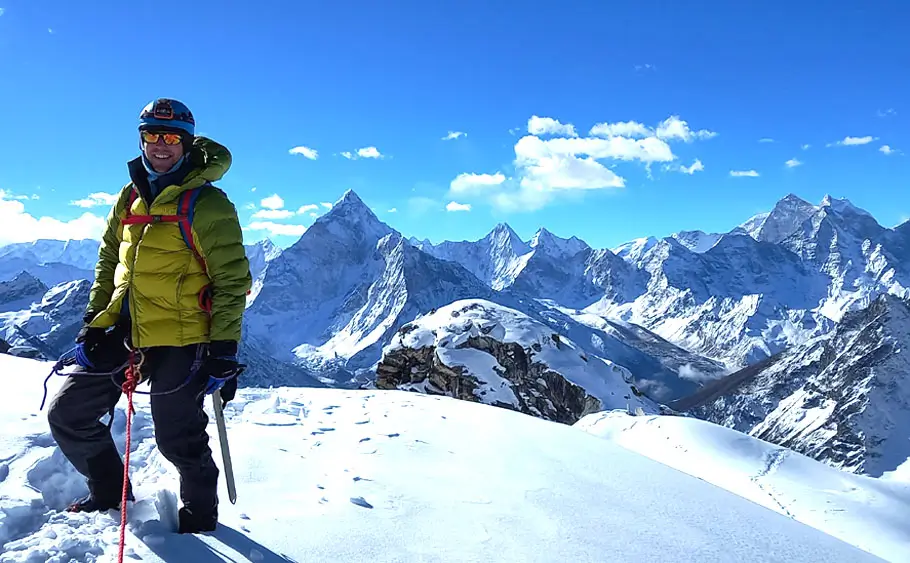

US$ 5150 per person
For a group of 7-12 pax.
-
1 person
US$ 6490
-
2 -
2 person
US$ 5900
-
3 -
6 person
US$ 5399
-
7 over
9999
US$ 5150
- Best Price Guarantee
- Secure Online Booking
- Flexible booking dates
- Owner operated company
- Decades of experience
- Dedicated sherpa team
- 100% success rate
- 5/5 ratings by travelers


Highlights of Mera Island Lobuche 3 Peaks Climbing
- Experience a brief scenic flight to Lukla
- Summit the impressive peaks of Mera, Island, and Lobuche
- Trek across the renowned Mera La, Amphu Lapcha, and Kongma La Passes
- Enjoy breathtaking panoramic views of Everest, Kanchenjunga, Makalu, Lhotse, Cho Oyu, Ama Dablam, Charpate Himal, Kangtenga Peak, Baruntse, Chamlang, Cholatse, Mera, Island, Lobuche, and more
- A refreshing hike to Chhukung Ri for acclimatization
- A small detour of Everest Base Camp and Kala Patthar
- Learn essential mountaineering skills
- Explore the charming Sherpa Buddhist villages
- Discover the beauty of Kathmandu on a sightseeing tour
- Wander through the protected areas of Makalu Barun and Sagarmatha National Parks.
Trip Overview
Three Peaks Climbing: Mera peak, Island peak, Lobuche peak
The Three Peaks Climbing Adventure is a prestigious, award-winning trek in Nepal, and for good reason. If you are an experienced trekker and climber, or if you are an inexperienced trekker and aspiring climber, this trek gives you the ability to reach the summits of Mera Peak (6,476 m), Island Peak (6,189 m), and Lobuche East Peak (6,119 m) in one expedition. The Three Peaks Expedition combines high-altitude trekking, the crossing of glaciers, technical climbing, and the amazing Himalayan views into a single, multi-faceted, and powerful trekking challenge located in the Khumbu region.
The 3 Peaks Climbing Expedition is not your typical trekking holiday, as you will have the alpine experience of a lifetime. On this trek, you will pass through ancient Sherpa villages, forests, and valleys, as well as scrub, dry, rugged, and glacial terrain, all while standing atop the summits of three trekking peaks that reach above 6,000 meters. This trip is one of the most thrilling and complete climbing treks offered in Nepal.
A flight from the capital of Nepal up to the town of Lukla begins the journey. This trek does not follow the busy, commonly used trek to the base of Mt. Everest. Instead, this expedition uses the trail to the less busy and incredibly scenic Hinku Valley, passing through stunning Sherpa villages. The villages of this trek give climbers the ability to adjust to the altitude and give an authentic Himalayan experience to the climbers before their first summit attempt.
The first peak we will climb during the Three Peaks Expedition is Mera Peak (6,476 m), the tallest trekking peak in Nepal. It is located in beautiful Makalu Barun National Park, and is deemed the least technical of the three peaks, so it is a great place to start for a beginner to high altitude climbing. The technical climbing is approached through snow and ice, and requires the use of crampons, ice axes, harnesses and fixed ropes. While the climbing is not very technical, the high altitude does make the climb challenging, but definitely worth the effort. The summit of Mera Peak boasts some of the best panoramic views in the world, as you can see some of the highest mountains in the world, including Mount Everest, Lhotse, Makalu, Cho Oyu and Kanchenjunga.
After climbing Mera Peak, the Three Peaks Expedition continues to traverse Amphu Lapcha Pass (5,845 m). This pass is also one of the most beautiful and challenging in all of Nepal, and is a great achievement in Alpine Crossings. It requires travel through glacial ice and careful navigation over snow. The beautiful passes of the rugged icy peaks of the Himalayas, towering glacial peaks and hanging cliffs, are one of the most memorable highlights of the whole expedition.
The expedition includes Island Peak, also known as Imja Tse, which at 6,189 m is one of the most famous trekking peaks in Nepal. Compared to Mera Peak, the ascent is much more technical, with the challenges of glacier crossings and crevasse navigation, as well as climbing with fixed ropes and the ascent of a steep, snow-covered headwall. Island Peak, when successfully summited, offers the 3 Peaks Climbing adventurer some alpine experience, and is a good precursor to some future expeditions in the Himalayas. The views from the summit will provide the climbers with the spectacular sight of the spires of Everest, Lhotse, Nuptse, and Ama Dablam, Makalu and Baruntse, and the Khumbu glaciers.
From Island Peak, the trail ascends and crosses the Kongma La Pass, which at 5,535 m is the highest of the Everest Three Passes. This portion of the Three Peaks Expedition links the climbers to the classic Everest Base Camp trek, and includes two of Nepal’s most famous sites, Everest Base Camp located at 5,364 m, and Kala Patthar, which is 5,545 m high. These world-famous locations provide close views of Mount Everest along with the Khumbu Icefall and many of the other peaks in the Himalayas, and offer yet another highlight before the final trek to the last of the summits.
The last destination for our Three Peaks Climbing journey is Lobuche East Peak (6,119 m), one of the hardest Trekking Peaks in Nepal. When compared to Mera Peak and Island Peak, it takes much more stamina, stronger climbing skills and more confidence with the steep snow, ice and mixed rock and ice. Climbers face rocky ridges, glacier sections, and a fixed rope climb to reach the exposed summit ridge. Standing on the summit completes the 3 Peaks Climbing challenge, and presents a reward to the climbers in the form of the views of Everest, Lhotse, Nuptse, Pumori, Ama Dablam, Cholatse, Taboche, and many, many snow-covered Himalayan Peaks. These views are completely panoramic and 360 degrees.
The Three Peaks Expedition is known for offering the chance to traverse three of the world’s most famous Himalayan Mountain Passes: Mera La (5,415 m), Amphu Lapcha Pass (5,845 m) and Kongma La Pass (5,535 m). Having these three strenuous high alpine passes on the itinerary adds a good amount of adventure and a completely new dimension to the expedition other than climbing three peaks. The itinerary, which is a mixture of thorough glacier travel, remote trekking, high alpine passes and technical climbing in one of the most high altitude environments available in Nepal, provides perhaps the most comprehensive and varied trekking alpinism on offer in Nepal.
Aside from the mountain challenges, the Three Peaks Climbing expedition combines adventure and culture. Along the trek, there are ancient monasteries, prayer flags, and Sherpa Villages that surround centuries-old trails where local cultures and customs meet those of the mountains. The hospitality of the Sherpa, combined with the beauty of Sagarmatha and Makalu Barun National Parks, creates an expedition that combines culture and nature as part of the adventure.
Our 3 Peaks Climbing itinerary incorporates days specifically set aside for acclimatization at regular intervals, giving climbers the opportunity to safely adjust to the altitude and increase their chances of successfully summiting all three peaks. Participants are taught vital skills to safely travel on glaciers and alongside runouts, as well as the safe use of ropes for both climbing and descending, jumar use, crevasse safety, and mountaineering gear. All of these skills, along with the personal instruction, increase one’s self-assurance to a great extent during the trek as well as for future endeavours in the world of climbing.
Three Peaks Expedition requires a fair amount of trekking fitness, coupled with an adventurous spirit and high altitude trekking experience. Although it is useful, prior climbing experience is not essential. With good fitness, adequate preparation, and some level of determination and spirit, the expedition is very attainable.
For many, completing the peaks in the Three Peaks Climbing Adventure is the ideal preparation for the first of many larger expeditions to the Himalayas. Peaks in the 3 Peaks Challenge, Mera Peak, Island Peak, and Lobuche Peak, provide the building blocks of preparation for eleven of the world’s tallest peaks, including Everest.
Whether you want to challenge yourself physically and learn the first stages of mountaineering, or if you just want to summit three of the most beautiful peaks in the world in a single expedition, our Three Peaks Expedition is a unique experience. Three Peaks Expedition combines world-class trekking, technical climbing, glacier travel, willow walking, the Everest base camp, and a taste of authentic Sherpa culture.
Mera Island Lobuche 3 Peaks Climbing Itinerary
01
Day 01: Arrival in Kathmandu (1,350m/4,428ft)
Hello and welcome to Kathmandu- a city of ancient culture, historical monuments, and the rare beauty of nature. We are glad you have chosen us for your 3 peaks climbing and trekking in Nepal. After meeting you at TIA, we will accompany you to your hotel.
After you get some rest, our tour guide will conduct a brief meeting where you will get to meet the rest of the group members. In the program, he will also explain about the program we have planned for you. Then he will also check all your equipment and clothing, and if required, he will help you in buying or renting gear at an affordable price.
Please get some rest and go to bed early as we have to board an early morning flight to Lukla tomorrow.

Duration
30 mins
Max Altitude
1350m
Meals
Excluded
Accommodation
3-Star Hotel
02
Day 02: Flight to Lukla, start trek to Chhutak or Paiya
We will start our day early morning with a drive to TIA for our short flight to Lukla town. Don’t forget to look from your plane window at the massive views of Kanchenjunga and Everest below. The landing at Tenzing Hilary Airport is a thrill in itself and on top, we will get to see the mighty 6187 m high Kongde Ri as soon as we set foot in the small airport.
Our local Sherpa crew will receive us with a big smile on their face. Then, we will eat our breakfast and start walking towards Mera Peak- our first Peak to conquer.
Our path first goes down steeply for about 2 hours till we reach the small quaint settlement of Surke. Now, the trail from here climbs up again for another 2 hours that will lead us to Pake.
The deep jungle of pine and rhododendron will then welcome us under its cool shadow and take us further to Chhutak located at the foot of Kalo Himal Danda.
The village can be a good site for an overnight stay but we will hike further and steadily ascend the 2945 m high Chhutak La Pass. Climbing down from the Pass, we will eventually arrive at Paiya village. This will significantly reduce our walking duration for the next day.
Attention
We would like to kindly inform you that in the spring and autumn months, direct domestic flights to Lukla may not be possible from TIA due to the high air traffic load. We will therefore ride to Ramechhap/Manthali Airport for about 4 hours and board a flight to Lukla for 20 minutes.
Duration
35 mins flight / 4 to 5 hours walk
Max Altitude
2,800 m
Activity
trekking
Meals
Breakfast, Lunch, Dinner
Accommodation
Lodge
03
Day 03: Hike to Pangkongma Gumpa
We will depart from Paiya after breakfast and hike down towards Paiya Khola. We will cross the Paiya Khola and ascend the 3081 m high Khari La Pass. Hiking downhill from the Pass, our path will then run through the terraced farmlands of the Khari Khola valley.
From here on, we will tackle many ups and downs during the trek till we arrive at Pangkongma. The colorful Mani Walls with sacred Buddhist mantras inscribed, the gurgling white waters of Dudh Koshi River, and many small monasteries will greet us in the village.
In clear weather, we can witness the old classic route to Everest from Jiri.
Duration
6-7 Hours walk
Max Altitude
2,846 m
Activity
trekking
Meals
Breakfast, Lunch, Dinner
Accommodation
Lodge
04
Day 04: Hike To Ramailo Danda
After exiting from Pangkongma village, we will resume our walk along the shore of Dudh Koshi River. Then, we will overcome a steep climb to 3175 m high Pangkongma La Pass. After we hike down from the Pass, the Dudh Koshi River will leave us and Hinku Khola will welcome us to our company onward.
The trail now climbs to 3085 m high Surke La, and once again enters the dense fir and rhododendron forest to take us to Ramailo Danda 3,220 meters elevation. We will see the summit of Mera for the first time along with the impressive panorama of Mojang Himal and Sanu Himal.
Duration
5-6 Hours walk
Max Altitude
3,320 m
Activity
trekking
Meals
Breakfast, Lunch, Dinner
Accommodation
Lodge
05
Day 05: Hike To Chhatra Khola
Be prepared for a long and arduous hike today but through the picturesque trail that blesses us with the breathtaking vista of Mojang and Mera Himals.
After Ramailo Danda, our route will make us climb and descend for about 3 hours till we arrive at Tama Khola. After crossing the river over a hanging bridge, we will then continue walking further. After about half an hour, we will arrive at 4G Danda which is the newly built teahouse en route. It is a perfect spot to eat our lunch.
After lunch, we will walk through the bamboo and rhododendron forest and steadily ascend for about ten minutes to reach Chhatra Khola. It is the gate to enter the protected area of Makalu Barun National Park.
Several wonderful cozy motels in between the green forests are located on the corner of the Chhatra Khola 3,122 meters. One of them will be our resting site for tonight.
Duration
6-7 Hours walk
Max Altitude
3,122 m
Activity
trekking
Meals
Breakfast, Lunch, Dinner
Accommodation
Lodge
06
Day 06: Hike to Kothe
The trail from Chhatra Khola will climb vertically through the bamboo forests for about 1.45 hours. Now, our route will lead us along a straightforward slope for about 3 to 4 hours to Taktor. Now is a good time to take a break for tea and lunch.
The route now takes us along the bank of Hinku Khola to the beautiful Tashing Dingma village. Now, we will cross the long steel bridge over Sanu Khola and walk for another 2.30 hours to reach Kothe 3,600 meters where we will settle for tonight.
This Sherpa village has a small checkpost that will issue the permit to set foot in the restricted area of Makalu Barun National Park.
Duration
5-6 hours walk
Max Altitude
3,600 m
Activity
trekking
Meals
Breakfast, Lunch, Dinner
Accommodation
Lodge
07
Day 07: Trek to Thaknak
Today’s hike is more of an acclimating hike to an altitude of more than 4000 m. So we will not hurry and walk at a gentle pace along the Hinku Khola shore. Shortly, we will walk through the small yak pasture situated on the western shore of Hinku Drangka.
Next, Gondishung will greet us where we will eat our lunch. Continuing with our journey, we will come across the ancient monastery of Lungsumgba said to be 200 years old. The Gumpa is also the perfect viewpoint to observe the grandeur view of Charpate Himal, Mera Peak, Kusum Kanguru, and Thamserku.
After enjoying the view, we will trek for 1 hour more to reach Thaknak where we will dine and rest.
Duration
3-4 hours walk
Max Altitude
4,350 m
Activity
trekking
Meals
Breakfast, Lunch, Dinner
Accommodation
Lodge
08
Day 08: Hike to Khare
Another day for a short acclimating walk before approaching the summit of Mera Peak. Leaving Thaknak, we will trek for about 30 minutes to reach the glacial lake of Sabai Tsho situated at 4463 m elevation.
After we spend some time in the pristine atmosphere of the lake, we will go on with our hike towards Khare. The trail will follow the lateral moraine of the Kharka Glacier from where we will overcome the steep ascent to reach the Hinku Nup glacier. The Charpate Himal and Kangtenga Peak open up in front of us.
We have Lhotse Shar Glacier in front of us which we have to climb to reach Khare. The beautiful shining peak of Mera under the setting sun will be our beautiful reward.
Duration
2-3 hours walk
Max Altitude
5,045 m
Activity
trekking
Meals
Breakfast, Lunch, Dinner
Accommodation
Lodge
09
Day 09: Rest day in Khare/Acclimatization
Within a few days, we have reached an elevation of more than 5000 m. Therefore, we must follow the proper acclimatization technique to help our bodies adapt to high-altitude air.
We will not stay idle but hike to the nearest ridge that towers at 5300 m height. It is the best vantage point where we can see the mind-blowing panorama of Mera La Pass, Mera Peak, and a mountain Lake.
After the ridge visit, we will return to our lodge in Khare and rest enjoying the superb view of Mera once again. Now is a good time to check all our equipment.
Duration
3-4 hours
Max Altitude
5,045 m
Activity
rest/hike/training
Meals
Breakfast, Lunch, Dinner
Accommodation
Lodge
10
Day 10: Trek to Mera Base Camp
In two days, we will attack the summit of Mera Peak so in order to prepare physically, we will take it slowly and walk only for 3 to 4 hours. After leaving Khare, the trail now ascends along the glacial ground till we climb to the top of 5415 m high Mera La Pass. The Pass bestows us the remarkable views of Everest, Lhotse, and Makalu.
Our base camp is situated 100 m down from the Pass where our team will put up the tents for our overnight stay. Our team will then prepare a delicious meal for us. Meanwhile, we will once again check our gear under the supervision of our climbing guide.
After eating our meal, we will attend a training session with our guide. We will practice using ice axes, harnesses, jumar, and carabiners. We will also practice walking up and down along the fixed rope.
Duration
3-4 hours walk
Max Altitude
5, 200 m
Activity
trekking
Meals
Breakfast, Lunch, Dinner
Accommodation
Camp
11
Day 11: Trek to High Camp
After wrapping up our tents at Base Camp, we will overcome the slippery climb along the glacial terrain to reach the High Camp of Mera Peak. We will come across a rock boulder, and after its crossing, we will finally arrive at our High Camp where once again our team will set up the tents.
The High Camp bestows the magnificent panorama of Makalu, Everest, Cho Oyu, Nuptse, Lhotse, Baruntse, and Chamlang.
For our self-confidence, it is better that we practice one more using our equipment for the climb.
Duration
4-5 hours walk
Max Altitude
5,780 m
Activity
Climbing
Meals
Breakfast, Lunch, Dinner
Accommodation
Camp
12
Day 12: Push to Summit Mera Peak, hike back to Mera La
The day to conquer the first peak of our 3 peaks climbing program has arrived. We will wake up early in the morning at around 3 am and after breakfast, we will get ready with warm clothing and our gear. After all our group members are ready, we will set off to attack the summit at around 4 am.
Based on our walk, pace, and health condition, we can conquer the Peak within 5 to 7 hours. The trail first follows a steep incline followed by a moderately challenging path across icy terrain.
During the entire period of climbing, our guide will keep an eye on us. If needed, he may make us use the pre-installed railings only after checking their safety by himself. During the crossing of the steep sections, he will also help us on using the appropriate gear.
We will be on right time to witness the sparkling peaks of Everest(8,848m), Lhotse (8,516m), Nuptse (7,855m), Cho-Oyu (8,201m), Lobuche (6,145m), Kanchenjunga (8,586m), Makalu (8,463m), and Chamlang (7,319m) at the summit.
After depositing the moment in our memory bank, we will now climb down to High Camp where we will celebrate our first success with a hot meal. Then dissembling the tents and carrying the garbage, we will proceed to Mera La Pass where once again camp will be our overnight lodge.
Duration
8 -9 hrs climb and walk
Max Altitude
6,461 m
Activity
climbing
Meals
Breakfast, Lunch, Dinner
Accommodation
Camp
13
Day 13: Hike to Kongma Dingma
Departing from Mera La Pass, we will proceed to the east and follow the path towards Kongma Dingma. The icy landscape along the route needs your careful attention and sure-footedness.
After about 5 to 6 hours, the arid landscape of Kongma Dingma appears in front of us. We will again set up the tent for our rest and dine. When the sun sets, we can see the beautiful peaks of Baruntse, Chamlang, and Hunku with impressive glacial lakes.
Duration
5 to 6 hours walk
Max Altitude
4,850 m
Activity
trekking
Meals
Breakfast, Lunch, Dinner
Accommodation
Camp
14
Day 14: Trek to Seto Pokhari
After breakfast, we will wind down our tents and slowly move to Seto Pokhari. Leaving Kongma Dingma, we will climb downhill towards the Honku valley. On the way, we will pass through a yak pasture from where you can delight your eyes with the breathtaking view of Baruntse.
With the accompaniment of the Honku glacial river, we will continuously gain altitude. The landscape slowly opens up the face of Everest and Lhotse in the distance. We will stay overnight in Seto Pokhari.
Duration
5-6
Max Altitude
5,035 m.
Activity
Trekking
Meals
Breakfast, Lunch, Dinner
Accommodation
Camp
15
Day 15: Hike to Amphu Lapcha Base Camp South
Exiting Kongma Dingma, the path will take us down to the enchanting yak pasture which bestows us with a marvelous view of Baruntse Himal. Then, we will move further towards Honku Valley from where we will climb to Seto Pokhari or White Lake.
The trail now climbs steeply towards the upper basin of the Valley. En route, we will encounter a serene glacial lake. The route will climb more however, the breathtaking company of Everest and 7321 m high Chamlang Peak will more or less ease our walk.
After about 6 to 7 hours, we will reach the south base camp of Amphu Lapcha Pass perched on the vertical slope of Panch Pokhari Lake.
Duration
5 to 6 hours walk
Max Altitude
5,650 m
Activity
trekking
Meals
Breakfast, Lunch, Dinner
Accommodation
Camp
16
Day 16: Trek to Chhukung via Amphu Lapcha pass
Another tough yet fulfilling day ahead of us. We will wake up at dawn and set off to cross the renowned Amphu Lapcha Pass which stands at 5845 m above sea level. A steep path will make us perform the arduous climb for about two hours till we arrive at the glacier.
We will now take out our high-altitude equipment and use jumar to cross the two railing sections. Now, the trail transforms into a gentle slope that will lead us to the Pass.
The Pass is an incredible vantage point that offers us the unique panorama of Island Peak, Cho Oyu, Everest, Makalu, Lhotse, Chamlang, Mera Peak, and Hongu Basin.
While descending from the Pass, we will conquer two rappel sections measuring twenty and thirty meters respectively. Then, a downhill hike for about 3 to 4 hours will lead us to Chhukung where we will have a cozy lodge for our night accommodation.
Duration
9 - 10 hrs walk
Max Altitude
5,845m
Activity
high pass
Meals
Breakfast, Lunch, Dinner
Accommodation
Lodge
17
Day 17: Rest day
After so much strenuous walking, a rest day in between is a much-needed break. We will wake up late and have a leisurely breakfast in our lodge. We can rest all day in our room or we can climb the famous Chhukung Ri near the village.
The Chhukung Ri mountain is a non-technical peak that somewhat resembles to Kala Patthar. We will climb this peak along the sandy terrain for about 3 to 4 hours. As we reach the top, the unbelievable spectacle of Island Peak, Makalu, Ama Dablam, and Nuptse opens up.
Then, we will return to our accommodation in Chhukung and rest.
Max Altitude
4,750 m
Activity
rest
Meals
Breakfast, Lunch, Dinner
Accommodation
Lodge
18
Day 18: Hike to Island Peak Base Camp
We will exit Chhukung after morning breakfast and march towards Island Peak Base Camp. Along the route, we will turn south and face a vertical ascent, then we will turn east that opens up the path to the main valley.
We will then follow the southern edge of the Lhotse Glacier moraine. Continuing on, we will traverse through the Imja and Lhotse glacial moraines, leading us to a spacious valley on the Southwest side of the island peak.
Finally, we will reach the Island Peak Base Camp where our team will establish our overnight camp for us.
We have already practiced our climbing equipment before climbing Mera. But we will again practice using the equipment that will help us to conquer the Peak as it is more technically challenging than Mera.
Duration
3 to 4 hours walk
Max Altitude
5,200 m
Activity
trekking
Meals
Breakfast, Lunch, Dinner
Accommodation
Lodge
19
Day 19: Push to summit island peak and trek back to Chhukung,
The second biggest day of our 3 peaks climbing/trekking program has arrived when we will set out to conquer the summit of Island Peak. Once again, we will wake up around 3 am, and after a light breakfast, we will put on our climbing attire and gear. Then with all our group members, we will set on our adventure.
After exiting the base camp, we will march to left and ascend the steep slope. Then the route follows the sandy trail with a few scattered stones. The slope now begins to narrow followed by a steep rocky channel. We will then reach the spot where most climbers set up their High Camp.
Advancing on, we will climb several rocky steps for about 3 hours which will lead us to the snout of the summit glacier. It’s time to take out our crampons, jumar, ice axes, and ropes. With these gear on hand, we will overcome the last section of the summit which is quite challenging due to its inclination to 35 to 45 degrees.
We are on top of Island Peak, be ready for the amazing panorama of illuminating peaks of Ama Dablam, Baruntse, Makalu, Lhotse, and Cholatse.
We will then hike down to our base camp for our meal. After disassembling the tent, we will return to our lodge in Chhukung.
Duration
9-10 hours walk
Max Altitude
6,165 m
Activity
climbing
Meals
Breakfast, Lunch, Dinner
Accommodation
Lodge
20
Day 20: Hike to Lobuche via Kongma pass
Today, we will cross one of the three Passes of the Everest – the prominent 5535 m high Kongma Pass. Our walk will not be easy but it’s not technical as well.
Leaving Chhukung, we will advance toward west and cross a tiny creek. Then the route climbs sharply and advances through the scree. After about 4.5 hours of climbing, we will reach the partially frozen lake located at the base of the Pass.
Now, tackling another steep ascent, we will reach the top of the Pass decorated with colorful prayer flags. We will rest at the top for a while clicking the amazing vistas of Everest, Ama Dablam, Lhotse, and Makalu in our memory.
Then we will climb down toward the east of the Khumbu Glacier and reach Lobuche where we will have long-awaited rest.
Duration
8 to 9 hours walk
Max Altitude
5,440 m
Activity
trekking
Meals
Breakfast, Lunch, Dinner
Accommodation
Lodge
21
Day 21: Hike to Everest base camp via Gorakshep then back to Gorakshep,
Early morning after breakfast, we will depart from Lobuche and traverse the Khumbu Glacier. En route, we will admire the northern slope of Everest along with Mahalangur, Pumori, Khumbutse, Lingtren, Nuptse, and many other icy rock Himalayas.
Next, our trails follows a short gradual climb towards Lobuche Pass also known as Thangma Riju. It is an outstanding viewpoint to witness the majesty of the grand Himalayas.
Now, the trail follows a steep ascension via Changri Glacier from where we can observe the Kala Patthar for the very first time. Traversing the glacial trail, we will now reach Gorakshep, a sandy desert with few lodges.
After resting and storing our backpacks in the lodge, we will now make our way to Everest Base Camp. The glacial path will lead us to the ridge which will then take us to the Camp. Although Everest is not visible, we can see the outstanding views of Khumbutse, Nuptse, Pumori, and Lhotse.
We will now hike down back to our lodge in Gorakshep and await for the next morning when we will climb the Kala Patthar.
Duration
6-7 hours walk
Max Altitude
5,364 m
Activity
trekking
Meals
Breakfast, Lunch, Dinner
Accommodation
Lodge
22
Day 22: Climb Kala Patthar and trek back to Lobuche
Early morning rise probably at around 4 am, and we set off to climb the iconic Kala Patthar. The climb itself is not technical but the traversing route will be along the smooth glacial terrain so careful attention is essential.
The route to the outstanding Peak offers us the beautiful glances of Khumbutse, Everest, Lingtren, and Changtse. The 2 to 3-hour ascension will finally lead us to the top from where we will witness the mystical sunrise over Nuptse, Everest, Amadablam, Lhotse, Lingtren, Khumbutse, Pumori, Lobuche, Changtse, and many more.
We will now head back to our Gorakshep lodge for breakfast, then we will head down to Lobuche.
Duration
2.5 hours climb / 5-6 hours walk
Max Altitude
5,550m
Activity
trekking
Meals
Breakfast, Lunch, Dinner
Accommodation
Lodge
23
Day 23: Hike to Lobuche High Camp
Shortly, behind Lobuche, the path winds initially mostly straight, to the Lobuche base camp. From here on, however, things get more strenuous. We will walk our way to the high camp of Lobuche Peak over steeper sections, including over scree.
After arriving at the High Camp, our crew will set up the tents and cook meals for us. The little refreshment feels good. But the day is not over yet. Our climbing guide will once again give us a short mountain training for the next day.
Duration
5 to 6 hours walk
Max Altitude
5,200m
Activity
trekking
Meals
Breakfast, Lunch, Dinner
Accommodation
Camp
24
Day 24: Climb Lobuche peak then trek down to Pheriche
The final highlight of our 3 peaks climbing/trekking expedition is ahead of us. At 4 am, we will make our way over scree fields and a few small climbing passages over rocks. After about 5 hours we reach the Headpoint with its ice fields. The climb, which is 45 to 60 degrees steep in places, will be equipped with fixed ropes in difficult places. We will make our way very slowly to the summit.
Once we reach the top, there will be time to see many of the high mountains in the area. Famous mountains such as Ama Dablam, Everest, Nuptse, and Cholatse greet us from up here.
Now it’s time to tackle the way back to Pheriche. But first, we will have a hot meal at our High Camp. Then we will follow the trail that will lead us to Thukla. We will then overcome the Thukla Pass at 4830 m with memorials for the great climbers.
Now the flat trail will then take us to Pheriche located above Tsola River where the cozy room of the tea house will be very welcoming.
Duration
9-10 hrs walk
Max Altitude
6,119 m
Activity
climbing
Meals
Breakfast, Lunch, Dinner
Accommodation
Lodge
25
Day 25: Hike to Namche bazaar
Leaving Pheriche, we will traverse through the Dudh Koshi Valley and its enriching forest of rhododendrons and pine. En route, we will pass the enchanting Sherpa settlement of Pangboche, and Tengboche. Both these Sherpa villages are known for their ancient monasteries. We may steal some time to explore these Gompas.
Then, the trail follows the beautiful trail through Phunki Tenga which will ultimately take us to Namche. It’s welcoming to spend the evening in some comfort of a hot shower, wifi, and tasty food.
Duration
6-7 hrs walk
Max Altitude
3,443 m
Activity
trekking
Meals
Breakfast, Lunch, Dinner
Accommodation
Lodge
26
Day 26: Hike to Lukla
We will leave Namche after breakfast and walk down to Monjo village from where the trail follows the Dudh Koshi River leading us to Phakding. An easy straightforward path will now take us to Lukla where we will celebrate our grand accomplishment with some Everest Beer.
Duration
6-7 hrs walk
Max Altitude
2,800 m
Activity
trekking
Meals
Breakfast, Lunch, Dinner
Accommodation
Lodge
27
Day 27: Flight from Lukla to Kathmandu
It’s hard to say goodbye to these Great Himalayas but unfortunately, we have to. Early morning, we will take a flight from Lukla airport to TIA of Kathmandu. Then we will drive you to your 3-star accommodation in the city.
You can then spend the rest of the day in two ways: either rest and sleep in your room or shop and walk in its narrow alleys. If you like, we can also organize a sightseeing tour for you where you will explore Boudhanath, Swayambhunath, and Durbar Square.
In the evening, we will together with our team enjoy a farewell cultural meal celebrating our success.
Duration
35 minutes
Max Altitude
1300 m
Meals
Farewell Dinner
Accommodation
3-Star Hotel
28
Day 28: Departure from Kathmandu airport
Departure and transfer to the airport. We will take you to TIA just before departure. We hope you had a nice trip and wish you a good flight.
Max Altitude
1300 m
Meals
Breakfast
Accommodation
ExcludedIncludes & Excludes
What is included?
- Airport Pick up / drop off ( private Car )
- Flight from Kathmandu to lukla – Kathmandu
- 3 * Hotel twin sharing room accommodation ( 2 nights in Kathmandu with breakfast)
- All meals during the trekking (breakfast, lunch, dinner and tea)
- All camping set tents, kitchen, dining & foods at Mera, island, Lobuche peak high camp
- Mera peak, island peak, lobuche peak climbing permit.
- Makalu barun national park permit and Sagarmatha national park permit.
- Climbing guide insurance & climbing equipment charge.
- Main climbing guide & assistant guide.
- Company provides climbing main rope.
- Complementary fresh fruit after dinner.
- Accommodation, tea house during the trek.
- Government licensed holder and good speaking English climbing guide.
- All staffs wages, foods, drinks, accommodations, transportations and Insurance.
- One strong sherpa helper for carrying your baggage, (1 porter for 2 clients)
- Hill Sherpa Trekking first aid kit with guide.
- Water purification tablets For Tap Water.
- Helicopter service will covered by your travel insurance, incase if Emergency.
- All Government taxes and official expenses.
- Sleeping bag, Down jacket, Duffel bag, and trekking poles provides by company but should be returned after the trek ( if needed )
- Oxy meter for checking pulse, level (AMS) Acute Mountain Sickness,
- Assistant guide provides for groups size of 8 people,
- Achievement Certificate by Nepal Mountaineering Association (after summit peak)
- Company provides trip Certificates ( after complete trip)
- Hill Sherpa Trekking Provides Complementary Sun Block Cap
What is excluded?
- International airfare tickets
- Nepal entry visa fee, visa obtains on arrival at the international airport in Kathmandu)
- Additional accommodations, food, and drinks in Kathmandu ( if stays extra day)
- Your personal medical & travel insurance,
- Desserts, sweet items like chocolate, cake, pie, pudding, any extra expenses
- Excess baggage luggage weight is 10-15 kg maximum,
- During the trek hot showers, mobile, camera, power bank any batteries charging, Wi-Fi internet,
- Kathmandu sightseeing and entrance fees ($ 25-30 USD per person)
- Your personal climbing gear
- All Kind Climbing Gears)
- Personal First aid kit
- Tips for Guide & Porters,
Note:
We also operate private trips.
Trip Information of Mera Island Lobuche 3 Peaks Climbing
Best Time to Mera, Island, Lobuche 3 Peaks Climbing
Our 27-day 3peaks climbing/trekking expedition takes you on an ultimate adventure of conquering the three magnificent mountains of Mera, Island, and Lobuche all towering above 6000 m. En route, you will also traverse the challenging Mera La, Ampu Lapcha, and Kongma La Passes.
Therefore, we don’t recommend you attempt this adventure during the winter months of December, January, and February, as well as the summer months of June to August irrespective of your experience.
The Himalayas are known for their unpredictable weather and unforeseen events. These risks are heightened during winter and summer, so we advise you to plan your expedition in spring from March to May or in autumn from September to November.
During the pre-monsoon season in spring, you can enjoy the clear and pleasant weather with temperatures of 25° C in the day and -15° C at night. The vibrant rhododendrons and wildflowers adorn the trail with cascading waterfalls and rivers.
The post-monsoon period in autumn on the other hand offers the best weather conditions, with stable and clear skies, along with mild temperatures of 20° C during the day, and – 7° C at night. As the winter snow melts away, it creates a clear path to the passes and high mountains.
Elevation and Distance
The three peaks that we will summit during our 3 peaks climbing/trekking expedition are Mera, Island, and Lobuche Peaks. The Mera Peak nestled at an impressive altitude of 6461 m, is located 75 km away from Nepal’s capital. Our highest overnight stop will be at High Camp of the peak, elevated at 5780 m.
On the other hand, the Island Peak stands tall at 6165 m and is located 160 km away from Kathmandu. The highest overnight stop for this peak will be at Island Peak Base Camp, situated at 5200 m.
Similarly, the Lobuche Peak, reaching an elevation of 6,119m, is located 150 km away from Kathmandu. The highest elevation of our overnight stop for this peak will be at Lobuche High Camp, at 5,200m.
The town of Lukla, located at an aerial distance of 135 km from Kathmandu, will serve as the starting point for climbing all three peaks. Additionally, we will conquer three massive Passes, namely Mera La at 5415 m, Amphu Lapcha at 5,845m, and Kongma La at 5535 m.
While en route to Lobuche Peak, we will also take a detour to visit Everest Base Camp, situated at 5364 m, located 200 to 300 km away from the capital and Kala Patthar at 5,550m.
Maximum/Minimum walk per day
Our 27-day 3 peaks climbing/trekking expedition is an incredible journey that will take you through the breathtaking landscapes of Makalu Barun and Sagarmatha National Parks in Nepal. Over the course of 24 days, we will have to really push ourselves and test our strength and endurance. Each day, we will cover an average distance of 15 to 20 km on foot.
The expedition integrates several challenging days when we have to walk for 9 to 10 hours. The most strenuous and arduous walking will be on day 12 when we conquer Mera Peak and descend to Mera La Pass, on day 18, as we summit the majestic Island peak and descend to Chhukung. Additionally, day 23 marks our ascent of Lobuche Peak from its High Camp, followed by a descent to Pheriche.
These demanding days will push us to walk for 9 to 10 hours through icy terrain. If conquering the summits is a challenging feat, then crossing the formidable Passes of Amphu Lapcha and Kongma is also not a joke that will also require equal hours of strenuous walking.
However, we also have some delightful easy walks planned. A perfect example is on day 8, when we traverse from Thaknak to Khare, with just a relaxed 2 to 3 hours of walking.
Difficulty and Acclimatization
Mera Peak is classified as a 1B Alpine grade, while Island Peak is graded at a 2B level in the Alpine Grading System. Both peaks offer a moderately challenging trekking experience in Nepal. On the other hand, Lobuche Peak is classified under Grade PD+ thus requiring technical climbing skills.
When all three peaks are combined in one program, along with crossing Mera La, Amphu Lapcha, and Konga Ma La passes, as well as a detour to Everest Base Camp and Kala Patthar, the journey transforms into an extreme adventure in the stunning Himalayas of Nepal.
Overall, climbing all these three peaks requires moderate technical skill. However, our experienced climbing guide will accompany you throughout the expedition and will also provide training in tying knots and using ice axes, jumars, carabiners, harnesses, and ropes.
Therefore, you don’t require very deep knowledge of mountaineering techniques, extensive experience in working with equipment, etc. Good physical fitness is of greater importance, so you need to prepare for the climb in advance. Two weeks of jogging in the morning is definitely not enough; long-term, systematic, and properly organized preparation is required.
The biggest risk is the lack of time and effort to adapt to the lack of oxygen. To address this issue, we have scheduled acclimatization days during the trek, with rest days in Khare and Chhukung. As the challenging ascent to the Peaks draws closer, the hiking hours are intentionally decreased to ensure our bodies are adequately prepared for the strenuous climb.
Can a beginner join this trek?
The 3 Peaks climbing/trekking expedition is ideal for beginners and novice trekkers who are in excellent health and have a positive mindset. While Mera, Island, and Lobuche peaks are not overly challenging in terms of altitude, climbing them does require specific technical skills like using ice axes, jumars, and walking with crampons over thick snow and ice. You will also have to overcome steep slopes and seracs.
Please remember that the Himalayas are still a high-risk area where weather conditions and your well-being can rapidly change.
In addition, you will have to traverse through the challenging terrains of the three High Passes – Mera La, Amphu Lapcha, and Kongma La – all exceeding an elevation of 5000 m. These crossings demand at least basic technical skills.
Our experienced climbing guide will provide you with the necessary training. However. We advise you to dedicate a minimum of 6 months in advance to prepare yourself physically and mentally, as well as acquire essential mountaineering skills.
Preparation and training
3 peaks climbing/trekking requires more than just a month of jogging or running. The 24-day hiking expedition across mountainous landscapes requires significant endurance, stamina, and muscle strength.
To properly prepare, we recommend engaging in activities like jogging, running, brisk walking with a backpack, cycling, and swimming at least 6 months before your journey. It is also beneficial to undertake high-altitude treks or attempt climbs such as Mera Peak or Island Peak beforehand.
Altitude Sickness
We have planned adequate acclimatization in between the treks during 3 peaks climbing/trekking program. But altitude sickness can still occur in high-altitude mountains no matter how experienced you are or how prepared you are.
So, be aware of symptoms such as headache, loss of appetite, insomnia, and dizziness. While medications like Diamox or Ibuprofen can help relieve symptoms, staying hydrated and ascending slowly can aid in its prevention.
Transportation, Meals and Drink
As your trusted partner in Nepal, we provide comprehensive services including airport pickup and drop-off, sightseeing in Kathmandu Valley with a private tour guide and vehicle, all ground transportation during your trip, and domestic airline tickets for the Kathmandu-Lukla-Kathmandu flight.
Additionally, we include 2 nights of accommodation (Twin Sharing Room) in a 3-star hotel in Kathmandu with breakfast included. During the trek, all essential accommodations will be in teahouses (Twin Sharing Room).
You will be provided with breakfast, lunch, and dinner with tea after every meal and fresh fruits after dinner. Tents will also be offered during camping in High Camps and Base Camps with unlimited food, tea/coffee, and hot water.
Communication, Gadgets charging, and Internet/wifi
The NCELL mobile network works better in the Khumbu region than the NTC network. So please purchase the NCELL SIM card in Kathmandu. You can access WIFI at lodges for a fee or get an Everest Link card for internet service.
Additionally, you can charge your gadgets at the lodges for an extra cost. Don’t forget to bring power banks or solar chargers for charging your devices at the camps.
Permits
Our tour guide will secure the necessary climbing permits for Mera Peak, Island Peak, and Lobuche Peak from the Nepal Mountaineering Association in Kathmandu.
The Makalu Barun National Park permit will be obtained in Kothe, while we will obtain the Sagarmatha National Park permit and the Khumbu Pasang Lhamu rural permit when we reach Lukla.
Altitude Chart of Mera Island Lobuche 3 Peaks Climbing
Equipment List

General Information
- Company provides feather sleeping bag but should be refund after the trek.
- Company provides Feather down Jacket but should be refund after the trek.
- Hill Sherpa Trekking provides duffle bag during the trek but should be refund after the trek.
- Mostly recommend for morning and evening, The windproof and waterproof thin layered jacket above 3450m.
- Mostly recommend for Daypack bag 35-45 ltr.
- Headlamp & extra batteries during the trek

Daily Use Essentials
- A Sun Black Cap & Fleece hat
- Sunglasses 100% snow uv protection
- A muffle (full cover mask)
- Sunscreen (30+ to 60 SPF depends on age)
- A pair of thin & warm gloves
- A pair Trekking poles
- Water bottle & filter
- Water purified tablets
- lips guard

Upper Body Essentials
- Warm hat
- A pair of t-shirts
- Thermal tops
- Sports bras for ladies
- windproof & fleece jacket
- waterproof jacket

All Lower Body
- waterproof trouser
- warmer & fleece trouser
- A pair of Comfortable trekking pants
- Extra comfortable sport pants
- A pair of sport shoe
- Thermal underwear
- A pair of comfortable waterproof trekking boots
- Pair of light sandals
- Some Thick (woolen) socks
- Sock liners
- Light shoes

Essential Climbing Gears
- Helmet
- Harness
- Ascender
- Descender
- Carabiners 4 locks, 2 unlocks
- Tape Celling – 120 cm
- Alpine Boot good condition & fit side
- Crampon good condition for alpine boot
- Ice-axe Normal

Personal Medical and First Aid Kits
- Diamox (125mg to 250mg tablets for AMS)
- Adhesive bandages and pocket masks
- Non-stick pad W/ Adhesive
- ibuprofen & paracetamol tablets IP
- Some Assorted adhesive bandages
- Warps, splints, and wound coverings butterfly bandage
- Blister treatment cream or similar
- Insect / anti-itch ointment
- Moves incase sprain any body
- pain-relief medication
- Sinex, & Eye Drops etc.
- Gauze sponge
- Saline solution
(Note: first aid kits & medicine will carrying with our company’s guide during the trekking However, we recommend you to bring your personal first-aid kit)

Important Things
- passport size photos with original passport copy
- Flight details (to pick you up & transfer to hotel)

Extra Essential Things
- Energy gel or dry foods (that’s your desire)
- Power bank is most important for backup device (if you have)
- Camera, chargers, extra batteries, memory card)
- Most important for ladies essentials things (if you are ladies)
Addons & Options for Mera Island Lobuche 3 Peaks Climbing
Addons
Price
Helicopter
US$
150
5 star Hotel
US$
150
Private Car
US$
100
Frequently Asked Questions
I don’t see any reserve day for the climb, is there any?
Unfortunately, we do not offer a reserve day for the climb. However, if your first try doesn’t go as planned, you may get the opportunity to make a second attempt to reach the summit. You can discuss this matter with the organizer and guide, and they can arrange it for you at an extra cost.
Among the three peaks, which one is easier to climb?
Mera Peak is less challenging than the other two so comparatively, it is easier to climb than Island and Lobuche.
Can I skip the climb to any one of the 3 peaks?
Yes, if you think, you are too exhausted and you need rest, you can skip the climb to any one of the peaks. Meanwhile, when other members try for the summit, you can rest in the Base or the High Camp.
How much time will we spend on the summit?
Since the day will be very long with ascending and descending, you may spend 5 to 10 minutes on the summit of each peak.
How much time will we spend in Everest Base Camp?
You can explore the camp, and interact with the campers for about 15 to 20 minutes.
Reviews on Mera Island Lobuche 3 Peaks Climbing






US$ 5150 per person
For a group of 7-12 pax.
-
1 person
US$ 6490
-
2 -
2 person
US$ 5900
-
3 -
6 person
US$ 5399
-
7 over
9999
US$ 5150
US$ 5150

Talk to Trip Expert
+977 9704823980 (Whatsapp)
✖
Free Travel Guide
Get Expert Guidance from Experienced Sherpas