Govt. Tourism License 3195/080/81





Khopra Trek 10 Days


- Best Price Guarantee
- Secure Online Booking
- Flexible booking dates
- Owner operated company
- Decades of experience
- Dedicated sherpa team
- 100% success rate
- 5/5 ratings by travelers


Highlights of Khopra Trek 10 Days
- A trek that is off the beaten path through the scenic Annapurna Region.
- Trek to the amazing Khopra Ridge (Khopra Danda).
- Take a trip to the holy alpine Khayer Lake (4660m).
- Enjoy mesmerising sunrises at Poon Hill and Khopra Danda.
- Visit traditional Gurung and Magar Villages.
- Stroll through the stunning rhododendron and oak woods.
- Get away from the crowd and enjoy some peaceful trails.
- Explore the world’s deepest gorge, the Kali Gandaki Valley.
- Travel in a community-owned teahouse and support local communities.
- Perfect short Himalayan adventure with culture, nature, and mountain views.
- Annapurna, Dhaulagiri, Machhapuchhre and Nilgiri are just some of the breathtaking scenic vistas that await visitors to this region.
Trip Overview
Khopra Trek 10 Days – A Closer Look at Khopra Ridge
Nevertheless, it is incredibly difficult to find a trek in Nepal that offers a great combination of breathtaking hikes through the Himalayas, cultural engagement, and unspoiled peace. The Khopra Trek 10 Days, located in the Annapurna region, has it all. It gets you far away from other popular and congested trek routes, while allowing the nature enthusiast and mountain lover to experience traditional villages and spectacular mountain ranges. The Khopra Danda Trek, without doubt, is a great alternative if you are looking for a real Himalayan trek without the crowds that you will encounter at the Annapurna Base Camp Trek.
This trek passes through many of Nepal’s picturesque villages, dense forests filled with blooming rhododendron and other deciduous trees, intricately terraced farmlands, and alpine regions. With each step toward Khopra Ridge, trekkers are provided with amazing views of Nepal’s highest peaks such as Annapurna South, Dhaulagiri, Nilgiri, Machhapuchhre (Fishtail), Hiunchuli, and more. Khopra Ridge is one of the best views in all of the Annapurna Region, with the breathtaking Kali Gandaki Gorge, the deepest in the world.
The majority of popular treks in Nepal have large crowds, however, that is not the case for the Khopra Trek 10 Days. The unspoiled and amazing beauty of the Himalayas is one of the many reasons to trek to Khopra Ridge. This place offers perfect photographic opportunities as nature provides a masterpiece at sunrise and sunset with the surrounding peaks cloaked in golden light.
A prominent feature of the Khopra Danda Trek is an optional day hike to the sacred Khayer Lake. Located at approximately 4,660 meters, this alpine lake is a sacred site for both Hindus and Buddhists. The combination of the wilderness, soaring peaks, and the lake creates a unique experience for both the spiritually inclined and nature lovers, helping to round off the Khopra trek.
The trek to Khopra Ridge can also be linked to important viewing points like Poon Hill, Mulde View Point, and Mohare Danda. Visiting these points provides trekkers with the opportunity to view spectacular sunrises and sunsets over the Himalayas as these points provide vistas of the Annapurna and Dhaulagiri ranges, making this trek one of the most spectacular short-to-moderate trekking options in the Himalayas of Nepal.
The spring months of March to May and the autumn months of September to November are the best times to complete the Khopra Trek 10 Days. The spring provides blooming forests of rhododendron, while the autumn offers crystal clear skies, making for excellent visibility of the mountains. Those wanting to experience emptier trails and a wintery landscape trekking in the winter months is an option.
The Khopra Trek 10 Days is an excellent choice for trekkers and nature lovers seeking a unique Himalayan trekking adventure. The Khopra Danda trek offers an off-the-beaten-path wilderness trekking experience in the Annapurna region of Nepal with the bonus of sacred Khayer Lake and stunning Himalayan views. The trek also provides ample opportunity for cultural engagement with local communities and visiting traditional villages along the trek.
Khopra Trek 10 Days Itinerary
01
Day 01: Drive from Kathmandu to Pokhara
Kick off your trip from Kathmandu to Pokhara on the Prithvi Highway. With the Trishuli and Marsyangdi Rivers by your side all the way, enjoy the sights of the verdant hillsides, scattered rural villages and distant mountain peaks. Arrive in Pokhara in time to enjoy a relaxing evening walking by Phewa Lake.

Duration
6-7 hours
Max Altitude
830 M / 2,723 feet
Activity
Driving
Meals
Breakfast
Accommodation
3-Star Hotel
02
Day 02: Drive to Ghandruk and Trek to Tadapani
This trip takes off from the picturesque Ghandruk to trek along the rhododendron and oak forests. Marvel at the views of Annapurna South, Hiunchuli, and Machapuchre (Fishtail). The path that leads to the settlement of Tadapani is surrounded by thick forests that offer a stunning Himalayan panorama.
Duration
5-6 hours
Max Altitude
2,630 M / 8,629 feet
Activity
Trekking
Meals
Breakfast, Lunch, Dinner
Accommodation
Local Teahouse
03
Day 03: Trek from Tadapani to Dobato
Today’s trek leads away from the more crowded Annapurna and into a less explored section of the region. Enjoy the sights of blooming rhododendrons and the other forests along the path. With each elevation gain, enjoy the vistas of the mountains that open along the path. Arrive in Dobato, a remote settlement that is known for its tranquillity and stunning views of the sunrises over the mountains.
Duration
5-6 hours
Max Altitude
3,355 M / 11,007 Ft
Activity
Trekking
Meals
Breakfast, Lunch, Dinner
Accommodation
Local Teahouse
04
Day 04: Trek to Chistibung via Bayeli Kharka
An optional early morning trek to Mulde Viewpoint, one of the best viewpoints in the Annapurna. This is the best view of the sunrise over Annapurna, Dhaulagiri, Nilgiri, and Machhapuchhre. Continue the trek after breakfast, passing through alpine meadows and ridges up to Bayeli Kharka. The trail shows an excellent view of Dhaulagiri and other peaks, before descending through forests to Chistibung. This small settlement lies in a peaceful valley beneath Khopra Ridge. Stay the night in Christibung.
Duration
5-6 hours
Max Altitude
3020 M / 9,908 Feet
Activity
Trekking
Meals
Breakfast, Lunch, Dinner
Accommodation
Local Teahouse
05
Day 05: Trek to Khopra Danda
One of the best trekking days of the trip. The trail gradually climbs in the open, above the treeline, to the ridge of Khopra Danda. On this stretch of the trail, the magnificent views of Dhaulagiri, Annapurna South, Nilgiri, Fang Peak, and the other giants of the Himalaya are all in view. Khopra Ridge commands one of the most impressive mountain views in all of Nepal. The stunning views and tranquil atmosphere make this one of the best trekking destinations in Nepal. Stay the night in Khopra Danda Community Lodge.
Duration
3-4 hours
Max Altitude
3,660 M / 12,008 Feet
Activity
Trekking
Meals
Breakfast, Lunch, Dinner
Accommodation
Local Teahouse
06
Day 06: Trek to Khayer Lake with Return to Khopra Danda
An early morning trek takes you to Khayer Lake, one of the picturesque alpine lakes in the Annapurna region. The trail runs through the high alpine terrain and offers stunning views of the mountains for the entire trek, all the way to the base of Annapurna South. Khayer Lake is a religious site for both Hindus and Buddhists and attracts many devotees during the Janai Purnima and other religious celebrations. Enjoy the tranquillity of the lake for a bit, and then head back to Khopra Danda for the night.
Duration
6-7 hours
Max Altitude
3,660 M / 12,008 Feet
Activity
Trekking
Meals
Breakfast, Lunch, Dinner
Accommodation
Local Teahouse
07
Day 07: Trek to Swanta Village
After one last sunrise from Khopra Ridge, descend through the beautiful forests and terraced fields to Swanta Village. This traditional Magar settlement offers a look into rural life in the Himalayas. Enjoy the community, the traditional stone houses, and the environment. Stay overnight at a local teahouse.
Duration
5-6 hours
Max Altitude
2345 M / 7,693 Feet
Activity
Trekking
Meals
Breakfast, Lunch, Dinner
Accommodation
Local Teahouse
08
Day 08: Trek From Swanta to Ghorepani
The trail descends to a suspension bridge and then begins to gradually ascend through forests and villages to Ghorepani. Enjoy views of the terraced fields and the daily life of the villagers. Ghorepani is a common stop along the Annapurna trekking route, and is where many trekkers go to Poon Hill. Stay overnight at a local teahouse.
Duration
5-6 hours
Max Altitude
2865 / 9,403 Feet
Activity
Trekking
Meals
Breakfast, Lunch, Dinner
Accommodation
Local Teahouse
09
Day 09: Trek to Birethanti via Poon Hill and Drive to Pokhara
The hike to Poon Hill begins well before sunrise, as it is one of the best places in all of Nepal to take in the sunrise. The first rays of the sun hitting Dhaulagiri, Annapurna, Machhapuchhre, and the surrounding peaks are an amazing sight. After returning and having breakfast, the trek descends through the rhododendron forests and local villages into Birethanti. The drive from Birethanti takes you to Pokhara, where you can enjoy the lakeside and rest. You will be spending the night in Pokhara.
Duration
6-7 hours
Max Altitude
830 M / 2,723 Feet
Activity
Trek / Drive
Meals
Breakfast, Lunch
Accommodation
3-Star Hotel
10
Day 10: Drive by Tourist Bus from Pokhara to Kathmandu
After breakfast, the return journey to Kathmandu begins on a tourist bus. The route takes you through the scenic beauty of the river valleys and the hills, giving you one last view of Nepal’s countryside. The net of the famous Kathmandu city marks the conclusion of the Khopra Trek of 10 Days, one of the many unforgettable adventures in the Annapurna Himalayas.
Duration
7-8 hours
Max Altitude
1,300 M / 4,264
Activity
Trekking
Meals
Breakfast
Accommodation
3-Star HotelIncludes & Excludes
What is included?
- Airport pick-up/drop-off ( by Private Car )
- Accommodation 3 star hotel twin-sharing room (2 nights in Kathmandu with breakfast)
- Accommodation 3 star hotel twin sharing room ( 1 night in Pokhara with breakfast)
- Kathmandu-Pokhara-Kathmandu by deluxe tourist bus.
- Drive to Ghandruk from Pokhara by jeep/bus & Back to Pokhara by private car
- All meals during the trekking (breakfast, lunch, dinner)
- Annapurna Conservation Area Permit (ACAP)
- Tourist Information Management System (TIMS)
- Complementary fresh fruit after dinner
- Accommodation, tea house/mountain lodge
- Government-licensed holder and English-speaking guide
- All staff wages, food, drinks, accommodations, transportation and Insurance
- Strong Sherpa helper for carrying your baggage (1 porter for 2 clients)
- Hill Sherpa Trekking first aid kit carried by guide,
- Helicopter service will be covered by your travel insurance, in case of an emergency
- All government taxes and official expenses,
- Sleeping bag, Down jacket, Duffel bag, and trekking poles provided by Hill Sherpa Trekking but should be returned after the trek (if needed)
- Oximeter for checking pulse and your oxygen level (AMS) Acute Mountain Sickness.
- The assistant guide is provided for group sizes above 7 people.
- Hill Sherpa Trekking provides trip certificates after the success of the trip.
What is excluded?
- Internation airfares
- The Nepal entry visa fee is obtained on arrival at the international airport in Kathmandu
- Additional accommodations, food, and drinks in Kathmandu (if you stay an extra day)
- Your personal medical & travel insurance
- Desserts, sweet items like chocolate, cake, pie, pudding, and any kind of tea/coffee, mineral water for extra expenses
- Excess baggage weight is 15 maximum.
- During the trek hot showers, mobile phones, cameras, power banks, and battery charging, Wi-Fi internet,
- Kathmandu sightseeing entrance fees
- Personal first aid kit during the trip.
- Tips for guide and porter
Note:
We also operate private trips.
Trip Information of Khopra Trek 10 Days
Best Season for the Khopra Trek
The Best Season for the Khopra Trek runs between March and May & September and November, as these two periods are the peak trekking times. These times are easily the best because of stable weather, clear skies, and impossible to beat mountain views. Spring, as well, is the best time to see the blooming, colorful rhododendrons along the trek.
Autumn features fresh, crisp air with amazing views of the Annapurna, Machapuchare, and Nilgiri mountain ranges. Winter trekking is still a possibility and is even a good time for trekkers looking for a more solitary experience, but it does come along with considerably colder temperatures. The best seasons to go are still Autumn and Spring.
Difficulty level of Khopra Trek
The Khopra Trek is classified as a moderately difficult trek, which is completed by trekkers with average fitness levels and some prior trekking experience. Trekkers on this route can expect to walk 5 to 7 hours a day, traversing multiple forests, a few staircases built from stone, and rugged ridges, with Khayer Lake (4,660m) being the highest point on the trek. While there is no technical climbing involved, the trek does include sections that are high altitude and a steep ascent that can be strenuous.
The trek is easily completed by most beginner trekking enthusiasts who are physically fit, as well as experienced trekkers who are seeking a less crowded trek in the Annapurna region, provided they are able to plan and prepare appropriately.
Can a beginner join the Khopra Trek?
Khopra Trek is accessible to beginners, as long as trekkers are prepared to be physically active for 10 days straight. Prior mountaineering experience is NOT required to take part in the trek. However, participants can expect to trek for 5 to 7 hours daily and deal with ascents and descents beyond 4000 meters. We suggest participants get into the habit of some form of cardio leading up to the trip. Khopra Trek is a great trek option for beginners who want to avoid the more congested trekking paths, but still want beautiful nature and trekking. Just be sure to prepare properly and listen to your body.
Altitude Sickness
Though the Khopra Trek is a moderately difficult trek, altitude sickness is still a risk, particularly during the hike to Khayer Lake (4,660m). While the symptoms usually present themselves as a headache, nausea, dizziness, fatigue, and loss of appetite (along with difficulty sleeping), they are usually not dangerous; it is best to stay on track. Painstakingly taking small steps, keeping the body and especially the legs well fed with the right minerals, and sticking to the regimen of the trip are very important.
Most trekkers complete the full trek without issues. However, if you are among the minority and display symptoms of altitude sickness, it is important that you inform your guide. With proper knowledge of the body, the Khopra Trek can be safe and more pleasant with gradual increases in altitude.
Accommodation, Food, and Drink
There are several options for lodging during the trek, including community and local teahouses. These offer a place to stay that is still involved in the community, as well as a room that is a bit more basic and simple. Teahouses and community lodges offer you a place to stay that is simple. Most lodges have rooms shared by two people. Rooms and bathrooms are usually shared by all lodgers. Meals at Teahouses offer a variety of options like Dal Bhat, noodles, fried rice, soup, and pasta. Vegetables, potatoes and eggs are all food options as well. Hot beverages served include tea, coffee, and hot lemon and ginger tea.
There are several options for hydration on the trail. Along the trail, you have the option of buying bottled water, but a more environmentally friendly option is boiled or filtered water. The quality of food, teahouses, and lodges really makes trekking in the Annapurna region a great experience.
Transportation
Beginning trekkers on the Khopra Trek are treated to a beautiful bus journey from Kathmandu to Pokhara. The same journey is repeated in the opposite direction to end the trek. A private vehicle from Pokhara takes trekkers to Ghandruk. On completion of the trek in Birethanti, trekkers are shuttled back to Pokhara by private vehicle. Travelers enjoy the combination of comfortable roads and private transportation, with trekking the remote mountain trails in the countryside and the scenic Himalayan landscapes of the Annapurna region.
Permits for the Khopra Trek
Two permits are required for the Khopra Trek. The Annapurna Conservation Area Permit and the Trekkers’ Information Management System Card are both essential for this trek. These permits provide support for the maintenance of the trail, conservation of the Annapurna region, and the safety of trekkers. These permits can be arranged by your trekking agency. This provides you with the ability to trek the beautiful Khopra Ridge and Khayer Lake without any hassle.
Trip Preparation and Fitness
Khopra Danda trek is moderately difficult, making it a viable option for beginners in hiking who have the experience and stamina, as well as seasoned hikers. There are a number of elevation gains and losses throughout the trek, and you will walk 5-7 hours daily for the duration of the trek. The highest point on the trek is Khopra Danda, which is at 3,660 m. There is an optional hike to Khayer Lake at 4,660 m, however, that hike is also more difficult and requires a lot more stamina.
The best way to prepare for the trek is to do some sort of hiking at least 4-6 weeks leading up to the trip. If you do not have the ability to go on hikes often, consider walking, jogging, biking, or stair climbing. Developing some light strength and endurance will also help with comfort on the trek.
Make sure to bring comfortable, old, broken in hiking boots, warm clothes, a waterproof jacket, a day pack, trekking poles, a pair of sunglasses, sunscreen, and a reusable water bottle. Proper pacing with a good steady walk and good hydration will help you achieve the best trekking experience.
You will not be disappointed with the stunning views of the Himalayas and the rich local culture, making the Khopra Danda a trek of a lifetime.
Cost & Budget
The price of traversing the Khopra depends greatly on transportation, accommodation, food, group size, and the services included. Usually, trekking packages include all the permits, guides and porters, accommodation, food, and transportation. However, trekkers need to set aside some money to cover personal expenses, including drinks, snacks, hot showers, charging devices, Wi-Fi, tips and travel insurance. Since the Khopra Trek is community-based, it shuns the tourist crowds, making the cost low and the experience truly Himalayan.
What to expect
The Khopra Trek combines stunning mountain ranges, breathtaking panoramic views, rich culture, and peaceful trekking trails. Expect incredible mountain views on the way as you pass through Gurung and Magars villages, rhododendron and alpine meadows, and along the trails that lead to the sacred Khayer Lake and Khopra Ridge, which will not disappoint the avid trekkers, as they boast some of the best views the entire Annapurna range can provide.
You will notice warm local hospitality as you stay in community and teahouse lodgings and experience the much-appreciated tranquility of the Himalayan wilderness as you distance yourself from the hustling crowds. If you are a nature lover and an outdoor enthusiast, this trek is a culture-rich and stunning panorama trek you will not want to miss.
Trekking Alternatives
If you have more time or want to have a unique experience in the Himalayas, you can find a number of amazing trekking routes in Nepal. Some can be combined with or chosen instead of the Khopra Danda Trek.
The Ghorepani Poon Hill Trek is a shorter trekking option which also happens to be an easier option. It offers amazing sunrise views of both the Annapurna and Dhaulagiri ranges. It is particularly good for first time trekkers and families.
If you want to trek further, the Annapurna Base Camp Trek takes you to the heart of the Annapurna Sanctuary and offers amazing views of a towering snow capped range along with a variety of different landscapes.
The Mardi Himal Trek is another quieter route that is of excellent trekking quality and offers amazing views of Machhapuchhre (Fishtail) along with Annapurna South and Hiunchuli.
For something more strenuous, the Annapurna Circuit Trek crosses the famous Thorong La Pass (5,416 m) and shows the diverse landscape of Nepal from lush valleys to high desert.
For a great experience you can also combine the Khopra Danda Trek with a high altitude trip to the sacred Khayer Lake. For this extension, you will need to add 1 or 2 days to the trek.
Despite the chosen route, all treks have unique, beautiful mountain settings and the rich culture and warm hospitality of the Nepalese communities. Our team will work with you to provide the best travel option for your fitness and time preferences.
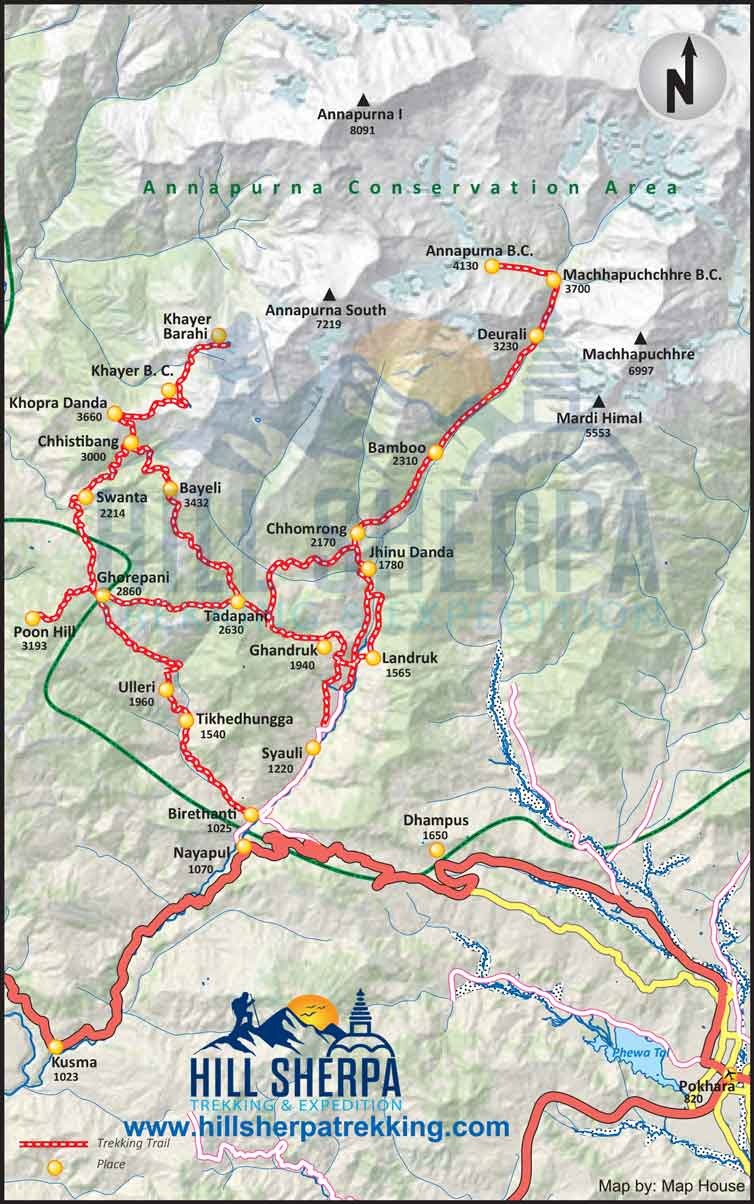
Trip Map of Khopra Trek 10 Days
Altitude Chart of Khopra Trek 10 Days
Equipment List

General Information
- The company provides a feather sleeping bag, but it should be refunded after the trek.
- Feather down Jacket but it should be refunded after the trek.
- Hill Sherpa Trekking provides a duffle bag during the trek, but it should be refunded after the trek.
- Mostly recommended for morning and evening, The windproof and waterproof thin-layered jacket above 3450m.
- Mostly recommended for a daypack bag of 35-45 ltr.
- Headlamp & extra batteries during the trek

Daily Use Essentials
- A Sun Black Cap & warm hat
- Sunglasses 100% snow uv protection
- A muff (full-cover mask)
- Sunscreen (30+ to 60 SPF depends on age)
- A pair of thin & warm gloves
- A pair of trekking poles
- Water bottle & filter
- Water purified tablets
- lips guard

Upper Body Essentials
- Fleece hat
- A pair of T-shirts
- Thermal tops
- Sports bras for ladies
- Windproof & fleece jacket
- waterproof jacket

All Lower Body
- warmer & fleece trouser
- A pair of Comfortable trekking pants
- Extra casual sport pants
- A pair of sport shoe
- Thermal underwear
- A pair of comfortable waterproof trekking boots
- Pair of light sandals
- Some Thick (woolen) socks
- Sock liners
- Light shoes

Essential Climbing Gears
- Diamox (125mg to 250mg tablets for AMS)
- ibuprofen & paracetamol tablets IP
- Some Assorted adhesive bandages
- Warms, splints, and wound coverings butterfly bandages)
- Blister treatment cream or similar
- Insect / anti-itch ointment
- Moves incase sprain any body
- pain-relief medication
- Sinex, Eye Drops, etc.
(Note: first aid kits & medicine will be carried with our company’s guide during the trekking. However, we recommend you bring your personal first-aid kit)

Important Things
- Passport-size photos with an original passport copy
- Flight details (to pick you up & transfer to the hotel)
- Medical and travel insurance

Extra Essential Things
- Energy gel or dry foods (that’s your desire)
- A power bank is most important for a backup device (if you have one)
- Camera, chargers, extra batteries, memory card)
- Most important for ladies essentials things (if you are ladies)
Frequently Asked Questions
 General
Should we take the time to see Khayer Lake?
Yes, Khayer Lake is a must-see on the trek for its beautiful views of the mountains and its rich cultural heritage as it is a site of a sacred pilgrimage.
Can beginners complete the Khopra trek?
The trek is also open to beginners who are relatively fit. It is suggested that some walking, hiking, or cardio activities, such as running, be done leading up to the trek.
What is the maximum elevation of the Khopra Trek?
The maximum elevation of the Khopra Trek is Khayer Lake, which rests at 4,660 meters (15,288 feet). Khopra Danda is at 3,660 meters (12,008 feet).
How long is the Khopra Trek?
The Khopra Trek is most commonly offered as a 10 Day trek that includes both Khayer Lake and Poon Hill. The trek can obviously be done in a different number of days.
What is the difference between the Khopra Trek and the Annapurna Base Camp Trek?
The Khopra Trek is more tranquil than the Annapurna Base Camp Trek, but both treks provide beautiful views of the mountains and a rich cultural experience.
 Preparation & Fitness
What is the difficulty level of the Khopra Trek?
The Khopra Trek is classified as a trek of moderate difficulty. It involves approximately 5 to 7 hours of trekking on a relatively challenging terrain, which includes some steep sections. There is no need to concern oneself with the need for any sort of climbing skills.
 Permits
What permits need to be secured for the Khopra Trek?
The Khopra Trek requires both the Annapurna Conservation Area Permit (ACAP) and the TIMS (Trekkers’ Information Management System) Card.
 Guides & Support Staff
Do I need a guide for the Khopra Trek?
You can trek without a guide if you have some experience and if the area permits independent trekking. That being said, hiring a trek guide is the better option for added safety, cultural knowledge, and an overall better experience.
 Accommodation and Facilities
Are lodging and dining options available along the trek?
Along the trek, there are community lodges and teahouses that provide accommodation and offer a selection of local and international meals.
Is Wi-Fi and electricity available on the trek?
Many teahouses along the trek have electricity that can be used to charge devices and offer Wi-Fi for a fee. It is harder to get a signal in the higher mountains.
 Weather & Seasons
When is best seasons for the Khopra Trek?
The ideal seasons for the Khopra Trek are spring (March to May) and autumn (September to November). These seasons are characterized by favorable weather with clear skies, mild temperatures, and excellent sightseeing of the mountains.
 Health & Safety
Can altitude sickness be a problem with the Khopra Trek?
Yes, altitude sickness can be a problem on the Khopra Trek. This trek is especially prone to sickness during the hike to Khayer Lake. The best way to deal with the sickness is to slow down and drink a lot of water.
Reviews on Khopra Trek 10 Days







✖
Free Travel Guide
Get Expert Guidance from Experienced Sherpas