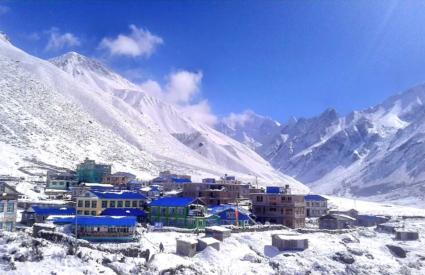
Transportation in Nepal will be one of the key parts of planning your trip to Nepal. Knowing the transport systems will ensure you are able to navigate the hustle and bustle of Kathmandu, the peaceful shores of Pokhara, the wildlife safari in Chitwan, and even the Everest Base Camp trek.
The beautiful geography of Nepal is both a blessing and a challenge for travel and transport in Nepal. is a relatively small country of great extremes in geography. In Nepal, you will find the flat Terai plains in the south as well as the highest peaks in the world in the north. This extreme variation in the terrain creates both a transport challenge and a transport marvel. Once you hit the main highways, many of the big cities are connected. In the mountains, the only means of transport are the many domestic flights to the airstrips and the trekking trails.
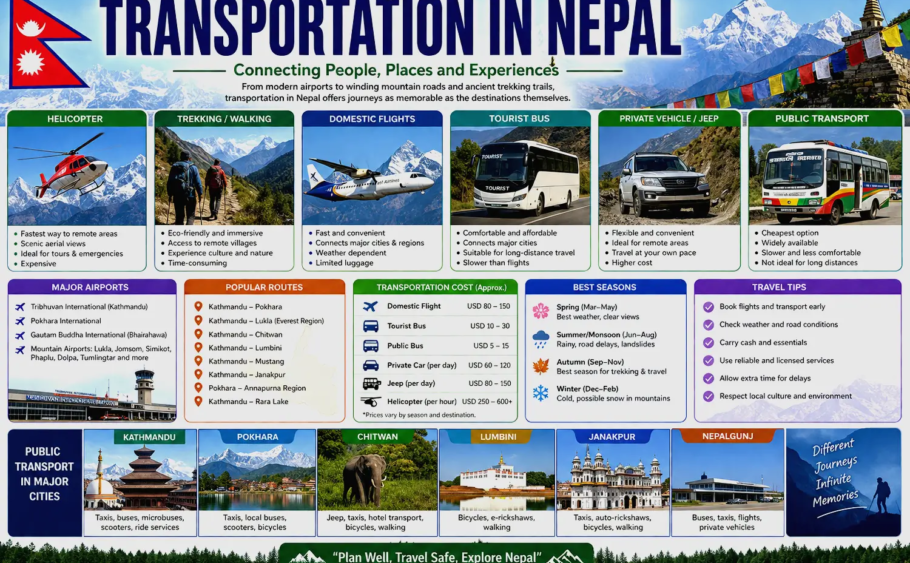
There are many transport options for the traveller depending on location, budget and style. For travelling to the mountains, many domestic flights are available. Nepal has a good system of tourist buses that are both affordable and comfortable for travel to popular destinations. For families and small groups, jeeps and cars are more flexible and convenient. The cheapest travel option is public buses. For the high Himalayas, trekking is the only means of travel.
Transportation systems in Nepal have greatly improved. Newer airports and an expanded highway network, plus more domestic flights and luxury tourist buses, make visiting easier than before. Travellers should still consider weather and construction delays, as well as landslides during the monsoon or heavy traffic into Kathmandu. Make sure to plan for flexibility.
An understanding of transportation systems in Nepal helps you maximize your time in this beautiful country, whether it’s your first visit or a return. Being able to change your plans is a critical part of travel in Nepal.
Why is transportation in Nepal unique?
Nepal’s unique geography adds much variety to the country’s transportation system compared to most countries in the world. From the Terai plains to the hills and mountain ranges of the Himalayas, there is a huge shift in elevation in a very short span. This incentivises the integration of road systems and air travel in addition to the more conventional trekking routes.
This worldview is not without its more logistical concerns. The road systems in Nepal connect most of the major cities; however, many of the more renowned trekking routes, such as those of Everest, Kanchenjunga, and parts of Manaslu, among others, remain largely undeveloped and/or inaccessible by conventional road means. This necessitates the use of a domestic flight to reach more remote parts of the trekking route, which is then connected via a mountain trail.
Nepal offers what are perhaps the most scenic flights in the world. The air travel routes offer vistas of the more inaccessible and less travelled parts of the country, which include the mountains as well as the alpine villages of the air travel routes. The flights to the trekking routes such as Dolpa and Simikot, among others, are as much a destination as they are a means of transportation.
Road journeys through Nepal are unlike any others. Most mountain highways hug river valleys, travel up steep hills, and go through traditional villages, forests, farms, and incredible mountain scenery. Travellers can expect a long journey due to the poor, winding roads, but the changing scenery is so beautiful that the journey is just as fun as arriving at the final destination.
Most mountain regions have no roads at all. This is where trekking as a form of transportation is important in Nepal. Residents and trekkers utilize paths that have existed and connected villages for hundreds of years. Porters, mules, horses, and yaks are used to transport goods.
In Nepal, there is an obvious and sustained effort to modernize and improve transportation infrastructure. New airports, improved roads, highways, tunnels, electric transportation, and newer road systems help boost the local economy and tourism. In the more remote areas of Nepal, continual travel flexibility is important due to the possible disruptions of winter and monsoons on transportation systems (especially road and air travel) that have been modernized.
Travelling in Nepal is not just about the movement from one destination to another. It is easy to see incredible natural and cultural diversity and experience Nepalese hospitality along the way. Travelling to Everest, whether by air, road, or foot, is just as rewarding as whatever awaits you at the end. Driving the roads through the beautiful mountain valleys, taking the ancient Himalayan trails, or using the air transport along the Everest air routes is rewarding in its own way.
Transportation Options in Nepal
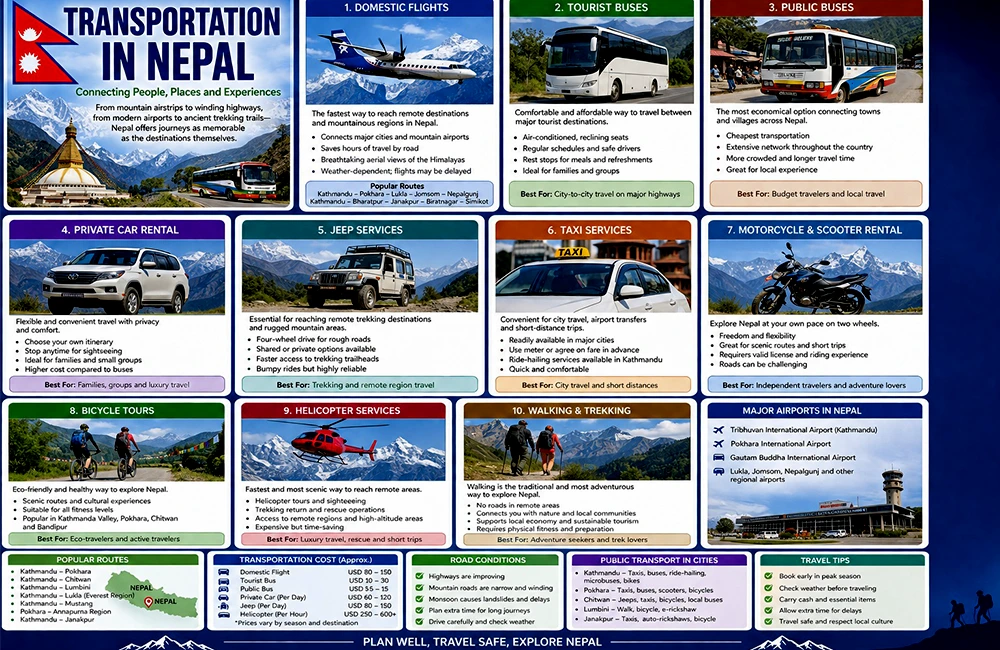
With urban areas, remote villages, and vast regions of the Himalayan Mountains, Nepal’s design facilitates a variety of transportation options for different types of journeys. A single mode of transportation is insufficient for getting to all destinations. Most travelers combine buses, private vehicles, and jeeps with the most common and useful method of transportation for reaching the most remote areas, trekking.
Most transportation is convenient and easily accessible for travellers to Nepal’s most visited destinations. There are comfortable tourist buses connecting the most popular travel locations of Kathmandu, Pokhara, Chitwan, and Lumbini. The domestic airlines reach the more remote areas faster than the several days of travel required by road. The more convenient and flexible option is the private vehicle with a local driver, which allows for travel at the same pace and provides the opportunity to stop at all the scenic locations along the way.
Tourists who want to travel to the more remote trekking areas of Nepal rely on even greater transportation, four wheel drive jeeps, to reach the ends of the remote trails. Beyond the ends of the roads, trekking is the only means of transportation. Besides being necessary, trekking through the forests, along suspension bridges, across the alpine meadows, and stopping in the traditional villages is a highlight of the trip to Nepal.
For short-distance travel within cities, there are easy to use options of taxis, ride-sharing, motorcycles, and even bicycles. For luxury travellers, or more conveniently, helicopter services support quick travel to remote destinations along with beautiful sightseeing flights with the added benefit of emergency evacuation needs.
The optimal mode of transportation will consider your itinerary, season of travel, budget and time flexibility, and comfort preference. Knowing the pros and cons of transportation will lead to better planning for your travel experience in Nepal.
Domestic Flights in Nepal
Especially for travel to the remote mountain regions, domestic flights are the fastest, safest, and most convenient mode of travel and transportation in Nepal. Road travel is unsafe and, in many instances, impractical due to the rough and rugged terrain of the Himalayas. In this regard, domestic airlines are essential in connecting the major cities and communities.
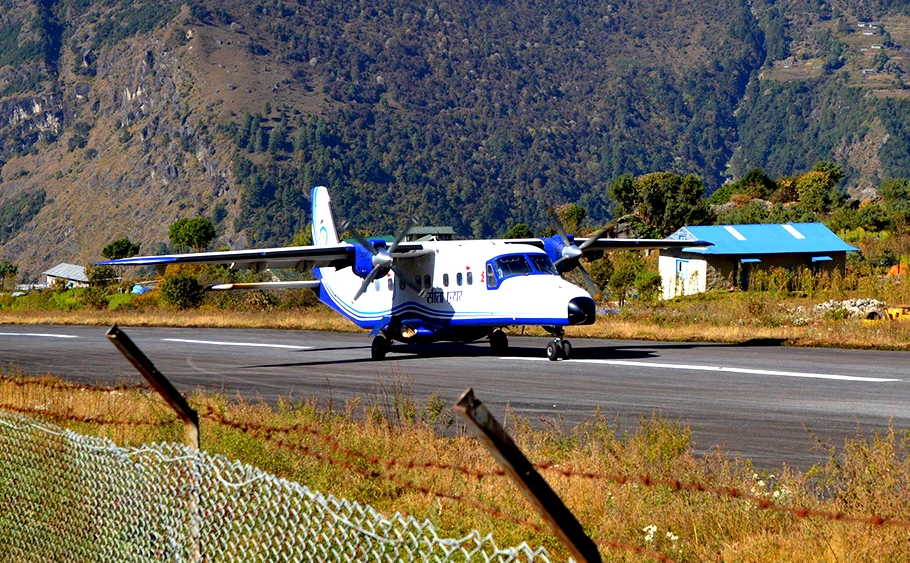
Though there are more than thirty domestic airports in Nepal, Kathmandu is the focal point of the domestic airlines. Flights are available to some major cities like Pokhara, Bharatpur, Biratnagar, and Nepalgunj or some remote areas like Lukla, Jomsom, Simikot, and Dolpa from Tribhuvan International Airport. Domestic airlines may operate these flights daily; however, the operating schedule is dependent on the weather and on the seasonal fare demand.
Domestic flights may often save the traveller several days of travel. As an example, the flight to Lukla is the fastest mode of travel to the Everest region, and takes approximately thirty to thirty-five minutes. Similarly, Jomsom flights serve the Annapurna and Mustang regions, and Nepalgunj flights connect the remoteness in the west of Nepal.
Flights may take a few minutes to a number of hours, but the scenic views of the Himalayas are one of the most appealing aspects of flying in Nepal. Passengers may see Mount Everest on flights that operate in clear weather, and the view of the other major peaks of the Himalayas is breathtaking. The mountain views, even for a few minutes, are an incredible experience.
Weather has a major influence on domestic flights. For example, flights to mountain airports require a minimum level of visibility and light winds, resulting in delays and cancellations, especially during the monsoon season (June to August) and winter (December to February). It is recommended that travellers include extra buffer days in their schedule, as the flights can be disrupted.
During the peak trekking season in the spring (March to May) and autumn (September to November), there is so much air traffic that flights to Lukla leave from Manthali Airport in Ramechhap, rather than the main airport in Kathmandu. This requires an additional four to five hours of travel before the flight.
Travellers who wish to travel to the most scenic and remote locations efficiently and make the most of their time should use domestic flights.
Advantages of Domestic Flights
The fastest way to travel in Nepal.
Access to the remote regions of the Himalayas.
Saves time compared to road travel.
The aerial views are amazing.
Great for travellers and trekkers.
Disadvantages
Flight cancellations and delays due to weather.
Cost of flights is greater than that of road travel.
Baggage restrictions.
Few flights to some destinations.
Tourist Buses in Nepal
Among the many modes of transport that help move tourists to the various major tourist spots in Nepal, tourist buses are one of the most popularly used. These buses are preferred for their reliability as well as comfort, affordability, and the ability to sightsee Nepal’s luscious landscape.
Compared to the buses used by residents, tourist buses include the amenities needed most by a traveller. These buses tend to have spacious, reclining, air-conditioned seats with good drivers. Added to this, the departure time and destination for most of these buses are predetermined. Furthermore, many of these buses provide free, packaged water, Wi-Fi (only on some), charging ports and make frequent stops to allow the tourists to eat and grab a bite to satisfy their hunger.
The most popular tourist bus routes include
From Kathmandu to Pokhara
From Kathmandu to Chitwan (Sauraha)
From Kathmandu to Lumbini
From Pokhara to Chitwan
From Pokhara to Kathmandu
From Kathmandu to Solu (Salleri, Phaplu)
From Kathmandu to Okhaldung
Some routes will take longer due to traffic and adverse weather conditions. The route from Kathmandu to Pokhara takes 7-9 hours, which many find long. Many find it worthwhile to view the rural villages and the terraced hills and other landscapes.
In the last couple of years, people have become more interested in VIP and luxury bus travel. These have a more comfortable long-distance travel style and have larger legroom, sofa seating, fewer people, and even entertainment.
The needs of both backpackers and families influence design. Comfort and cost-effectiveness are balanced.
Advantages of taking a tourist bus
Comfortable seating.
Affordable prices.
Daily departures.
Safe and reliable.
Beautiful scenic views.
Disadvantages
Longer travel times.
Traffic congestion near cities.
Construction of the road can result in delays.
Public Transportation in Nepal
One key reason public transportation is so vital in Nepal is that it is the main means of interconnecting villages and towns throughout the country. It is popular among tourists who want to experience the culture of Nepal and, at the same time, a wonderful way to keep the budget in check.
Public transportation in Nepal covers a lot of ground, no matter how big or small. Travelling by bus can be inexpensive, but it can be crowded, especially on the weekend and public or religious holidays. The number of passengers can affect the length of the trip because of the many stops the bus is forced to make to pick up and drop off passengers.
If you are a tourist who wants to travel somewhere a little off the beaten path, public transportation can be the only way to access that region, especially if there is no designated tourist bus to that area.
For tourists who are not familiar, public transportation can be a unique way to mix with the residents of Nepal, but if you are carrying valuables or want to be more comfortable, you may want to consider a tourist bus or a private vehicle.
Advantages of Public Transportation in Nepal
The least expensive means of transport
Coverage of the country-wide.
Services are frequent.
Local culture.
Disadvantages
Can be cramped.
Limited luggage space.
Lengthier trips.
Less comfortable than a tourist bus.
Private Car Rental in Nepal
Travelling via a hired private vehicle is the easiest and most flexible means of travelling in Nepal. A private car hired with an experienced local driver is a popular choice since this saves the traveller from the burden of worrying about navigation, road conditions, or traffic while giving the traveller the desire for a personalized itinerary.
Private transportation is preferred by families, honeymooners, photographers, business people, and small groups. Private means of transportation make travelling more convenient and offer more privacy, and give the traveller control to stop the vehicle for sightseeing, photography, meals, or breaks compared to the forced stops done by scheduled buses.
There are a variety of transportation means ranging from sedans to SUVs and luxury vehicles as well as Toyota Hiace vans, minibuses and coaches based on the travelling group.
Compared to public means of transportation, private vehicles are more costly, but many travellers are willing to spend more due to the time and flexibility savings afforded.
Advantages of a Private Car
Flexible itinerary.
Comfortable travel.
Professional local drivers.
Ideal for families and groups.
Door-to-door service.
Disadvantages
Higher transportation costs.
Less economical for solo travellers.
Jeep Services in Nepal
Jeeps are the most effective means of travelling to reach the remote and rugged areas of rural and mountain Nepal. Where road conditions are rough, steep, and unpaved, jeeps are the safest and most practical means of transportation.
Private and shared jeeps are easily available for the many travel routes that lead to the most popular trekking trailheads such as Salleri, Syabrubesi, Besisahar, Chame, Dharapani, Jomsom, Muktinath, and Upper Mustang. These jeeps are able to effectively bring people to areas that travel used to require long days of trekking to reach.
Despite rocky roads, jeep rides can be an enjoyable experience that weaves through picturesque valleys, rivers, waterfalls, and forests as well as local Himalayan villages. They are an experience in and of themselves.
Private jeeps are the most comfortable option and the most flexible, while shared transportation is better for those handling a tighter budget.
Advantages of Jeep Services
Access to remote destinations.
Faster than trekking long approach routes.
Suitable for mountain roads.
Flexible for group travel.
Disadvantages
Rough and bumpy rides.
Road conditions can be affected by the weather.
The price of private hire is going up.
Taxi Services in Nepal
In Nepal, you can find taxis in almost all major cities like Kathmandu, Pokhara and Bharatpur. Taxis are convenient for going to the airport, hotel pick up and drop off, going on a city tour, shopping and for short-distance travel.
Travellers should request that the drivers turn on the meter. If for any reason a meter taxi is not available, negotiate a price before you start the journey. Larger cities have a ride-sharing option, which is another great way to get around the city.
For those who do not want to deal with the crowds and discomfort of public transport, taxis are a good option.
Motorcycle and Scooter Rental
Travellers looking for an independent and flexible option for exploring the Kathmandu Valley and Pokhara tend to rent scooters and motorcycles. This is a great way to discover the hidden and less travelled routes.
The roads in Nepal tend to be busy and more on the challenging side. You will need to be more confident if you choose to operate a bike here. Helmets are a must, as are the local rules of the road.
Renting a motorcycle in Nepal is a great option for those who want to take a day trip to Nagarkot, Bandipur, Dhulikhel and the outlying areas of Pokhara.
Bicycle and Mountain Bike Tours
Cycling is another eco-friendly and popular way to get around Nepal. If you want to explore the cities and villages of Kathmandu Valley, Pokhara, Bandipur, Lumbini and Chitwan, all the way to the quiet and scenic countryside, they have great cycling routes.
For the rugby types, Nepal is a destination for mountain biking. It has some of the best trails in Asia that are not only challenging but also provide jaw dropping views of the Himalayas.
There are various tour companies that plan guided cycling trips and provide quality mountain bike rentals in Nepal. This allows travellers at all levels the wonderful opportunity to enjoy cycling in Nepal.
Helicopter Systems and Trekking Transportation in Nepal
Helicopter Services in Nepal
Helicopter systems are a crucial portion of the transport system in Nepal, especially in the Himalayan region, where accessibility by road is difficult or impossible. Although helicopters are typically used for emergency rescues, they are a frequent means of travel for luxury travel, sightseeing, as well as the return trek and expeditions. For those who are time limited or for those who want to have a different experience of Nepal’s scenic views, helicopter travel is an option for a later travel experience.
Most of the travel time and safety constraints involved in accessing the remote mountain regions is greatly reduced with the option of helicopter transport. Villages located in the regions of Everest, Annapurna, Langtang, Manaslu, Dolpo and Mustang may be reached with the aid of helicopter transport within a few hours. This is better than the many days of an exhausting trek that could have been used to reach these areas.
Helicopter travel offers an excellent option to those who want to witness first-hand the scenic views of the highest peaks in the world. The trek to see Everest Base Camp by helicopter is one of the most preferred excursions in Nepal. It offers spectacular views of not only Everest, but also Lhotse, Nuptse, Ama Dablam, and the Khumbu Glacier. Many of the available tours even have the option of landing at Base Camp or Kala Patthar, followed by breakfast at the Everest View Hotel.
Beyond the traditional sightseeing activities which utilize helicopters, they also have an essential role in high-altitude trekking and mountaineering. Many trekkers use helicopter transport to return after completing long treks, including the Everest Base Camp and the Annapurna Circuit. It is a much faster return that saves days of trekking and provides stunning views of the mountains.
Helicopters also serve a vital role in emergency evacuations for trekking related medical issues. Services are often needed for altitude sickness and injuries in the backcountry. Helicopter services will transport trekkers to a medical facility in either Kathmandu or Pokhara. Because of this, it is advised to have travel insurance that covers high-altitude helicopter evacuation for trekking in Nepal.
Helicopter transport services have a higher cost compared to other transportation in Nepal, but they also have a value that cannot be compared to other services of their kind. There are a number of locations in Nepal that are highly sought after and can only be accessed by helicopter services.
Walking or trekking is an important part of life in many areas of Nepal, particularly in the Himalayas. Millions of remote village inhabitants have for centuries used footpaths and trails to travel between communities and to take goods to/from the village, to school, to markets, and to facilities for health care.
For travellers, trekking is a great means of exploring the sights and scenes of Nepal. Popular trekking routes include the Everest Base Camp Trek, Annapurna Circuit, Langtang Valley Trek, Manaslu Circuit Trek, Upper Mustang Trek, and Kanchenjunga Trek. Each of these routes begins where the road ends.
When trekking, hikers encounter and cross many features of Nepal, including woods, alpine meadows, suspension bridges, glacial rivers and high mountain passes. While trekking, hikers stay in local tea houses and gain valuable and unique information about the lifestyles and customs of the more than 100 ethnic groups in Nepal.
Horses, mules, donkeys, yaks and porters transport goods in many remote areas. These traditional means of transport are very important to support the local economy and supply businesses and lodges in the mountains with food and equipment. Many villages are still not accessible by road.
In Nepal, walking is a great way to appreciate the fine hospitality, culture and natural beauty of the country as well as reach a destination.
Benefits of Trekking Transportation
Environmentally friendly.
Immersive cultural experience.
Access to remote villages in the Himalayas.
Stunning mountain scenery.
Promotes sustainable tourism.
Major Airports in Nepal
With its blend of urban and rural geography and topography comprising primarily of mountains, Air travel in Nepal is an incredibly useful way to travel. There is only one international airport in Nepal, two newly constructed international airports, and several domestic airports. All of these serve trade, tourism and transport.
Tribhuvan International Airport (Kathmandu)
Tribhuvan International Airport serves Kathmandu, the capital of Nepal, and is the busiest airport in Nepal. It is both the main and only international gateway. It is the only airport hub for all domestic flights. From Kathmandu, you can take a flight to virtually all major cities. These include Lukla, Pokhara, Bharatpur, Nepalgunj, Janakpur, Jomsom, Simikot and Dolpa.
Pokhara International Airport
One of the most popular cities in Nepal, Pokhara has a good tourist infrastructure and is now more accessible with the newly constructed Pokhara International Airport. It has both domestic and some international flights and is a gateway to the Annapurna region and all the treks that begin in that area. These include the Annapurna Base Camp, Poon Hill, Mardi Himal, and the Annapurna Circuit.
Gautam Buddha International Airport
Gautam Buddha International Airport, located in Bhairahawa in western Nepal near Lumbini, the birthplace of the Buddha, enhances international travel to and from Nepal and especially simplifies access to Lumbini. It serves pilgrims and tourists.
Mountain Airports
There are many famous mountain airports in Nepal, giving access to remote trekking areas. These have spectacular surroundings, but are known for their difficult landing situations.
The most famous mountain airports include
Lukla (EVEREST)
Jomsom (Mustang and Muktinath)
Simikot (Humla)
Dolpa
Phaplu
Tumlingtar
These are important for trekking and mountaineering, and also for the local communities and emergency services.
Popular Transportation routes in Nepal
Nepal’s transport networks connect all major cities, most cultural sites and significant wildlife and trekking locations. The transport method can be selected based on many criteria, including location, budget, availability and preference.
Pokhara from Kathmandu
Taking a trip on the Kathmandu to Pokhara route is the most popular journey in Nepal. The options for travellers include flights, tourist and public buses or the use of a private vehicle.
Domestic flights save a significant amount of travel time as the flight is only 25 to 30 minutes. The use of a tourist bus on this route can take 7 to 9 hours, while the use of a private vehicle is more flexible and comfortable. This journey offers travellers the opportunity to see rivers and terraced fields along with traditional villages and views of Himalayan peaks in the distance.
Chitwan from Kathmandu
Chitwan National Park is a popular wildlife destination in Nepal. The park can be reached with a flight to Bharatpur Airport, a tourist bus or the use of a private vehicle.
The flight takes 20 to 25 minutes, while travel by road takes 5 to 7 hours. Chitwan offers travellers jungle safaris, canoe rides and birdwatching, and the opportunity to see one-horned rhinoceroses and Bengal tigers.
Lumbini from Kathmandu
Access to Lumbini, the birthplace of Lord Buddha and a UNESCO World Heritage Site, is by a domestic flight to Bhairahawa or a journey by road.
Flights take 35 to 40 minutes, while both the tourist bus and a private vehicle take 8 to 10 hours. This journey takes travellers along hilly terrain before descending to the fertile plains in southern Nepal.
Kathmandu to Everest Region (Lukla)
Most trekkers fly from Kathmandu to Lukla and then begin their Everest Base Camp Trek. This flight is one of the most beautiful flights in the world, taking about 30 to 35 minutes. During peak season, trekkers may fly from Manthali to Lukla.
An alternate route to Everest Base Camp is to drive to Salleri or Phaplu and trek to Lukla from there. This option does add many days to your trek, but it lessens dependency on flights.
Kathmandu to Mustang
From Kathmandu, it is common to fly or drive to Pokhara, and then travel to Jomsom via flight, jeep, or motorcycle. The adventurous option is to drive the jeep through the gorge of Kali Gandaki, while the more convenient and fastest method is to fly.
Pokhara to Annapurna Region
From Pokhara, it is common to travel via private vehicle or jeep to trailheads, such as Nayapul, Kande, Ghandruk, Phedi, or Jhinu Danda, and then begin the trek.
Kathmandu to Janakpur
Janakpur is the birthplace of Goddess Sita, and it can be reached from Kathmandu in about 30 minutes via a domestic flight or by road in about 7 to 8 hours. Janakpur is a significant pilgrimage site that attracts thousands of Hindus year round, especially during the festival of Vivah Panchami and Ram Navami.
Kathmandu to Rara Lake
Rara Lake is one of the most secluded spots in Nepal, and it contains the largest lake in the entire country. The common method of travel is to fly to Nepalgunj and then fly to Talcha Airport. From there, you will have to trek or drive the rest of the journey. Even with the complex travel itinerary, visitors have the opportunity to enjoy untouched natural scenery and tranquillity.
Transportation for Trekking Destinations, Transportation Costs, Road Conditions, Public Transportation in Major Cities
Transportation for Trekking Destinations
Getting to some of Nepal’s most popular trekking areas may take multiple flights, driving, and walking. Some trekking routes start close to the main highways, while others are deep in the Himalayas and can only be accessed by domestic flights or multi-day drives. When deciding the best means of transport, consider the itinerary, budget, and how much time you have, along with what season of the year you will be travelling. Knowing how to get to each trekking location will help you plan the most efficient and enjoyable trip.
Everest Base Camp Trek
The trek to Everest Base Camp starts with one of the world’s most beautiful mountain flights to Lukla. During the busy trekking season in spring (March – May) and autumn (September – November), most flights to Lukla leave from Manthali Airport in Ramechhap because of the traffic congestion in Kathmandu’s domestic airport. The journey to Manthali takes about 4 – 5 hours and is followed by a 20 – 25 minute flight to Lukla.
For the rest of the year, flights go directly from Kathmandu to Lukla. Once in Lukla, the trekking route to Everest Base Camp passes through the town of Phakding, Namche Bazaar, Tengboche, Dingboche, Lobuche and Gorakshep.
For those wishing to avoid cancelled flights, driving to Salleri or Phaplu is an option, but it will add a few more days to the itinerary. Helicopter returns from Gorakshep are a popular option for completing the trek, as it saves several days of walking.
The trek to Annapurna Base Camp starts in Pokhara. Travellers arrive in Pokhara via domestic flights, tourist buses, or private vehicles, where they continue on to the trailhead.
Private vehicles or jeeps transport trekkers to Nayapul, Jhinu Danda, Siwai, Ghandruk, or Kimche, depending on the itinerary. Recently made improvements on rural roads have allowed trekkers to shorten the distance they trek.
Annapurna is one of the most popular trekking destinations in Nepal. It has a well-developed road system that brings trekkers close to the trailheads.
Upper Dolpo is one of the more secluded areas of Nepal. Most trekkers leave Kathmandu to reach Nepalgunj by flight and then take a domestic flight to Juphal. From Juphal, the only way to progress is on foot.
Since the roads are not able to access the area, air transportation is the most viable option to reach this remarkable place.
Kanchenjunga Base Camp Trek
The Kanchenjunga region is one of the most isolated trekking regions in Nepal. Most itineraries include a flight from Kathmandu to either Bhadrapur or Suketar followed by several hours of driving to reach the start of the trek.
It takes more planning to reach Upper Dolpo because of its remote location, but trekkers are rewarded with stunning views, fewer travellers, and an untainted representation of Himalayan culture.
The Upper Mustang Trek combines road travel with trekking. The first leg of the journey is to Pokhara and then on to Jomsom either by flight or jeep. This is the start of the trek.
Those with less time will often use jeep transport for sections of the route. Others will complete the route by trekking for a more immersive cultural experience.
Manaslu Circuit Trek
To get to the start of the Manaslu Circuit Trek, trekkers travel by road to Machha Khola or Soti Khola.
Recent improvements to the access roads have made the Manaslu region much more accessible and easier to visit. The Manaslu region does not escape the mountain road difficulties experienced during the monsoon.
The trek around the Annapurna Circuit has seen the most changes due to roads and expansion. Most trekkers travel from Kathmandu or Pokhara to Besisahar by local bus or jeep. From Besisahar, most continue via four-wheel-drive jeep to Chame or Upper Pisang, where the trek starts.
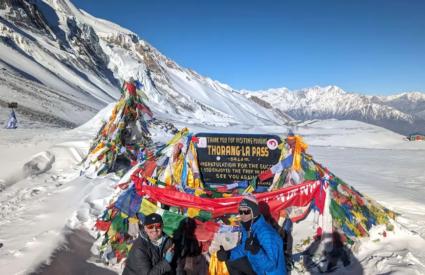
After traversing Thorong La Pass, most trekkers end their trek in Muktinath. From Muktinath, most trekkers choose to travel to Pokhara via the Jomsom route. And trek to ghorepani poon hill. A combination of trekking, jeeping, and domestic flights allows trekkers to choose their own adventure.
Of all the trekking routes in the Himalaya, the Langtang Valley Trek is one of the easiest to get to from Kathmandu. Trekkers leave Kathmandu and travel between 7 to 9 hours by local bus, tourist jeep, or private vehicle to Syabrubesi, the start of the trek.
There are no domestic flights to the start of the Langtang Valley. The road journey passes through beautiful hills, rivers, and traditional villages and then into Langtang National Park.
The cost of transportation in Nepal is affected by the destination, season, and even the mode of transport. The cheapest way to get around for budget travellers is public buses. For travellers wanting comfort, they will usually opt for private vehicles and domestic flights.
Some of the transportation costs usually incurred by travellers are described below.
Domestic Flights
For long-distance travel and travel to the mountainous regions of Nepal, domestic flights are the best way to save time. The cost of flights is usually determined by demand, the weather, and the time of booking.
Tourist Buses
Tourist buses make affordable and comfortable travel between the major cities of Nepal. For more comfort and more amenities, travellers may opt for a Luxury or VIP service.
Public Buses
Public buses are the most affordable option for transport and connect almost every district of Nepal. These buses do take more travel time, which is ok for budget travellers.
Private Cars
Private vehicles give the traveller the most comfort and a flexible travel experience. The cost usually is determined by the type of vehicle, how far they are going, and how long they will be gone.
Private Jeeps
For transport to more remote areas and trailheads for trekking, the most commonly hired vehicles are four-wheel drives. There are shared jeep services to make this even more affordable.
Helicopter Services
The fastest, most convenient transport to the most remote areas of Nepal is helicopter services. This is the most expensive form of transport and is determined by how long the flight is and the destination of the flight. These services can be personalized or chartered.
Given the variability of the costs of transportation in Nepal, the best way to save costs with the best travel experience is to book in advance. This is especially important in the peak trekking seasons of autumn and spring when the costs are the highest.
Sustainable Transportation and Eco-Friendly Practices in Nepal
With the increase in tourism, Nepal has found a bigger need for sustainable and eco-minded transport systems. Eco-minded transport options help travellers to Nepal preserve the natural beauty and landscape that the country has to offer.
Walking and trekking are by far the best transport options when it comes to caring for the environment. Several trekking routes are free of motorised transport and help minimize the traveller’s impact on the surrounding environment.
Cycling is gaining popularity in places like Kathmandu Valley, Pokhara, Bandipur, and Lumbini. Guided cycle tours are also eco-minded and promote a healthier lifestyle as opposed to motorized transport.
There are more choices for transportation in Nepal. Kathmandu Valley is being introduced to electric buses, cars and taxis. This is helping the valley reduce air pollution and conserve fuel.
Make use of public transport when possible.
Walk or cycle to your destination when possible.
Use a form of transport that is close and local to you.
Keep natural and preserved areas safe and not disturbed.
Minimise plastic waste during a trip.
Nepal’s mountainous ecosystems are fragile, and the right transport options help not only keep the environment safe, but also benefit local communities.
Transport Obstacles in Nepal
Several transport obstacles in Nepal have been caused by the developing state of the country’s infrastructure, coupled with Nepal’s unique geography.
The country’s transport system is in a particularly difficult state due to the mountainous geography. The steep, unstable state of some of the mountains makes the construction and maintenance of a road system very difficult, and increases the financial burden on the country’s transport system.
Monsoon rains pose a further disruption. The rains can trigger landslides that block the road system, and transportation in the higher elevations can also be disrupted by snow and fog.
While travel conditions in and around Kathmandu Valley can be aggravating for both locals and tourists alike, driving can become frustratingly slow due to ongoing construction on major highways.
Travelling to other regions in Nepal via air is very much at the mercy of the weather. Rain or snow can cause flight delays, while strong winds and visibility issues may even result in flight cancellations.
The good news is that the situation is gradually improving as the infrastructure of the roads and the buildings of the airports are modernizing and expanding and the services are being modernized along with the roads.
The Future of Transportation in Nepal
Over the next several years, Nepal plans to allocate a significant portion of its budget toward the improvement, modernisation, and expansion of its transportation systems to both increase and facilitate Nepal’s tourism while improving Nepal’s economy.
Several major expansions of the highways are already in progress to improve access from Kathmandu to Pokhara, Chitwan, and Lumbini to the east. Safety of the roads and ease of travel are the focus.
There are plans for new expressways and tunnels to further facilitate and accelerate travel. Additionally, the Kathmandu-Terai Expressway is under construction and, when completed, will shorten travel to Southern Nepal.
Both accessibility and reliability of domestic air travel are being improved through upgrades of regional airports and the advancement of Nepal’s aviation infrastructure.
To achieve cleaner transport, the objective focuses on electric buses, taxis and charging infrastructure to reduce emissions.
Modernisation of the transportation system in Nepal will be more efficient and less polluting to the environment.
Helpful Travelling Tips
There are ways to make travelling in Nepal easier if you plan for your transportation. Here are some tips that may help
Flights between the cities should be booked as soon as possible during the spring and autumn.
It is a good idea to plan for one or two extra days in your schedule for possible weather delays.
Bring cash. Many of the places that are further out have no way of making electronic payments.
For a more comfortable travel option, use tourist buses or hire a private vehicle.
Driving in the mountains can be tricky. Using skilled drivers for these roads is advisable.
Pack important medicine as well as food and water, and clothing appropriate for the weather for long trips.
If trekking the Himalayas, buy travel insurance for high-altitude trekking and helicopter evacuation.
Before travelling to the mountains, check the forecast.
Always follow the rules for transportation in the area you are in.
Having transportation helps you enjoy travelling instead of being a burden.
I am the Founder and Owner of Hill Sherpa Trekking Pvt. Ltd. With more than 15 years of experience in the Himalayan tourism and mountaineering industry, I established the company with a passion for mountain adventures and a commitment to responsible tourism. Since then, I have dedicated my career to creating safe, authentic, and unforgettable trekking and climbing experiences throughout the Himalayas.





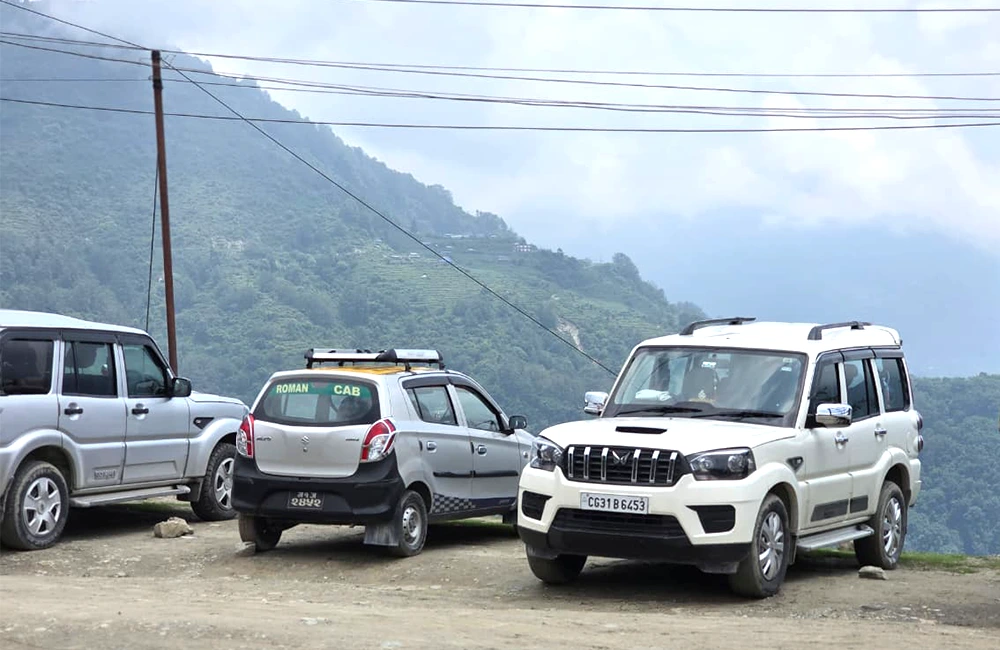
 Road journeys through Nepal are unlike any others. Most mountain highways hug river valleys, travel up steep hills, and go through traditional villages, forests, farms, and incredible mountain scenery. Travellers can expect a long journey due to the poor, winding roads, but the changing scenery is so beautiful that the journey is just as fun as arriving at the final destination.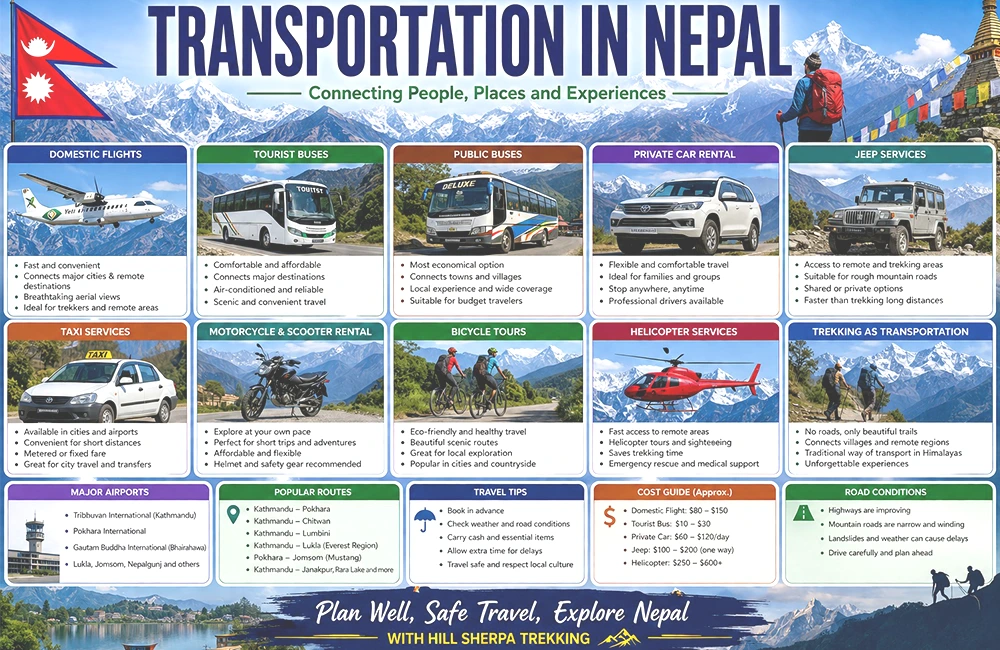
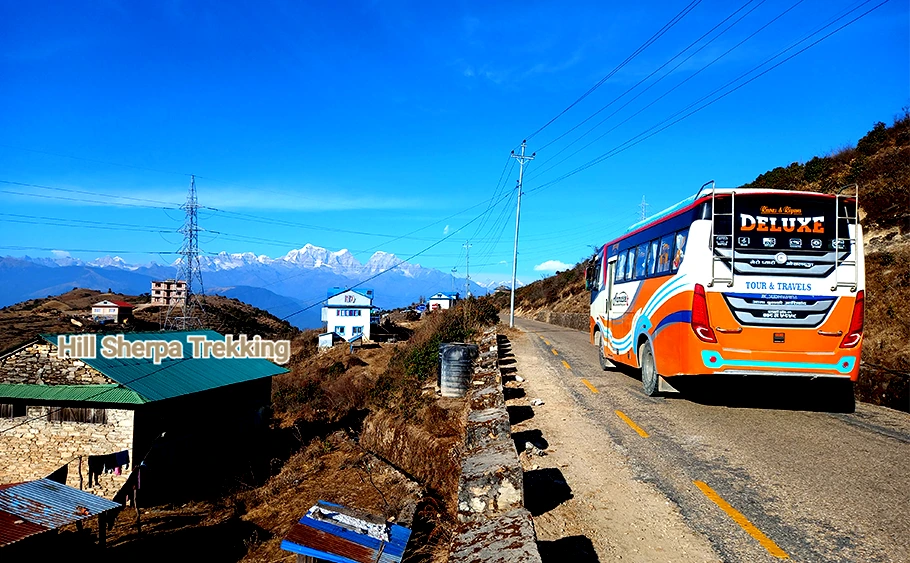 Among the many modes of transport that help move tourists to the various major tourist spots in Nepal, tourist buses are one of the most popularly used. These buses are preferred for their reliability as well as comfort, affordability, and the ability to sightsee Nepal’s luscious landscape.
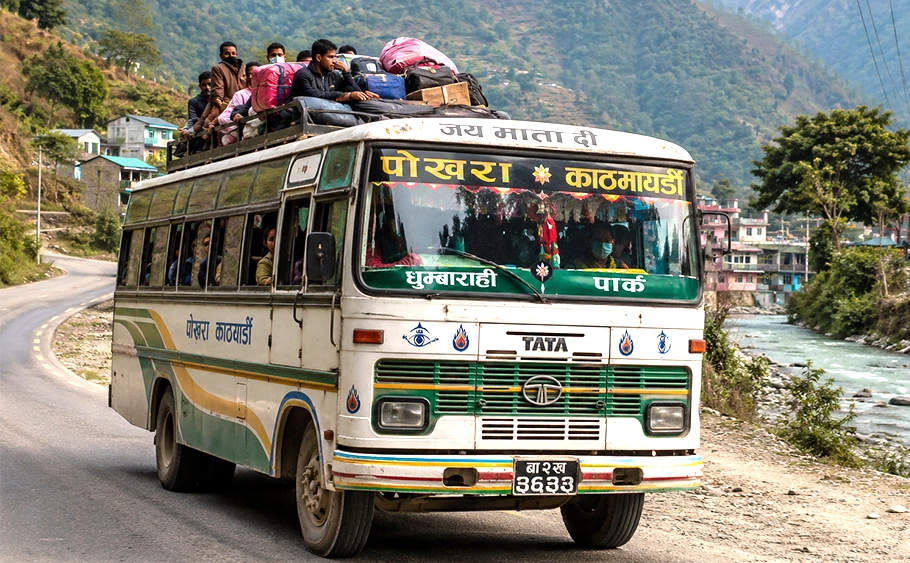 One key reason public transportation is so vital in Nepal is that it is the main means of interconnecting villages and towns throughout the country. It is popular among tourists who want to experience the culture of Nepal and, at the same time, a wonderful way to keep the budget in check.
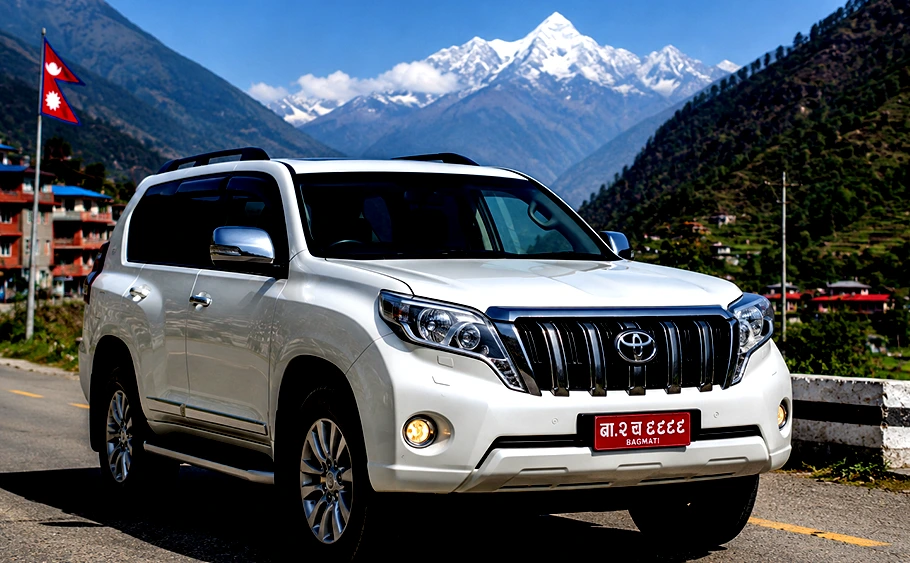 Travelling via a hired private vehicle is the easiest and most flexible means of travelling in Nepal. A private car hired with an experienced local driver is a popular choice since this saves the traveller from the burden of worrying about navigation, road conditions, or traffic while giving the traveller the desire for a personalized itinerary.
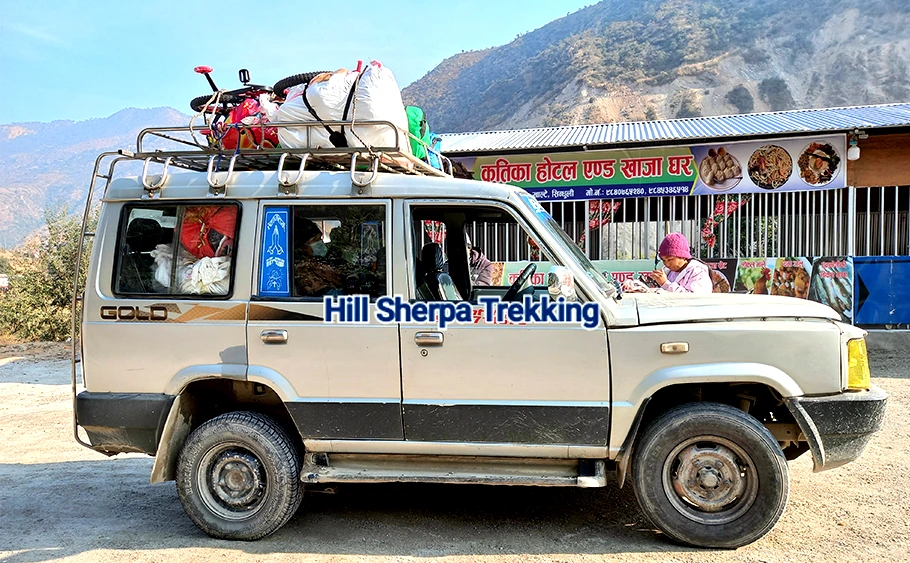 Jeeps are the most effective means of travelling to reach the remote and rugged areas of rural and mountain Nepal. Where road conditions are rough, steep, and unpaved, jeeps are the safest and most practical means of transportation.