Nepal is the land of breathtaking landscapes, as it extends to the towering Himalayas and the fertile lowland jungles with its natural beauty and rich culture. Nepal is a country that welcomes tourists to come and experience its beauty and its rich culture.It is essential, regardless of whether you are in Kathmandu winding through ancient alleys, engaging in distant trekking activities or just absorbing the bustling life of local marketplaces, because having your mobile phone connect well is paramount.This guide offers the necessary information on how to get a SIM Card in Nepal and so you will not have difficulty being connected to the outside world at a relatively low cost when you travel to Nepal.Whether it is the selection of the appropriate provider or acquiring and enabling your SIM card to be used, this article will guide you to ensure you stay in touch during your travel to Nepal.
Key Takeaways
SIM Options: Select a prepaid, postpaid, or data only SIM depending on your requirements.Purchase
Locations: The product is stocked in the airport, official network stores and authorized retailers.
Necessary Documents: Carry a copy of your passport, photograph, address evidence and visa or entry
Activation Procedures: Choose a provider, purchase the SIM, complete a form, pay and activate
in-store.Cost Efficiency: SIM cards are priced at NPR 100-200 and the data package is as cheap as NPR
50.eSIM Option: It can be used with other compatible devices offered by Ncell and Nepal Telecom.
Short-term Lot Savings: Purchase here and now to stay connected and convenient.Knowledge on SIM Card alternatives in Nepal.Travelling through the Nepalese mobile environment would imply that one knows the kind of different SIM card plans, inclusive of the options.Now, we will go into details.
Understanding SIM Card Options in Nepal
Navigating the mobile landscape in Nepal means understanding the various available SIM card options. Let’s delve into the specifics:
Prepaid SIM Cards
Travellers frequenting Nepal highly prefer prepaid SIM cards mainly due to three advantages, they’re affordable, flexible, and easy to use. With prepaid SIM cards, you pay the amount you choose and your package comes with mobile data, calls, and texts. There are no contracts or monthly plans, so tourists who plan on a short visit find these especially convenient. Tourists can conveniently recharge their prepaid SIM cards in the many local shops that sell them or they can pay online through the many local online payment platforms and even the telecom service centres.
Postpaid SIM Cards
With a postpaid SIM card, you pay for your mobile services after your billing cycle. Unlike the prepaid plans, postpaid SIM cards are billed monthly, and charges are based on how much you use these services. Postpaid connections also tend to have a bigger data plan and come with other benefits, but to get a postpaid plan, you have to show proof of identity, a local address, or proof of residency, which means that these plans are mostly for business people, residents or other long term visitors.
Data only SIM cards
Travel SIM cards that are designed for people who specifically want data to use online services rather than make calls are called data-only SIMs. These SIM cards come with a data plan that is large and generous. These types of SIM cards are great for travellers who love using apps such as Facebook or Instagram, for video calls while they travel, or for email and other services. These SIMs are also wonderful for travellers who use navigation apps as they travel through Nepal.
eSIM Technology
All eSIM-compatible devices now include eSIM services from all major telecom networks in Nepal, including Ncell and Nepal Telecom (NTC). eSIM is the digital version of the SIM card that is embedded into the device (smartphone, smartwatch, tablet, etc.) so that the user does not have a physical SIM anymore. The user can digitally activate the mobile plan. This is especially useful for international travellers visiting Nepal as it makes the process faster and more convenient.
Benefits of eSIM
The convenience of eSIM is beyond the physical SIM purchase. The user does not have to visit a retail store to buy the physical SIM. eSIMs also make changes to mobile plans and mobile networks convenient because the user does not have to remove or change the SIM. The benefits of eSIM include more space on the device, multiple profiles per device, and better security because the user doesn’t carry an eSIM which can be lost or damaged.
Types of SIM Cards Available in Nepal
There are many types of SIM cards available in Nepal including prepaid, post-paid, eSIM, and data only. The two main telecoms in Nepal, Ncell and Nepal Telecom, have good coverage in all the major and most of the rural regions in Nepal. The proper SIM card choice in Nepal depends on the length of stay, data plan, travel itinerary, and device. Most tourists prefer the prepaid card alternative.
Nepal Telecom (NTC) Prepaid and Postpaid SIMs
As the largest telecommunications provider in Nepal, Nepal Telecom (NTC), as a government-owned company, provides international roaming service, mobile, and internet services. NTC’s SIM Cards come in prepaid and postpaid and they cover a large range of customers. They have different subscriptions for the internet, which can be purchased on a daily and monthly basis, thus making them a good option for a tourist. NTC has extensive coverage and as a result, is very instrumental for local and international communications in the remote areas of Nepal, as they have reliable and very competitive services.
Ncell – A Preferred Choice for Tourists and Locals
Ncell is one of the leading private telecom providers in Nepal and the company is known to provide a high-speed and reliable service since NTC. The coverage of this provider is strong 4G inside cities and major touristic sites. The services of Ncell consist of a range of prepaid and postpaid SIM cards, which are supplemented by both data-only and voice and data packages. Ncell SIM cards designed specifically to satisfy the requirements of tourists include packages that make life in Nepal enjoyable to them, as they seek to be in the country on a short-term basis. Ncell has wide coverage and speedy data services and therefore it is a choice for many.
Smart Cell – Affordable Data Plans
Though smaller and less reputable than NTC and Ncell, Smart Cell offers competitive mobile services, particularly to data-hungry users.It is mostly urbanized and has prepaid and data-only plans which makes it the best choice of city residents or visitors who will not travel far to more suburban areas.The outstanding feature of Smart Telecom is its affordability and it is particularly appropriate among travelers who want to enjoy an affordable mobile service when staying in key Nepalese cities.All of them have something to sell, NTC with its far spread and many plans, Ncell with its blistering speeds and tourist-friendly services and Smart Telecom with its affordable offerings.
Where to Buy a SIM Card in Nepal
When you land in Nepal, staying connected is a top priority. You have several straightforward and convenient options for buying a SIM card
At the Airport
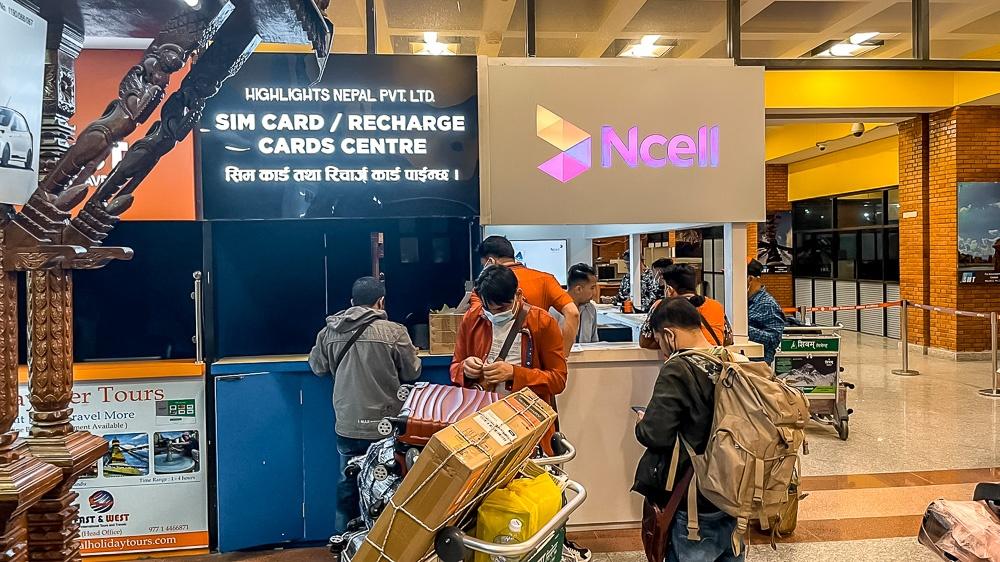
Location: When you enter the arrivals hall at the airport, look for the kiosks that are marked.
Available Providers:Ncell and Nepal Telecom are the two companies you’ll find here. These are two of the best service providers in Nepal, and you can expect their service to be reliable even in the remote areas of the country.
Process: These stalls are made for people like you. They are designed to set you up and have you registered so that you have a working phone you can use to leave the airport. The staff at these counters deal with international travellers and will have the best practices to set you up and to have your SIM activated in no time.
Tips: It is true that a SIM purchased at the airport will be more expensive than one purchased elsewhere in the city. But the peace of mind you have in getting set up and connected immediately is worth the extra money you paid.
Official Mobile Network Stores
What to Expect
This is likely a great example of a business that focuses on maximizing all aspects of customer service. These stores help you understand the various plans and services based on your estimated length of stay and the data you require. These stores can help you solve all of your problems and the staff will support your device and make sure your SIM is working.
The Benefits
You know you’re getting the right product and service directly from the provider, and it’s always the best place to go in case you have concerns with your product.
Authorized Retailers
Location: These are found in the cities (THAMEL)
Selection: These retailers sell SIM cards from different providers and can activate them.
Verification: Check that these shops are approved by the providers. Check that the shops carry the providers’ logos and certifications. This helps you avoid scams from unauthorised merchants who sell fraudulent and expired SIM cards.
Convenience: SIM cards are sold in convenience stores that are situated near a lot of foot traffic, so you are likely to come across one when you are in the city centre.
Tip: Verify that the SIM is functional in the store, and ask for a receipt.
Documents Required to Purchase a SIM in Nepal
It will be helpful to know what the required documents are to help you when you are buying a SIM in Nepal. They are
Passport Copy
Why: A passport copy will be required to purchase a SIM in Nepal as this will be a traceable copy of your identification.
How: You will have to make a photocopy of the passport page that contains your personal details. It is helpful to make several clear copies.
Recent Passport-size Photo
Requirement: Like many other countries, a recent passport-size photo is also required to buy a SIM card in Nepal.
Tips: It is better to travel with several passport-size colour photos with plain backgrounds. If you do not have one, there are many shops in the tourist area that take passport-size photos for a small fee.
Proof of Local Address
Why it’s Needed: Local address verification is usually a requirement for temporary residency and is a standard verification protocol to ensure the SIM card will not be misused.
What You Can Use: You will usually just need a confirmation for your hotel reservation. You may present these in hard copy or electronic form when paying. If you or your friends are staying in an Airbnb or another friend’s place, you can substitute it with an address confirmation message from your host.
Visa or Entry Stamp
Purpose: This shows that you are legally present in the country. There are laws in Nepal that ensure every SIM card user can be traced.
How to Prepare: Make sure your visa is valid and you have your entry stamp in your passport when you get to Nepal. You may have to show your visa and entry stamp to buy the SIM card.
Simplifying the Process
Organise Your Documents: When you have to show a lot of documents, it may be helpful to have a small document holder in your travel bag. Put all the documents you may need in one place.
Check Requirements in Advance: To avoid making a trip to the store only to learn you can’t purchase a SIM card, check the service provider’s website or contact them using the information provided on their website to learn if any changes to the document or other requirements have been instituted.
Don’t Hesitate To Ask for Help: If you don’t understand the process or you need help organizing your documents, you can ask staff at your hotel or your local friends for help.
With this information, getting a working SIM in Nepal for the remainder of your trip can be done with little hassle and maximize your connectivity.
Buying and Activating a SIM in Nepal
Shooting, Business, or Trek – Call them all the same when you are properly connected. Here’s a no-fuss guide
Choose a Provider
Coverage: Research the provider(s) that can give you the best coverage where you will be most popular. Ncell and Nepal Telecom are great for city usage and have extensive coverage in rural areas as well.
Costs and Plans: Depending on where and how long you are visiting, look into SIM costs and the available data/call packs. Consider your probable data/call needs over the stay.
Find the Store
Finding Store: Official/Authorized provider stores can be found in international arrivals and are present in all major Nepalese cities and towns.
What To Bring: You will need your passport, a passport-size photo, and proof of a local address (hotel booking prints work).
Fill Out the Form
Registration: You will fill out a registration form with your personal information and submit the form along with your verification documents.
Make the Payment
Cost: You will typically be spending 100 NPR on a SIM with a generous credit boost.
Selecting a Package
Selecting a data or calling package can depend on daily needs at a lower cost or a large monthly package at a higher cost.
Nepal SIM Card Activation
Inserting the SIM Card
To protect from SIM card/potential phone activation issues, power off the phone before inserting the SIM.
Power On and Connect
Insert SIM. The phone will do a network search and connect automatically. The screen will display the phone provider.
Configure Settings
Some plans may need the phone provider to do the configurations. Please check the instructions that come with the SIM for help, or ask the seller for help. If you encounter problems, please call for support.
Manage Use
Please check your balance and data usage each time. Most providers have a quick dial code to check this. You can update your balance or buy data packages as you need.
Troubleshoot Problems
Contact the package provider for any SIM card service issues.
Costs
SIM cards cost under NPR 200 with a small prepay balance.
Packages
Daily packages can be as low as NPR 50 and are great for short trips.
Weekly and Monthly Packages: Best for longer durations, these packages offer a great deal and a great data allowance of up to NPR 1500.
Why You Should Get a SIM Card as Soon as You Land
Instant Connection
Having a SIM card as soon as you touch down means you can connect straight away. You can skip the hassle of having to find a SIM card vendor at the airport or in the city, and you can make calls and send texts and use data immediately. Having a SIM card as soon as you arrive in a new country is especially helpful in booking a transport or contacting the travel agency via online maps.
More Affordable
SIM cards that you can get while travelling internationally are significantly cheaper than paying your home country’s international roaming fees. Depending on your destination, the travel SIM may also be significantly more affordable than purchasing a local SIM card.
Convenience
The hassle of searching for a SIM card in a foreign city is no more. You can avoid a potential language barrier and save time that would normally be spent waiting in long lines at various stores.
Limits Overages
Manually loading a SIM card with a data, calls, and texts package means you can use and pay for that package. Doing this prevents SIM card overages and allows you to use and pay for your provided data. Additionally, you can ensure that you have downloaded any maps or apps before your trip so that you can have everything ready to go as soon as you arrive.
Using an eSIM in Nepal
Using eSIMs in Nepal is becoming more common but remains relatively new. eSIMs are sold alongside SIMs at NTC and Ncell. Make sure your device uses eSIMs.
Selecting and Installing an eSIM
Check the official websites for the competing SIM providers to see their posted eSIM plans. Keep essential pricing and services in consideration to pick the most optimal eSIM provider. Keep in mind your expected data usage, where you will travel, and how long you will be in Nepal.
Typically, you will receive an email after purchase with the eSIM installation/setup guide. Follow these steps, and you are on your way. After eSIM installation and setup, ensure your device has a reliable signal/network and verify that you can make calls, send messages, and browse the internet.
For the best experience while travelling around the country, eSIM customer support should be contacted for help. This service ensures the eSIM will function properly for the entirety of your visit to Nepal.
Cost of SIM Card in Nepal
The cost of the three available SIM cards in Nepal is as follows
SIM operator
Cost (NPR)
Inclusion of Initial Credit
Nepal Telecom (NTC)
100 – 150
Included
Ncell
100 – 200
Included
Smart Telecom
Approx 100
Included
Note: The actual cost of the SIM cards may vary depending on the location and sellers.
What kind of Data packages are available in Nepal?
In Nepal, major telecom providers like NTC, Ncell, and Smart Telecom offer an extensive selection of data packages designed to meet the varied needs of both prepaid and postpaid users. Here’s a breakdown of the most commonly available types of data packages:
Daily Data Packages: Ideal for users needing quick, short-term internet access.
Weekly Data Packages: Perfect for travelers on short visits who need consistent internet access throughout the week.
Monthly Data Packages: Best for residents or long-term visitors requiring stable internet connectivity.
Unlimited Data Packages: These are suitable for heavy data users who do not want to worry about running out of data.
Night Data Packages: Great for users who prefer downloading or streaming during off-peak hours.
Social Media Data Packages: Good for tailored for avid social media users, offering access to platforms like Facebook, Instagram, and Twitter at reduced rates.
Tourist SIM Packages: Specifically designed for tourists, these packages often bundle data with voice minutes and texts.
Combo Packages: Combine voice, text, and data for a comprehensive communication solution.
Long-term Packages: These are aimed at users who need prolonged access and prefer not to recharge their SIMs frequently.
These packages are generally more cost-effective than standard mobile network rates. Purchasing them is straightforward:
To buy a package from NTC, simply dial *1415#.
For Ncell packages, dial *123# or *17123#.
For Smart Telecom, dial *141#.
You can quickly subscribe to the package that best suits your connectivity needs in Nepal using these codes.
Can we use an International SIM in Nepal?
Yes, it is possible to use an international SIM card in Nepal. This offers the convenience of maintaining your existing number without switching to a local SIM. However, it’s important to be aware that roaming charges can be quite steep and might only provide limited network coverage. International roaming tends to be costly, so another option is to purchase a global travel SIM card that includes service in multiple countries, including Nepal.
It’s also crucial to ensure that your phone is compatible with Nepal’s GSM network to avoid connectivity issues. International roaming can be expensive, especially for data, so consider opting for a roaming data package. These packages are often prepaid and include a set amount of data, calls, and SMS, which can be more economical.
For those planning a longer stay in Nepal, purchasing a local SIM card would likely be more cost-effective and provide better service overall.
Considering International SIMs
In Nepal, you can use the international SIMs, but they will not be cheap
Roaming Charges: Roaming can be very expensive and this is particularly true when it comes to the use of data.
Local SIM: This is usually a superior choice when making longer stays because they are more comprehensive and less expensive.
Advantages and Disadvantages of Acquiring a SIM Card in Nepal
Advantages
Local Connectivity: This is to maintain constant connection with local networks that is needed during extended stays.
Cost-effective Communication: It provides cheaper call rates, texts, and data than it does with international roaming charges.
Mobile Data Access: This is essential in order to use GPS, search the internet and be connected anywhere.
Availability: It is readily available in airports and in stores as well as official sellers in the country.
Plan Flexibility: Large selection of both prepaid and postpaid plans to meet various usage patterns and budgets.
Disadvantages
Registration Requirement: It requires the official identification and may be sluggish.Poor Network Scopes: Network services cannot be dependable in rural or underdeveloped locations.
Risk of Incurring extra fees: There is a risk of paying an extra fee to utilize plan limits or other features.
Hardware Compatibility: Test your phone to see whether it can use local SIM cards and network bands.Language and Service Issues: There may be a problem with communication with the customer service in the event of technical issue.
Conclusion
As you are going on your trip to Nepal, the land of breathtaking mountain ranges and diverse cultural fabrics, you will need a good communication network, and one of the networks is the Everest Base Camp Trek. It is easy to get a local SIM card when one arrives in order to carry out travel logistics. It is cost effective in connectivity, so you find navigating, booking and sharing your experiences easy without having to incur the heavy international roaming costs. One can easily get connected as the acquisition processes are quite simple, at the airport or at the city centers, where often you arrive with the needed documents, namely the passport, a passport-sized photograph, and evidence of local accommodation.
In case you have a device that is compatible with eSIMs, it is even simpler to use an eSIM, giving you the opportunity to switch your mobile plan before landing. Granted that you may prefer a traditional SIM card because of its accessibility and simplicity in topping up or using an eSIM because of its convenience and efficiency, either of the two options should serve the purpose of your needs and make your stay in Nepal more comfortable. This strategy saves time, money as well as makes your travelling experience even more fulfilling as you are completely absorbed by the beauty and culture of Nepal and you can relate to the people back home.
Frequently Asked Questions
How much does a SIM card cost in Nepal?
The cost of a prepaid SIM card in Nepal ranges from NPR 100 to NPR 500, approximately $1 to $5. Data plans start at about NPR 100 for small data bundles, with more extensive packages and combo plans at higher prices.
Can tourists buy SIM cards in Nepal?
Tourists can easily obtain SIM cards at mobile service provider stores, authorized retailers, airports, malls, and local shops in Nepal. To register, you must present your passport and a passport-sized photo and follow the provider’s instructions for activation.
Which SIM is best for Nepal?
NTC and Ncell are popular choices in the Kathmandu Valley and are widely used throughout the country due to their extensive coverage and availability of top-up cards.
How can I get a new SIM card in Nepal?
To get a SIM card, visit an authorized store or kiosk, fill out the registration form, and provide all necessary documents for activation.
Can we use foreign mobiles in Nepal?
Foreign mobile devices must be registered through the MDMS system within 15 days of entry into Nepal. Devices already registered by designated importers do not require additional registration.
How to get a SIM card for foreigners?
Foreigners need a passport to get a SIM card at airports in Nepal. Tourist SIM cards often come with a fixed plan and are valid for 90 days.
Which wifi is best in Nepal?
WorldLink Communications leads as the top ISP by subscriber share in Nepal, followed by DishHome and Nepal Telecom.