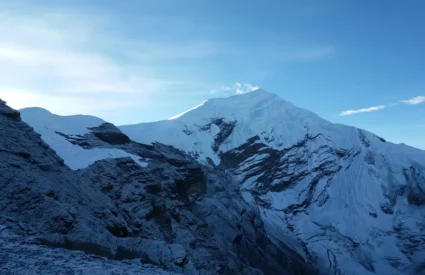
Peak Climbing in Nepal: The Ultimate Guide to Himalayan Adventures
If you fancy climbing in one of the most breathtaking places in the world, then Nepal is the destination for you. Nepal is home to some of the most beautiful, highest and most famous mountains, including the highest mountain on Earth, Mount Everest. Though Everest may draw professional climbers to Nepal, it also offers many other incredible climbing opportunities that do not have to draw you into high adventures an 8,000 meters. This is the main focus of this guide, Peak Climbing in Nepal.
Nepal is home to many mountains with breathtaking views and offers lots of trekking and peak climbing, such as Mera Peak, Island Peak, Lobuche East, Pisang Peak, and Chulu East. These can all be climbed using breathtaking trekking and mountaineering skills. Nepal has many of these trekking peak climbing options for those who are ready to take on an adventure after completing the popular walks in Nepal, such as the Everest Base Camp Trek and the Annapurna Circuit Trek.
Nepal trekking and peak climbing are a bit easier in comparison to the other trekking peaks in Nepal. With good guidance, some training, good fitness, and healthy acclimatization, many of these peaks are totally doable and climbable by those who are trekking enthusiasts and those who are trekking for the first time, as well.
Every trek on these peaks is an adventure in and of itself. Along the way, you walk through forests of all kinds and many different valleys, as well as walk through traditional villages, ancient monasteries and meadows before reaching the summit of a mountain over 6,000 meters high. Throughout much of the trek, you experience breathtaking mountain views, as well as some of the best hospitality and culture from the people of Nepal.
Whether you want to trek above the clouds on Mera Peak, take on the technical challenge of Island Peak, or combine your trek with the famous Everest Base Camp Trek, Nepal offers climbing opportunities to match a variety of fitness levels and travel aspirations.
This is the guide that will give you everything you need to know to plan your Peak climbing in Nepal adventures. You will find details on the most popular climbing destinations, the levels of difficulty, permits, training, and gear, as well as the best times of year to go, potential costs, and safety concerns. You will also find information on how to select your Peak climbing in Nepal, which is the most important step in planning your first Himalayan adventure.
Why choose Peak climbing in Nepal?
Nepal has long been regarded as the quintessential destination for the Himalayas, with trekking and climbing the tallest mountains deemed as the top methods to explore it. With thousands of trekkers making the journey annually, Nepal is a country that has breathtaking views that are unique to this part of the world. While trekking provides access to numerous scenic viewpoints, Himalayan peak climbing gets you even closer to the adventure by allowing you to stand on the summit of a mountain.
The diversity of Nepal trekking peaks is one of the biggest reasons to choose Nepal. While Mera Peak is known for easier climbs, more technical peaks like Island Peak and Lobuche East are also options. Nepal has routes that cater to all climbing abilities. Many of these peaks tower over 6,000 meters, providing an exciting mountaineering experience, but without the technical considerations of 8,000 meters climbs.
Another benefit is Nepal’s excellent trekking and climbing framework. Along major climbing areas such as Everest, Annapurna, Langtang, and Manaslu, trekkers can find suitable teahouses, experienced guides, porters, trails, and even a rescue system. All of these combined ensure that the harshness of high altitudes is very easy and fun for international travellers.
The country’s mountain scenery is one reason travellers are also drawn to highly memorable trips and expeditions to go climbing in Nepal. Picture opening yourself to the stunning, all encompassing view of Everest and all of the other peaks. The experience of climbing that high can never be replaced, even the experience of sunrise from above 6,000 meters.
The culturally rich journey that makes peakclimbing in Nepal very unique is another reason travellers are highly drawn to these trips. The journey contains very welcoming, rural, simple and traditional communities across the climbing route. This journey is very fulfilling to both the travellers and the community, given that it contains a trekking culture very different to that of simply reaching the peak.
Safety is a prime motivator for most climbers travelling to Nepal. The trekking agencies employ very experienced certified climbing guides and offer climbing gear, clear acclimatization, and weather escort, as well as evacuation services. The guides are very well trained and experienced, and the trekkers can also make a very big difference in respect of safety and getting to the peak.
Previous experiences have ranged from very memorable to simply focusing on fulfilling a commitment, and taking very unique adventure photographs, to actually focusing on smaller exercises to prepare for very large scale climbing expeditions. View Peak climbing in Nepal as being a different experience in very unique adventure photography, fulfilling dreams, and a very different trek.
What is Peak Climbing?
Peak climbing in Nepal is a combination of adventure trekking and climbing, which is popular in the Himalayas. It often goes through the trekking peaks, which are usually 5800-6500 meters in height. Peak climbing is different from regular trekking, which has trekking trails that lead to scenic viewpoints or a mountain pass. In peak climbing, trekkers reach the highest point of a mountain, requiring the use of specialized climbing gear.
In Nepal, the mountains classified as trekking peaks for climbing are done so by the Nepal Mountaineering Association. While not as high or as technical as the expeditions, the trekking peaks still require a level of fitness, adequate preparation, and the ability to acclimatize to travel along the high, icy, and often challenging to navigate glaciers.
Most itineraries that include trekking and peak climbing require several days of trekking through remote valleys, forests, and mountain villages. Hiking helps climbers adjust to the elevation and is a great way to view the beautiful scenery of Nepal and interact with the local culture. During one of the last stops on the trekking portion, climbers set up a high camp and receive a lesson on the use of gear such as ropes, crampons, harnesses, helmets, and ice axes.
The trek to the summit is often an expedition that starts between midnight and 3 a.m. During this time, climbers navigate icy and roped sections and travel along a glacier to reach the highest point of the mountain. This portion of climbing is often the most strenuous of the journey, but is significantly rewarding since it provides a view of the tallest mountains in the world.
Peak climbing is seen as the best way to learn mountaineering. It builds confidence at high altitudes and teaches great skills, plus you aren’t in the Himalayas for years learning to climb. Many climbers use trekking peaks to prepare to climb at larger challenges such as Ama Dablam, Mount Everest and Manaslu, etc.
Outside of trekking, peak climbing is the best combination of all of the challenges and rewards seen in mountaineering, plus it is the most exhilarating experience.
Trekking and Peak Climbing
While trekking and climbing adventures take you into the beautiful and grand Himalayas, they are very different adventures to have. Exploring the locals and nature, as well as the hiking routes, is a big part of trekking. Peak climbing is even more of a challenge, as you have to gear up with climbing equipment and use a different set of skills and techniques to make it to the top. Knowing the differences between trekking and peak climbing is essential to know what best fits you for your first adventure into the Himalayas, especially your interests, goals, and fitness.
Trekking
Nepal’s trekking-focused tourism offers trekkers an opportunity to view the breathtaking landscapes from the high mountain passes along an established trail system that runs through the valleys and along the banks of the rivers. Trekking has the added benefit of not requiring trekkers to have any specialized climbing skills. The focus of trekking is on the slower, scenic hike to famous locations like Everest Base Camp, Annapurna Base Camp, Gokyo Lakes, and Annapurna Circuit, Manaslu Circuit, and Ghorepani Mardi Himal Trek, and many short and sweet treks in Nepal.
Accommodations are usually in teahouses, and the daily walks to the base camp are usually 4 to 7 hours, making trekking an option for most people in good health who are prepared and have no issues with the altitude.
Peak Climbing
Peak climbing offers all the challenges of trekking, plus the thrill of climbing. Peak climbing has a variety of challenges that range from trekking for days to high altitudes that require the use of climbing gear to traverse the ice and snow.
Summit Day is known to be the most difficult part of the entire trek. Most climbers start before the sun even comes up, crossing large glaciers and climbing snowy ridges.
The major peaks of Nepal can be less difficult than climbing some of the more technical peaks of major expeditions. Still, they do require the willingness to be fit, a willingness to acclimatize properly, and the guidance of mountain climbing guides with good experience.
The trek to climb a peak is a step that many adventurers take once they have trekked the more famous routes. Standing on the peaks in the Himalayas makes it all worth it and provides an adrenaline rush along the way to teach the new skills needed for mountaineering.
Trekking vs. Peak Climbing at a Glance
Trekking
Peak Climbing
Walks on established mountain trails
Includes trekking plus climbing to a mountain summit
No technical climbing skills required
Basic to moderate mountaineering skills required
No climbing equipment needed
Uses crampons, ice axe, harness, helmet, ropes, and mountaineering boots
Lower risk and less physically demanding
More physically demanding due to altitude and technical sections
Ideal for beginners
Suitable for fit beginners (on easier peaks) and experienced trekkers
Accommodation mainly in teahouses
Teahouses plus high camps or climbing camps on some peaks
Maximum altitude usually 3,000-5,500 m
Summits generally range from 5,800-6,500 m
Which one should you choose?
Trekking in Nepal is a great option for an excellent first experience. You will be able to take in the beautiful surroundings as well as the culture and famous trails. Once you finish trekking, consider high peak climbing as an adventure of a lifetime. Many climbers first experience the Himalayas via Mera Peak or Island Peak. Both provide a great first route as well as the challenges of Himalayan climbing.
Why Nepal Is a World-Famous Climbing Destination
For good reason, Nepal is frequently referred to as the center of Himalayan climbing. It is arguably one of the best destinations for mountaineering on the globe. It has eight of the fourteen mountain peaks above 8,000 meters, including the peak of Mount Everest. Aside from inspiration, Nepal offers trekkers, climbers, and explorers a lot more than just its tallest peaks. Among them are dozens of mountain trekking peaks that are accessible to people who do not want to attempt a major expedition to the tallest peaks in the world.
One of the biggest positive aspects of Nepal is the remarkably extensive array of climbing routes spanning from easy treks to as high as 6,000 meters or very high technical treks. Unlike many other mountain climbing destinations, Nepal provides a whole spectrum of climbs, from easy ascents such as Mera Peak to more difficult treks such as Island Peak, which is also a glacier.
What makes Nepal attractive is the stunning natural beauty. Imagine an expedition that would give you the opportunity to see the views of the sunrise from climbing Mount Everest or possibly standing on one of the numerous glacier peaks with breathtaking views and surrounded by some of the tallest mountains on the globe. You would probably travel to numerous locations to see such diverse views.
Each expedition through Nepal’s throbbing cultural heart has a reward that surpasses the others. Routes that thread their way up the mountain pass through villages of the hospitable Sherpas, Gurungs, Tamangs, and Tibetans. Ancient monasteries, decorated prayer flags, prayer wheels, and centuries of traditions of Buddhism create a special space that integrates physical and cultural journeys for every climber.
Another reason for its global recognizability is Nepal’s developed trekking system. Popular climbing areas show the presence of comfortable tea houses, knowledgeable local guides, good porter service, organized rescue systems, and a well-designed trekking system. Such services make Himalayan adventures straightforward for myriad world climbers.
Nepal also has the advantage of good climbing seasons. The spring (March – May) and autumn (September – November) months bring stable weather, good visibility, and comfortable temperatures that are the perfect conditions for a successful bid to the summit.
Most importantly, the legendary Sherpa community dwells in Nepal. Their generations of mountaineering make up the backbone of Himalayan climbing. Their understanding of high-altitude environments, combined with their tenacity and great spirit, makes Sherpas a good addition to any expedition.
For all these reasons, thousands of adventurers return to Nepal peak climbing annually. Nowhere else can you experience the cultures of the mountain peoples and discover unspoiled wilderness in the heart of the Himalayas while making a lifelong dream come true.
Best Destinations for Peak Climbing in Nepal
Nepal is home to a plethora of trekking peaks, each with unique climbing experiences and challenges. New and seasoned climbers will find peaks that satisfy their personal climbing goals. Some climbs offer trekking through beautiful and remote valleys, glacier travel, snow climbs, and breathtaking views from a summit over 6,000m.
Many of the best climbing peaks are found in the Everest and Annapurna regions. Established trails and climbing guides and plenty of opportunities to acclimatize, make these regions ideal for beginner and expert climbers.
Some of the peaks offer a beautiful view with a simple ascent, while others peaks require a more advanced ascent over steep snow and ice. These peaks are an example of why Nepal is one of the best places in the world to practice mountaineering.
Here are the top 5 climbing peaks in Nepal.
Mera Peak Climbing
Mera Peak is a rewarding climb for those looking to start mountaineering and is the highest trekking peak in Nepal, standing at 6,476m. Situated in the remote Hinku Valley, trekking safely to Mera Peak avoids the heavily trafficked Everest Base Camp trail while offering stunning views of the Himalayas.
Despite Mera Peak being one of the highest mountains in Nepal, it is one of the least technical of the six thousand. This is because you are trekking through the forests, alpine meadows, and glacial valleys. The last bit is simply a gentle slope covered in snow. This route makes Mera Peak a great first time ascent when paired with a good guide and proper acclimatization.
You enjoy one of the best views in the entire Himalayan range when you reach the top. From this vantage point, you can even see the five highest points in the world (Everest, Lhotse, Makalu, Cho Oyu, and Kangchenjunga) as well as countless other mountain ranges.
Mera Peak is the ideal first time ascent as it is a good introduction to what climbing in the Himalayas looks like. This climb can also be used as a good way to prepare for more technical climbing.
Mera Peak Climbing
Mera Peak is 6,476 m tall and is the highest trekking peak in Nepal. Because of the nature of the climb, as long as climbers are physically prepared and acclimatized, the climb can be undertaken by those who are relatively new to climbing. That said, there is a considerable height gain.
The trekking route is relatively secluded and follows the Hinku Valley. It is rich with lush green forests, high meadows, traditional Sherpa settlements, and glacial terrain. It is along this route that trekkers make their way to Mera High Camp.
Trip Highlights
The greatest height a trekking peak in Nepal can reach
Island Peak is the most climbed trekking peak in Nepal, reaching an elevation of 6,189 meters (20,305 ft). Located in the Everest region, Island Peak is also often done in conjunction with the Everest Base Camp Trek. This peak is often popular in that it combines trekking and climbing in one.
Climbers who decide on this peak mainly take the trek that follows the avenue to Everest through Namche Bazaar, Tengboche Monastery, Dingboche, and Chhukung. This offers an excellent opportunity to acclimatize as well as experience Sherpa Culture and the famous landscapes in Nepal.
The summit climb is a more technical challenge when compared with Mera Peak, as it involves travelling on a glacier, rope, and ladders in addition to a steep snow headwall near the summit that is often encountered. However, the team does instruct everyone on the equipment prior to the attempt, allowing this to be an achievable experience, especially for those in great fitness and who are new to climbing.
You can also get an excellent 360 of the surrounding Khumbu Himal, Lhotse, Ama Dablam, Baruntse, Makalu and others at the top of Island Peak.
Island Peak Climbing
Island Peak melds Nepal’s iconic mountain adventures with a trek to base camp and some glacier climbing.
Crossing glaciers, using fixed ropes, and negotiating a steep glacier headwall place Island Peak in the slightly more difficult category compared to Mera Peak, but it is still very much a beginner’s climb with the assistance of a guide.
Trip Highlights
All the base camp feels
Summit Kala Patthar just in time for the sunrise
Learn to climb a glacier
Amazing views of Everest
Duration
14 to 18 Days
Maximum Height
6,189 metres
Difficulty Level
Moderate
Best For
Those looking for a combined trekking and climbing adventure.
Lobuche East, standing at 6119 meters, is described as a thrilling climb. It is perfect for those climbers wanting to advance their skills. Lobuche East is on the trekking route to Everest Base Camp. Because of that, it is often done as part of a trek to Everest Base Camp and Kala Patthar.
The first part of the climb is up a glacier. The rest of the climb is up a mixture of snow and rock. Some parts of the climb are vertical and will require the use of fixed ropes. Those who do not have much climbing experience but are in shape and will follow the advice of a guide will also be able to summit.
From the summit of Lobuche East, you can see all of the major peaks of the Himalayas, including Everest, Lhotse, Nuptse, Pumori, and Ama Dablam. Because of the views and the challenge that climbing Lobuche East provides, it is the best trekking peak in Nepal.
Pisang Peak (6091 m), one of Nepal’s classic trekking peaks, sits within the Annapurna massif. One of the best options for climbers doing the Annapurna Circuit Trek combined with some mountaineering.
The first steep section goes through the traditional village of Pisang and the following sections of the trail move above the tree line through yak pastures and alpine meadows to the high camp. The condition of the snow has an impact on the use of fixed ropes for the summit day’s steeper snow slopes and sections of the trail.
Pisang Peak has amazing views of Annapurna II, Annapurna III, Annapurna IV, Tilicho Peak, Gangapurna, the Chulu Peaks and Manaslu. The combination of cultures, views, and the trekking and technical climbing makes it a great adventure in the center of the Nepalese Himalayas.
At 6,584 meters, Chulu East Peak is one of the trekking peaks that is a little more climbing intensive than others in the Annapurna region.
The trek to Chulu East Base Camp normally proceeds along the Annapurna Circuit. Trekking the circuit is good to aid acclimatization, and the circuit shows more varied landscapes, including everything from sub-tropical forests to alpine deserts.
To get to the summit, you need to cross glaciers and climb snow. For this, you will need to use a fixed rope and carry along some personal climbing gear, including crampons, a harness, and an ice axe. It is also a good idea to be fit and accustomed to trekking at high altitudes.
The views from the summit are of Annapurna, Dhaulagiri, Gangapurna, Tilicho Peak, Manaslu, and the Tibetan Plateau, and a trek to Chulu East is a good consideration for those who want to experience the Himalayas and go on a more intensive trek before going on more advanced expeditions.
The combined Everest Base Camp TrekwithPeak Climbing in Nepal is arguably the best trekking experience in the Himalayas for adventure lovers. You no longer need to choose between trekking and climbing. This combination lets you do both. You will experience the Sherpa way of life, see Mt. Everest, and trek one of the most famous trails in the world, and that is not all. This package allows you to climb a mountain higher than 6,000 meters.
It is no wonder that this package is one of the top Peak Climbing packages in Nepal. This package showcases some of the best views in the world and the best experience that Nepal’s trekking has to offer while also being the perfect trek for acclimatization. The experience is formed even more by the fact that trekkers who choose this package not only climb a mountain but also reach Mt. Everest’s Base Camp and also view the majestic Kala Patthar.
Trekking combined with climbing adds more benefit to your experience than making a trip to more places. The gradual climb through the Khumbu region has an incredible payoff of Sagarmatha National Park and gives your body a chance to adjust to the higher altitudes.
Better Acclimatization
One of the biggest problems to tackle on a climb is getting your body used to the altitude. The Everest Base Camp Trek not only prepares your body for the altitude with scheduled acclimatization days in Namche Bazaar and Dingboche, but also has you spend time at a lower elevation before making the final climb to an altitude of 6,000 meters.
The right acclimatization not only lessens the chances of you developing Acute Mountain Sickness (AMS), but also the chances of you reaching the summit.
Experience Two Adventures in One Trip
Instead of trekking to Nepal twice, you can now do two world-class adventures in one trip. You will spend time in the Sherpa villages, see world-renowned monasteries, trek to Everest Base Camp, watch the sunrise from the top of Kala Patthar and have time to climb one of the many summits in the Himalayas.
This combination is a great use of your time if there are constraints on your vacation time.
Developing Confidence While Climbing
The trekking portion gives climbers a chance to acclimatize to the mountain environment and to learn the skills necessary to be a technical climber. Throughout the trek, the guides provide the climbers with the opportunity to learn how to use
Crampons
Ice axe
Climbing harness
Helmet
Ascender (Jumar)
Descender
Fixed ropes
For many novices, this is a great opportunity to learn the basics of Himalayan mountaineering.
Amazing Views of the Himalayas
While visiting the Himalayas, few adventures have so much to offer in terms of diverse scenery along the trek. Along the way, climbers will have the opportunity to see up close
Mount Everest (8,848.86 m)
Lhotse (8,516 m)
Nuptse (7,861 m)
Ama Dablam (6,812 m)
Pumori (7,161 m)
Makalu (8,485 m)
Cho Oyu (8,188 m)
Baruntse (7,129 m)
Provide amazing scenery and photo opportunities that will last a lifetime.
Experience the Rich Culture of the Sherpas
The Everest region has a rich history of the Sherpas, not just of the mountains. Throughout the trek, the climbers will have the opportunity to visit ancient Buddhist monasteries, spin prayer wheels, cross suspension bridges draped with prayer flags and experience the wonderful hospitality of the communities.
This adds many dimensions to the climbing expedition.
Most Popular Peak Climbing Routes on Everest Base Camp
You can combine several trekking peaks with the Everest Base Camp Trek. However, two routes, in particular, have the best accessibility, scenery, and acclimatization schedules.
Everest Base Camp + Island Peak Climbing
This combination is the most popular trekking and climbing route in Nepal.
It begins with the flight to Lukla, then a trek through Namche Bazaar, Tengboche, Dingboche, Lobuche, Gorakshep, Everest Base Camp, and Kala Patthar. After reaching Everest Base Camp, the route then goes to Chhukung and Island Peak Base Camp to attempt the summit.
This route takes an average of 14 – 18 days.
It is an excellent route for beginner climbers and trekkers.
Everest Base Camp + Lobuche East Peak Climbing
This combination still includes Everest Base Camp, but adds a more technical climb.
After Everest Base Camp and Kala Patthar, the route then descends back to Lobuche village. From there, climbers ascend to Lobuche High Camp and then attempt the summit, which involves glacier travel, fixed ropes, and a steeper snow slope, compared to Island Peak.
This combination is generally an 18 days trek and is best suited to those who have climbed before or have high-altitude experience.
Benefits of Acclimatization
One of the most important portions of any climbing expedition is proper acclimatization.
The combination of the Everest Base Camp Trek with climbing a trekking peak helps your body acclimatize to the progressively lower oxygen levels. Unlike short itineraries, which rush to base camp, this combination of expeditions is best for those who are serious about achieving a successful climbing expedition.
Most plans allocate acclimatization days to Namche Bazaar(3,440m) and Dingboche (4,410m).
Acclimatization days also generally entail short treks to even higher elevations before sleeping at a lower elevation, a strategy known as climb high, sleep low.
Acclimatisation days increase the body’s oxygen adaptation, lessen fatigue, provide a lower risk of altitude sickness, and greatly increase the chances of a successful summit.
Difficulty Level of Peak Climbing
One of the most frequently asked questions about peak climbing in Nepal is about the level of difficulty. The answer is not straightforward, as it depends on a number of individual considerations such as the peak you are climbing, your physical condition, past experience trekking, level of technical difficulty and most importantly, the weather and your body’s adjustment to high altitude.
Generally, trekking peaks in Nepal are easier than expedition peaks like Mt. Everest, Manaslu and Ama Dablam, but they too should not be taken lightly. Many trekking peaks in Nepal are above 6000m and when you consider the physical impact of the altitude, oxygen becomes very sparse and therefore even simple tasks require more physical effort.
For fit beginners, Mera Peak is considered to have an easier climb, however, Island Peak, Lobuche East and Chulu East require greater levels of technical difficulty, greater levels of endurance, and a fair level of confidence on snow and ice, along with the ability to use basic mountaineering equipment.
Every year, many climbers manage to reach the summit of the trekking peaks and with the high level of preparation, professional guidance and a well-structured itinerary considering sufficient time for acclimatization, the challenge is worth the effort and climbing the trekking peaks in Nepal is an adventure for many determined individuals.
Best Times for Peak Climbing in Nepal
For a successful Nepal Peak Climbing venture, selecting the right season is essential. The weather can change rapidly in the Himalayas, impacting conditions and affecting the ability to reach the summit. Although peak climbing can be done at various times of the year, it is considered that the most stable weather and great conditions with good views of the mountains occur in spring and autumn.
During April and May, days are warmer and longer, and there is a higher likelihood of clear skies. If you are planning a trek to the summit of Everest, the best time to plan that peak climbing adventure, particularly in Nepali territory, is during these months. The best months for climbing are undoubtedly April, May, and September to November.
The autumn months of September, October, and November are also a great option, particularly to avoid the cold in the winter season. Avoid the summer monsoon at all costs and be wary of the pre-and post-monsoon periods. These will provide the least promising weather conditions, as well as very unstable and treacherous conditions for climbing.
Every season has different conditions and experiences. The best season depends upon your personal climbing goals, level of experience, and the weather conditions you prefer.
Spring (March – May)
Spring is the season in which most people attempt a Peak Climb in Nepal. With the onset of warmer weather and the clearing of some of the snowfall, access to the higher elevation climbing routes becomes easier, and Nepal as a whole offers some of the best climbing opportunities the world has to offer, especially in the Everest and Annapurna regions.
The trails, at lower elevations, become verdant and colourful with rhododendrons and alpine flowers. The higher elevation routes remain stably snow-covered, allowing safer and more reliable travel to the glaciers and summit.
Most mornings remain clear, and winds at higher elevations are light and some snow may be present. Afternoon development of clouds remains the only limitation to summit attempts. Spring is also the busiest season for most of the large-scale Himalayan expeditions, and the enthusiastic presence of climbers competing to achieve their own summits, from every nation, definitely adds to the excitement in the mountains.
Spring climbing benefits
Stability of weather with cool climbing conditions
Mild daytime temperatures
Festive blooming of the rhododendron forests
Clear mountain photography
High success on summit attempts
Big selection of climbing bookings
Fall (September to November)
Fall is one of the best seasons to attempt Himalayan Peak Climbing, with some considering it the best time in the whole of Nepal to complete climbing expeditions. After the summer monsoons, the dust and humidity are cleared, resulting in crystal clear views.
For the fall season, the weather is mostly dry and the daytime temperatures are mild. Nights are cool at higher elevations. Because weather patterns are stable, fall is perfect for climbing expeditions on Mera Peak, Island Peak, Lobuche East, Pisang Peak, and Chulu East.
This is the season of Nepal’s biggest festivals, Dashain and Tihar, allowing climbers to see facets of the local culture and immerse themselves in the festivities.
Fall is the peak season for trekking, especially for the popular trekking routes and teahouses, causing the most congestion of the year. Because of fall trekking congestion, it is best to book your climbing expedition as early as possible.
Benefits of fall climbing
Clear mountain views for great photography
Reliable weather
Easy trekking
Good conditions for snow and glaciers
High rate of successful summits
Cultural immersion during festivals
Winter (December to February)
Experiences of winter climbing are profoundly different from those of autumn or spring. Without a crowd of trekkers or climbers, winter brings a more tranquil state to the mountains. With winter solitude and peaceful terrain, winter brings breathtaking, picturesque snow-covered trails and scenery.
Winter offers new challenges for climbing as well. With camps and mountain summits reaching below -20°C, winter brings heavy snowfall, making many routes difficult along the mountains. Strong winds, icy routes, and a daylight disappearance increase difficulty as well.
There are many challenges to winter climbing, but experienced climbers equipped for the elements can still climb Mera Peak.
Benefits of winter climbing
Fewer climbers around
Peaceful trails and tea houses
Outstanding winter snowscapes
When clear days, good visibility
When there is a challenge:
Bitter cold (below 0°C, below freezing)
More constant challenging snowfall
Strong winds
Greater technical challenges
Winter climbing is only recommended for experienced climbers.`
Monsoon (June to August)
For most climbers, summer is the least favourable season for peak climbing expeditions and for good reason. For most of Nepal, summer is the rainy monsoon season. Heavy rains cause lower trails to become muddy and slippery, while cloud cover reduces all visibility of the mountains. Frequent landslides and swollen rivers cause travel delays.
For both the Everest and Annapurna regions, monsoon season climbing is discouraged due to unstable weather and poor conditions for summits.
Some regions in Nepal’s rain shadow, particularly Upper Mustang and some sections of Dolpo, experience less rain during the monsoon season and show different trekking options, though they lack the popularity of other trekking regions.
Problems in the monsoon
Intense rain
Wet, slippery paths
Obscured mountain views
Higher landslide risk
Many travel disruptions
Most climbers are advised to do their Nepal peak climbing in the spring or fall for the best experience possible.
Peak Climbing Permits and Regulations
You must obtain climbing permits for every expedition you undertake in Nepal. These permits are instrumental for the government to administer its conservation efforts, regulate the climbing practice, and verify that the climbers adhere to the government’s safety and environmental policies and concerns.
What permits you require for your expedition is determined by what peak you are climbing and what region you are travelling to.
Nepal Mountaineering Association (NMA) Climbing Permit
If you are climbing trekking peaks designated by the NMA, meriting climbing permits include Mera Peak, Island Peak, Lobuche East, Pisang Peak, and Chulu East.
Climbing permit costs vary by season. Winter climbing permits are the least expensive, while permits for the spring climbing season are the most expensive.
Generally, the trekking agency you employ will handle the logistics and obtain the necessary permits you require for your expedition.
National Park and Conservation Area Permits
In addition to your climbing permits, you also require entry permits for the national parks or conservation areas that you will be travelling through for your expedition.
Some common permits include the following
Sagarmatha National Park Entry Permit (Everest Region)
Annapurna Conservation Area Permit (ACAP) (Annapurna Region)
Langtang National Park Permit (Langtang Region, where applicable)
Permits are a means for the government to help with environmental efforts and to help promote sustainable tourism on Nepal’s protected mountains.
Local Regulations
Improvements in mountain safety and environmental responsibility have resulted from several adjustments in Nepal’s regulations.
As part of these regulations
Permits for specific climbing peaks must be arranged through a licensed trekking or climbing agency.
More often than not, licensed climbing guides are required, while in other conditions, their presence is strongly endorsed.
Climbers have the responsibility to either pack out their waste or practice siting and of the local ecosystems.
Most climbing regions take care to abide by a “Leave No Trace” policy.
While in many situations, licensed climbing guides are a requirement, travel insurance is strongly recommended, particularly insurance which covers high-altitude trekking and emergency helicopter evacuations.
These policies and regulations promote the practice of environmental responsibility while enjoying the great outdoors.
Equipment Checklist for Peak Climbing
Right equipment is vital for peak climbing preparation in Nepal. Just as the peaks can drop below freezing, the weather in the Himalayas is known to be temperamental. Appropriate clothing and climbing gear will assist in keeping you comfortable and safe on your journey to achieving all of your climbing goals.
Most trekking companies will provide gear, including ropes, snow anchors, and safety hardware, to be used by the entire climbing group. Some companies will rent or provide personal climbing gear, including crampons, helmets, harnesses, and ice axes. Regardless, it is the responsibility of the climber to confirm what gear is provided in their package prior to arriving in Nepal.
To help you prep for the adventure of a lifetime, we have put together a guide that includes everything you may need for Himalayan climbing.
Clothing
Layering is important in the Himalayas, with many thin insulated layers aiding in the ability to change clothing as the temperature fluctuates. Instead of one insulated jacket, many thin layers are better.
Base Layers
Base layers help in thermal regulation and help wick moisture from the body. Base layers are preferably made from synthetic materials or merino wool.
Some base layers include
thermal tops and bottoms
wicking trekking t-shirts
lightweight underwear
women’s sports bras
Base layers made from cotton should be avoided, as they absorb moisture and remain wet, and at high altitudes will make you cold.
Mid Layers
Mid layers help insulate body heat but allow moisture to escape.
Some recommended mid-layers include
fleece jackets
lightweight insulated or softshell jackets
fleece trousers (optional in the warmer months)
Outer Layers
Outer layers protect from wind, snow, and rain.
You should pack
waterproof jackets (Gore-Tex or similar)
waterproof trousers
windproof shells
high-quality down jackets rated for -20°C or lower
A high-quality down jacket is one of the most important summit day pieces of equipment.
Headwear
Retaining heat is easier with a warm head.
Some recommended headwear is
warm wool hats
sun hats or caps
neck gaiters or Buffs
balaclavas
UV-protection sunglasses or glacier glasses
Gloves
Multiple pairs of the following gloves should be packed
lightweight liner gloves
warm fleece gloves
waterproof insulated climbing gloves
backup gloves
Footwear
Quality footwear is essential in both climbing and trekking.
Bring
Durable mountaineering boots that take crampons
Trekking boots
Camp shoes or sandals
Warm wool socks (4-5)
Thin socks
Climbing Gear
Above the snowline, technical climbing gear is required. Your climbing guide will train you on the use of each piece of gear to keep you safe.
Some of the important gear needed for climbing includes
Mountaineering boots
Climbing helmet
Climbing harness
Crampons
Ice axe
Ascender (Jumar)
Descender (Figure 8 or ATC)
Carabiners (locking and non-locking)
Safety sling
Prusik loops
Cow’s tail
Climbing rope (provided by guide)
Some companies include this equipment as part of the package, while others pop up as rental stores in Kathmandu.
Trekking Equipment
After two weeks of trekking to the base camp, you’ll want to the trekking gear to be just as comfortable.
Recommended gear
Backpack
40-50 liters daypack
With a waterproof rain cover
Duffel Bag
Most trekking companies provide portered duffel bags.
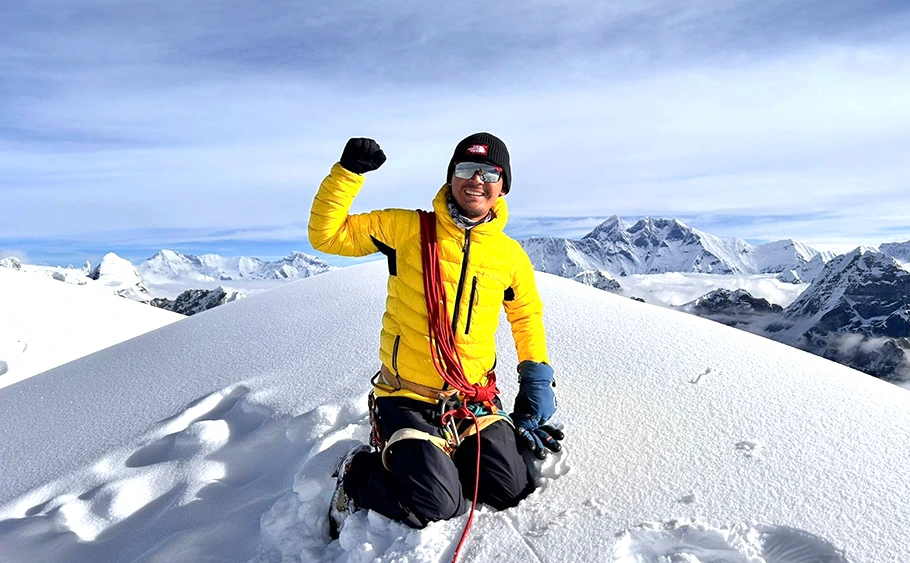
I am the Founder and Owner of Hill Sherpa Trekking Pvt. Ltd. With more than 15 years of experience in the Himalayan tourism and mountaineering industry, I established the company with a passion for mountain adventures and a commitment to responsible tourism. Since then, I have dedicated my career to creating safe, authentic, and unforgettable trekking and climbing experiences throughout the Himalayas.





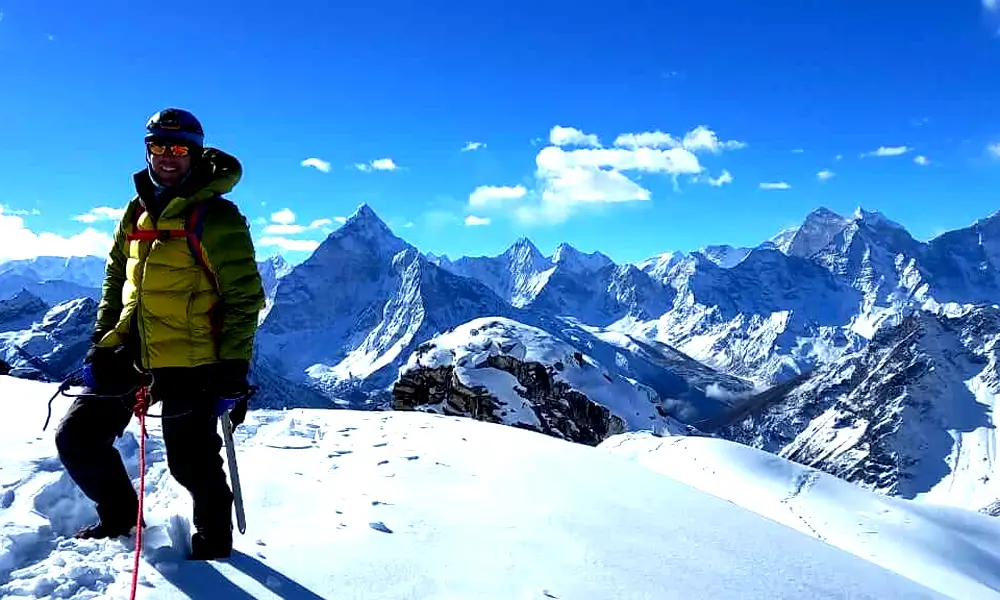 Nepal has long been regarded as the quintessential destination for the Himalayas, with trekking and climbing the tallest mountains deemed as the top methods to explore it. With thousands of trekkers making the journey annually, Nepal is a country that has breathtaking views that are unique to this part of the world. While trekking provides access to numerous scenic viewpoints, Himalayan peak climbing gets you even closer to the adventure by allowing you to stand on the summit of a mountain.