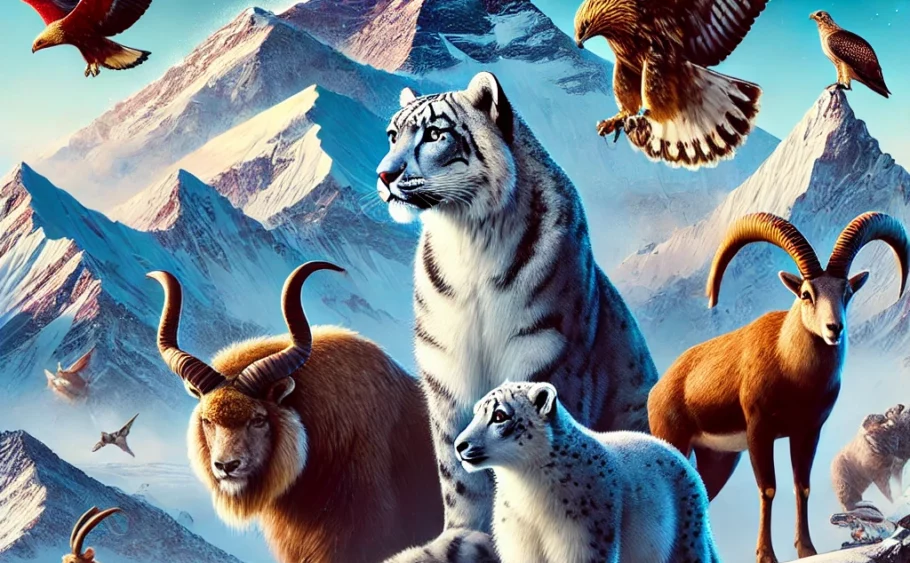
This is the best question to tackle with various thoughts. Everest Region is the home to Mount Everest, the highest peak in the world, with an altitude of 8848.86 m above sea level is popularly known as the Everest Region and is also home to the unique diversity of nature and its diversity of geography, wildlife, flora, and fauna. It provides the habitat for the biodiversity of the high-altitude wildlife and plants, making the region a great place for the ecosystem to rely on. In such extreme conditions, weather, and other factors that come along with the increase in altitude, wildlife found unique paths to survive and live.
The factors known for their unstable conditions, remote and difficult geography, and extreme conditions make the wildlife there unique, as it needs a few challenging ways to survive. The cold feature of the region, as it lies at a high altitude in the Himalayas, and the weather conditions as well as the terrain geography stand as the main factors that make survival there for animals a bit challenging and rare to find those animals and wildlife, as well as the plants to be found all around the world.
So, we are about to share and discuss the unique conditions in which these animals survive, making them rarer and more difficult to see worldwide. We will discuss the biodiversity that creates a unique ecosystem that allows them to survive in such high-altitude conditions. Stick here to begin your journey inside the insightful wildlife of the Everest Region.
The Wildlife Ecosystem On Mount Everest
The ecosystem of the Everest Region is a bit diverse and adopts wide features and factors, making it a hard place for any beings that are found there to survive. First, we need to identify some factors that are making the conditions difficult. Some of them are as follows.
Climate
The climate in the Everest Region is a typical weather condition of high-altitude geography, which is very unstable all year. Even after the weather forecast, it is very hard to predict and determine the upcoming weather, which means the weather can suddenly change features there. It makes the human topography and animals tackling the sudden change in weather a difficult one for them. It also affects the change in seasonal vegetation, which is important for Herbivorous animals, as well as making it hard to be on hunting sites for carnivorous animals to hunt on hunting sites, making it one of the main factors that make the Evert region a difficult place for animals for their survival.
Environment
The environment is obviously unique in there over the geography of Everest. But it also comes with features which along attached to the factors affecting biodiversity. The environmental features, such as the vegetation, plants, and the animal food chain, are challenging even though they have diverse natural features. This is due to the climate, as we discussed above. The climate is very unpredictable. It makes the seasonal plants grow before the season and sometimes later than they should. In recent times, it has become harder for animals, mostly herbivores, which are totally reliant on plants, due to climate change. It also affects the animals which are predators in nature and totally rely on hunting.
Adoptions
Sometimes, animals need to adapt to higher altitudes and sometimes to lower altitudes to escape the extreme conditions of the changing seasons. It can also happen due to the scarcity of food, the late arrival of seasons, and the weather as needed. Animals need sudden changes in location and altitude in search of food and stable weather conditions. It makes it difficult for them as they need to adapt to new geography, altitude, and ecosystem. Mostly, animals tend to change altitude from lower to higher in summer and higher to lower in winter to escape the weather conditions.
Some Animals Are Found In the Everest Region
The Everest Region is a diverse place to explore, with many animals. However, we will mention only some of the rare animals and birds we picked due to their rarity and the need for good fortune to witness them.
Snow Leopard
It is a rare species of leopard, seen rarely over the Everest Region and some other parts of the Himalayas. This is due to its habitat at altitudes between 3000 and 6500m above sea level. The leopard is also listed as an endangered animal.
Wildlife Along the Everest Base Camp Trek Route
The changing wildlife of the Everest Base Camp Trek is one of the things that makes it so exciting. Wildlife occupies the exquisite river valleys and eventually the ice moraines. Each part of the trek provides unique opportunities to view different wildlife. Though it often is a matter of luck, the observant trekker may encounter different varieties of Himalayan wildlife.
Lukla (2,860 m / 9,383 ft)
Lukla is characterised by its temperate forests and is filled with rhododendrons and oaks.As the trekker passes through the lower elevations, the forests are filled with various types of birds and birds are often heard before they are seen. Spring is often the best time to go birdwatching.
In the forests of Lukla, you may be able to spot some of the larger mammals that are often more elusive. The surrounding forests are home to barking deer, red pandas, Himalayan black bears, Himalayan weasels and martens. Of these mammals, the red panda is the most elusive of them all, as they are only active and visible during dawn and dusk.
Wildlife commonly found around Lukla – Phakding (2,610 m / 8,563 ft)
Barking Deer
Yellow-throated Marten
Himalayan Weasel
Himalayan Monal
Kalij Pheasant
Forest birds and butterflies
Red Panda (rare)
Himalayan Black Bear (rare)
What Animals Live on Mount Everest?
Features
It lives at altitudes between 3,000 m and 6,500 m above sea level.
Large, cat-like in appearance with white fur and a long tail. It has yellow eyes and pointed ears with black rosettes.
Active and stealthy in nature. It mostly hunts at the time of dawn or dusk over rocky locations.
It is the highest-altitude species of cat.
Spotted in rocky landscapes over Lobuche, upper Khumbu, and Thokla Pass.
The path to Phakding follows the Dudh Kosi River and is filled with forests and small Sherpa settlements. The combination of forests and streams provides an excellent habitat and home to many mammals and birds.
Himalayan Monals, woodpeckers, laughingthrushes, wagtails, and eagles are often seen flying over the valley, while squirrels, pikas, and Himalayan Weasels are small mammals that are sometimes spotted along the trail.
The forests surrounding Phakding have red pandas and black bears, but the chances of seeing one are very low.
The following wildlife can be seen around Phakding
Himalayan Monal
Kalij Pheasant
Woodpeckers
Himalayan Weasel
Squirrels
Butterflies
River birds
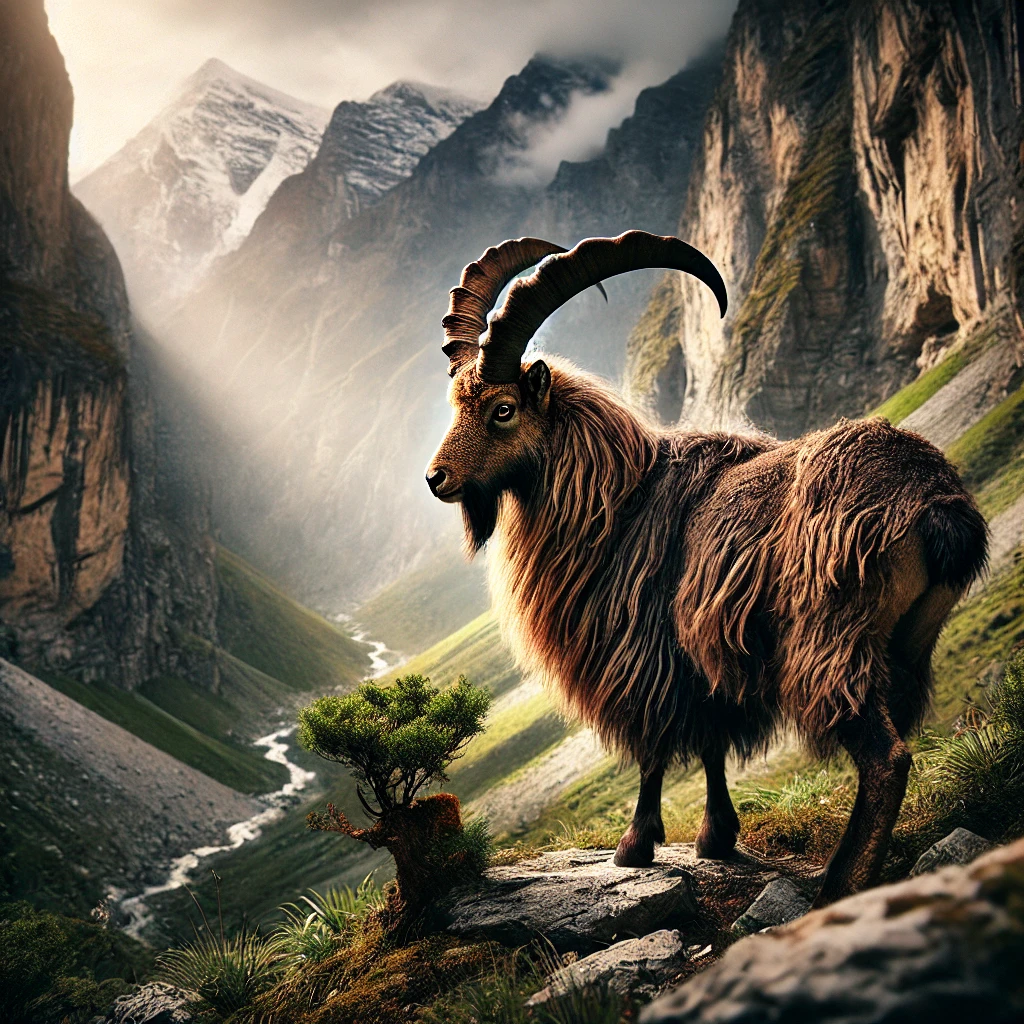
Himalayan Tahr
It is also found in the Everest Region. Due to its unique features, this goat species can survive in high altitudes and extreme cold conditions.
What Animals Live on Mount Everest?
Features
It is usually found at an altitude between 3000 m and 5500 m above sea level
It resembles a goat with a white beard, dark brown fur coat, and black facial markings.
It is a social animal in its behaviour.
It is the largest goat species, and it is wild in nature.
Spotted mostly in rocky terrain over meadows of Gokyo Lake, Tenboche, and Ama Dablam Base Camp forest.
Namche Bazaar (3,440 m / 11,286 ft)
Starting in Namche Bazaar, trekkers begin to see more alpine landscapes and leave the dense forests behind. Namche Bazaar is a part of Sagarmatha National Park. It is a good place for people who want an introduction to Himalayan wildlife. Himalayan Tahr are usually spotted along the trails trekked to the Everest View Hotel and to Khumjung. Musk Deer are mostly spotted when they are resting in the forest in the evening and early in the morning.Several birds, including Himalayan Griffons, Golden Eagles and other colourful pheasants, can be spotted easily. There are enough different habitats that Namche is one of the best locations for wildlife photography.
Namche Bazaar is home to the following wildlife
Himalayan Tahr
Himalayan Musk Deer
Himalayan Serow
Himalayan Griffon
Golden Eagle
Blood Pheasant
Himalayan Monal
Red Panda
They are also listed as endangered. They are found in some parts of eastern Nepal, mostly at the high altitudes of the upper hilly region in the Himalayas.
What Animals Live on Mount Everest?
Features
It is found at an altitude between 2000m to 4000m from the sea level.
It has the appearance of reddish-brown fur and a long tail. It has a distinctive black face and ears.
It is shy in nature.
It is a species that is close to the features of raccoons in nature and is only active during the dawn and dusk of the day.
Mostly encountered in Sherpa land wildlife, Langtang National Park, and Makalu Barun National Park.
Tengboche (3,867 m / 12,687 ft)
Tengboche is known for its rhododendron forests and its monastery. This area is along the Everest Base Camp Trek and is rich in wildlife. You might see Himalayan tahrs on the grassy hillsides or musk deer in the unobtrusive forest glades.Rhododendrons draw all sorts of critters in the springtime to capture picturesque nature shots. Large birds soaring in the skies above the valley include Himalayan griffons, bearded vultures (lammergeiers), and golden eagles.
Wildlife around Tengboche
Himalayan Tahr
Himalayan Musk Deer
Blood Pheasant
Himalayan Monal
Bearded Vulture
Himalayan Griffon
Golden Eagle
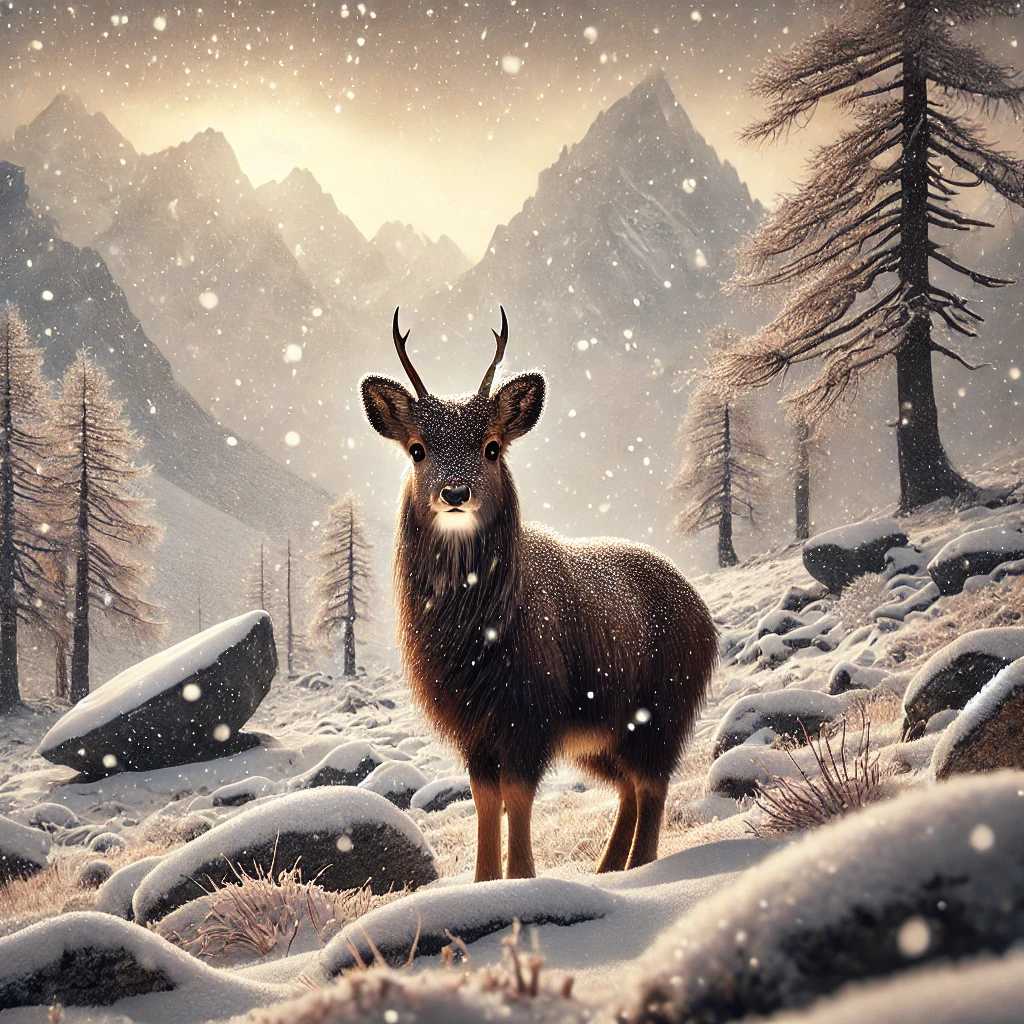
Musk Deer
It is a species of high-altitude deer that lives in the cold region of Everest and is found across the Himalayas, mostly during the fall snowfall.
What Animals Live on Mount Everest?
Features
It is found between an altitude of about 2500m to 4500m
The appearance of deer alike radish brown coats, short, pointed horns, and a long fur tail.
It is active in nature during dusk and dawn and lives in solitude
It is the only species of deer that has no antlers
It is spotted mostly in the dense forests of Deboche, Tengboche, and Dingboche, especially over Imja Valley.
Dingboche (4,410 m / 14,469 ft)
Above the tree line, the terrain becomes more rocky and uneven, with patches of alpine meadows. The range of altitudinal zonation leads to fewer, more specialised, high-altitude, cold-weather fauna.
Around Dingboche, Blue Sheep (Bharal) can be found. These animals are very nimble and like to eat alpine grasses. They can often be found on rocky outcrops and are the main inspiration to attract the legendary Snow Leopard, which is one of the top predators of the Himalayas, although they are very seldom spotted.
Birds in the area include the Yellow-billed Choughs and Red-billed Choughs, and also the Himalayan Griffons and Snow Pigeons.
Dingboche is home to the following animals
Blue Sheep (Bharal)
Himalayan Marmot
Pika
Yellow-billed Chough
Red-billed Chough
Himalayan Griffon
Snow Leopard (very rare)
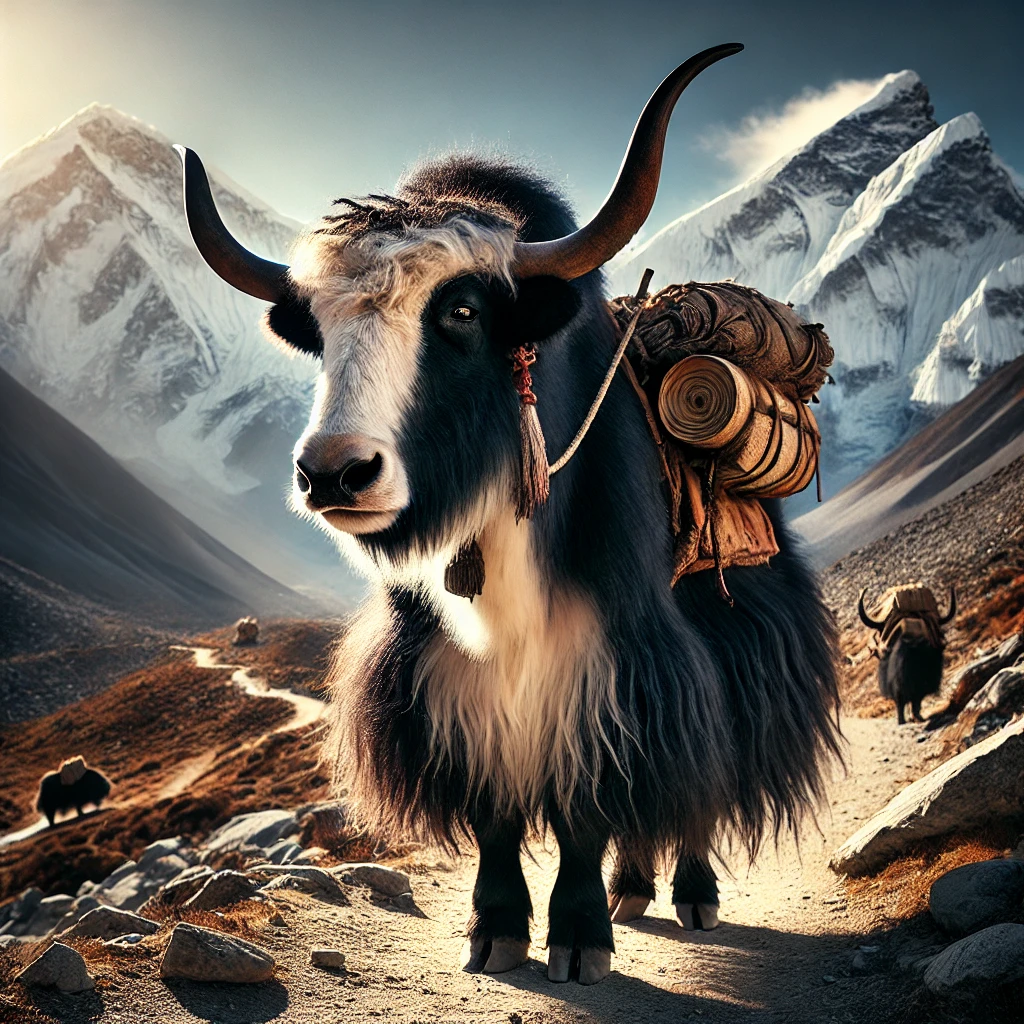
Yak
It is an iconic animal for the Everest Region. Mostly a working animal for the Himalayan people for transferring goods, milk products, and meat.
What Animals Live on Mount Everest?
Features
Found in between 3000m to 5500m from the sea level
Appearance of robust, shaggy hair, curved horns, and humped shoulders
It is also social in behaviors
Contributes to the local cuisines and is also used as an animal means to transfer goods
Encountered in high-altitude terrains and meadows around the Everest Region.
Here, we also need to mention some of the rare birds and iconic wildlife of the Everest Region. Some of them are as follows.
Himalayan Munal
It is the national bird of Nepal, widely known as Danfe in its local name. It is rarely found in the uppermost part of the Himalayas. It is a very colourful bird that is also very rare around the Everest region.
What Animals Live on Mount Everest?
Features
It is found between altitudes of 3000m to 4500m
It has the appearance of colourful plumage, a green back, and golden breasts with a bright blue head.
It also has a unique tail with black and white stripes.
It is social in behaviour and active during the morning and evening, singing.
It is the national bird of Nepal.
Encountered around the skies of Tengboche and Pangboche and across the area of Ama Dablam.
Blood Pheasant
It is a rare species of Blood Pheasant that is rarely seen and the only species of its kind native to Nepal.
What Animals Live on Mount Everest?
Features
It mostly inhabits over and between altitudes of 2500m to 4000m.
It has the appearance of red plumage with a long tail and red crest on its head.
It lives in solitude and is active during the time of dawn and the time of dusk.
It is the only pheasant species known to be native to Nepal.
Spotted in the dense forest across the Namche Bazaar and vegetation near Lobuche
Golden Eagle
This type of eagle is found across the mountains of Asia and Europe. It is a big and powerful eagle in its species. It is also a wildlife feature to witness in Everest Region wildlife.
What Animals Live on Mount Everest?
Features
It has a habitant over and between the altitudes of 3000m to 5000m from the sea level.
It resembles a large eagle, with a golden head and neck and a brown body. It also has powerful and sharp wings and talons.
It is solitary in nature and mostly active during the daytime.
It is among the largest and strongest eagle species all across the world.
How Animals Survive In Such Extreme Conditions?
Animals’ survivability in different extreme conditions comes with mutation and strategic moves, which are also part of the natural cycle. Most animals and birds descend to lower altitudes to escape the cold conditions. During the arrival of summer, they ascend to higher altitudes to adapt to colder regions again. The animals that can survive such extreme cold still live there, hibernating.
For the low oxygen, it is their natural mutations, and the features in their red blood cells, as well as the organs that are capable of respiration, are built in a way that they can adapt and survive the low-oxygen environment.
Conservation Efforts and Challenges For Wildlife in the Everest Region
The wildlife seen across the Everest Region is already rare; some of them are even listed as endangered animals or species about to become extinct. This comes with the different factors which are the cause of these conditions. The wildlife and the ecosystem of biodiversity are very diverse there, and they need to be preserved before they become just the banner of books and museums. The main reason for this is over-tourism and the effects of climate change. The region itself is the only place where some of these species survive and can adapt for their survival. So, the conservation of the region itself plays a big role in preserving these species.
Most of the big factors, such as climate change and tourism, come from humans, so it is our responsibility to make efforts to conserve this wildlife and the ecosystem of rare flora and fauna. Tourists who arrive in large numbers should be managed and made aware of the cause and effect of their activities, from nature to the life inside it. Activities such as waste management, noise cancellation, and spoiling of forests should be strictly followed.
The major factor in climate change should be the immediate matter of the world. The mountain peaks of the Himalayas, which were covered in snow all year, are slowly losing their features and turning into black hills. This means the ecosystem and environment around them are also losing features, increasing the difficulty of wildlife survival.
So, again, we need to consider strict rules and regulations for visitors, and local communities should be aware of the hunting of animals and birds to preserve them. Regarding climate change, people worldwide must make equal efforts to prevent such diverse natural biodiversity from going extinct.
Why Mount Everest Wildlife Matters?
No logical question has been raised about why all wildlife is important, but when we look into the significance and characteristics of wildlife that exists in the Everest region, it is because they are unique among others, such as being rare to see and in danger. It is also very special to see and study zoology and the nature of various species since the place is under extreme conditions that the habitat lives in.
The biodiversity in the regions of the upper Himalaya also needs to be balanced. The chain and the ecosystem are significant in managing the environment and retaining nature as it is. In addition, the above-mentioned animals contain traditional importance and conserve characteristics. Some of them are specifically linked with culture, traditions, and religious importance, which makes the traditional values of the Himalayas varied.
We should also keep such blessings of nature to pass on to the other generations. The information sessions should not only teach the history of animals and extinct wildlife. We must also conserve them since as the most intelligent creatures within the natural chain. And this is what makes us human.
Wildlife by Elevation Zone
Different animals live on Mount Everest’s base as compared to the Summit. As you travel up Mount Everest, the environment changes drastically from thick and lush forests and fast-flowing rivers to alpine meadows to rocky, uneven terrain, to glaciers and snow that doesn’t melt. At each different elevation, there is different wildlife that has adapted to the different climates, types of vegetation and the amount of oxygen that is present. Trekking on Mount Everest can expose you to different wildlife at different elevation zones. Knowing the different wildlife present in the zones can prepare you to know what animals you can expect to see.
Wildlife Below 2,500 Meters (8,202 Feet)
Everest’s lower elevations (Lukla, Phakding, Dudh Koshi Valley) are where the greatest biodiversity is found. They are full of forests that are thick with Pines, Rhododendrons, Oaks, maples, and Bamboos. These provide shelter and food for various species of mammals and birds. Combined with the warmer weather and plentiful water, these forests are rich with wildlife compared to the rest of the Himalayas.
The famous and endangered Red Panda, which lives in the Bamboo woods, is one of the mammals that is present. Even though spotting a red panda is a rare occurrence, the dense forests and rich wildlife provide one of the best opportunities to spot a red panda. Other mammals that can be seen include the Himalayan Black Bear, the barking deer, yellow-throated martens, Himalayan Weasel and various species of squirrels.
Aside from Mammals, there is also a great variety of birds. Trekkers can spot various species of birds, including the colourful Himalayan Monal (also the national bird of Nepal), the Kalij Pheasant, and various Cuckoos, Flycatchers, Woodpeckers, Laughingthrushes and many songbirds. The rich vegetation and plentiful waterways during the spring and summer provide an ideal habitat for many insects, including Butterflies, bees, and Dragonflies. These all aid in the pollination of the vegetation that is present and therefore abundant.
This elevation zone hosts the richest wildlife diversity on Everest due to the combination of an accommodating ecosystem and dense chain of forests.
Animals Between 2,500 and 4,000 Meters (8,202 / 13,123 Feet)
As you trek towards Namche Bazaar, Khumjung, Phortse, and Tengboche, the tree line thins, and temperatures begin to drop. As this happens, wildlife becomes much more specialised to adapt to the rougher, colder terrains.
This zone is also home to the Himalayan Tahr, which is one of the more commonly seen mammals during the Everest Base Camp trek. The Himalayan Tahr, a mountain goat species, is frequently found on steep, rocky slopes. Other mammals trekkers may spot in this zone include the Himalayan musk deer, the Himalayan serow, pika, the Himalayan marmot, and the woolly hare.
This zone is a birdwatcher’s paradise. The Himalayan Griffon Vulture and the Golden Eagle can be found soaring about, while the Blood Pheasant, the Snow Pigeon, the Red-billed Chough, and the Yellow-billed Chough can be found near the villages and monasteries.
In the spring, the blooming forests of Rhododendrons attract many birds and other wildlife, making this the prime elevation zone for wildlife photography.
Wildlife from 4,000 to 5,500 Meters (13,123 / 18,045 Feet)
Above 4,000m, the tree line is crossed, and the landscape impacts heavily on the remaining vegetation. The vast rocky valleys and wetlands extend to the horizon, all while the temperature remains near 0°. The same can be said for the air pressure.
Only animals that are highly adapted to extreme environments can live in these conditions. Blue Sheep (Bharal) are one of these mammals. They have grey-blue coats that are camouflaged with the rocky cliffs. Blue sheep are the main target of the Snow Leopard, an elusive big cat and endangered species.
The other mammals that inhabit this environment include Himalayan marmots, pikas and in the most remote valleys, the Himalayan wolf. The most active of the mammals in this harsh climate are the birds. The Yellow-billed Chough and Red-billed Chough can be seen flitting about the trekking lodges and high camps looking for scraps. Snow Pigeon and Himalayan Griffon are also common.
At this altitude, it is one of the highest habitats in the world for large permanent mammals.
Animals Above 5,500 Meters (18,045 Feet)
Above 5,500 meters, life becomes scarce. This area is mainly composed of glaciers, ice, rock and very strong winds. Even on the ground, the air has almost half the oxygen as at sea level. This makes life unsustainable, especially for large mammals.
These birds are among the highest permanent residents in the Himalayas.
Tiny jumping spiders are among the other highest permanent residents of the world. Strong winds blown up the side of Everest to the high slopes carry insects to the spiders, making them some of the highest living permanent animals ever recorded.
Although wildlife is scarce in these regions, nature’s resilience is evident as numerous extremophiles, microorganisms such as algae, fungi, and ice and snow-residing bacteria, survive even in extreme conditions.
What Lives Above Everest Base Camp?
Base Camp sits at an altitude of about 5,364 meters (17,600 feet), where the combination of little vegetation and scarce wildlife is harsh and disheartening. Surprisingly, plenty of hardy wildlife is able to survive at this altitude.
The wildlife most often observed at Base Camp consists of Yellow-billed Chough and Red-billed Chough, which are often seen flying around Base Camp and scavenging food left behind by Base Camp visitors. Snow Pigeons and the Himalayan Griffon Vulture soar in the sky above the Khumbu Glacier.
You may also be lucky to see a Blue Sheep grazing on the rocky slopes. Snow Leopards are also found at this altitude, as they prey on Blue Sheep, but frequent sightings are unlikely due to their nature and the harsh conditions.
Predators of Blue Sheep are found even higher on Everest, where the South Col and the summit region are located. Almost no life is found at these altitudes, but research has shown bacteria and algae, especially the cold-adapted varieties, can survive in the snow and ice at these altitudes, while other extremophiles may be blown in by the winds.
The animals and plants of Everest illustrate some of the most impressive adaptations to dealing with some of the toughest conditions on the planet. From the forests that stretch below Lukla to the frozen slopes even above Everest Base Camp, every zone of Everest is home to species that have evolved to survive in a part of the world that few animals dare to go. Everest is a region of immense beauty that attracts trekkers, but the region is also home to some forms of wildlife that have adapted to survive at nature’s limits and is of interest to wildlife fans.
Lobuche (4,940 m / 16,207 ft)
Lobuche has rocky, sharp-sloped alpine and glacial moraine as its most dominant feature, along with the harshest of the high-altitude cold-weather fauna most evolved to exist in this area.
Blue Sheep can still be seen around the cliffs. Choughs can be sighted around the lodges as they forage for food. Soaring above the Khumbu Glacier are the Himalayan Griffons, which can be seen riding the air currents. Snow Leopards are known to inhabit the most secluded regions of the upper Khumbu, but are hardly ever seen near Lobuche.
Lobuche is home to the following animals
Blue Sheep
Yellow-billed Chough
Red-billed Chough
Snow Pigeon
Himalayan Griffon
Snow Leopard (very rare)
Gorakshep (5,164 m / 16,942 ft)
Gorakshep is the last of the permanent settlements leading to Everest Base Camp. Among the glacial debris, the landscape of Gorakshep is steadily becoming more rocky and dry. The low temperatures
Wildlife is limited, but Yellow-billed Choughs can be seen flying around most lodges and camps. Snow Pigeons are less common but can be spotted. Himalayan Griffons may be seen soaring overhead.
While Blue Sheep can be found on most ridges, they tend to be less common at these higher elevations.
Wildlife around Gorakshep
Yellow-billed Chough
Red-billed Chough
Snow Pigeon
Himalayan Griffon
Blue Sheep (occasional)
Everest Base Camp (5,364 m / 17,598 ft)
While most people see Everest Base Camp as a desolate and harsh land, it is not completely devoid of life. Although no large mammal is found on the glacier, several impressive species are able to survive on this extreme altitudinal range.
The most frequent birds seen are Yellow-billed Choughs. They are often seen circling the camps in search of food. Snow Pigeons and Himalayan Griffons can be seen flying over the Khumbu Glacier.
Rocky slopes are the habitat of Blue Sheep, and while incredibly rare, Snow Leopards may be found in the surrounding mountains while hunting. Hardy microorganisms are found living in the snow and ice in the highest range of the world, reflecting that Earth’s highest mountain sustains life.
Wildlife at Everest Base Camp
Yellow-billed Chough
Red-billed Chough
Snow Pigeon
Himalayan Griffon
Blue Sheep (nearby slopes)
Snow Leopard (extremely rare)
Cold-adapted microorganisms
Wildlife Highlights Along the Trek
The Everest Base Camp Trek is not only one of the most famous mountain treks in the world, but also one of the best treks for experiencing amazing biodiversity in the Himalayan region.Ranging from the forests of Lukla to the icy habitats of the Everest Base Camp, the trek also showcases endangered red panda and Himalayan tahr, griffon vultures, and snow leopards. The trek is equally rewarding for wildlife fans as it is for mountain fans, one of the cores of its popularity.
Conclusion
So, up to here, we talked about the biodiversity of the Everest Region and the wildlife found all over the Himalayas. They are equally important for the natural chain and the ecosystem to sustain the environment as we have. Most of them are already rare to spot and are in the condition of endangered and near extinction. It is mostly due to climate change and activities such as pollution, hunting, etc., which disturb the ecosystem and the pyramid of cycles in the animal food chain.
Again, we need to control activities that can affect or could have a bigger impact on the environment to preserve rare and endangered animals and all the lives that fully rely on a proper and clean natural environment. As mentioned above, it is our responsibility, too, as we are the most intelligent beings on this planet. All of these factors come from us, so we must take responsibility for preserving them naturally. It is what makes us Human.
Frequently Asked Questions
What Types of Animals live in the Mount Everest Region?
The animals that fall under the category of mammals, such as Leopard, Deer, and Tahr, have habitats there. The birds that are primarily habitable at higher altitudes and in cold weather, such as Himalayan Monal, Pheasant, Golden Eagle, snow-cock, etc, have a vast habitat there. Besides the animals and birds, it is also home to many diverse plants only found at higher altitudes.
How do animals survive extreme cold and low oxygen?
They survive such conditions of extreme cold and low oxygen with their natural features as well as the strategic short migrations during the cold weather. To survive in low oxygen at such high altitudes comes with a genetic mutation and the characteristics in their red blood cells. It all comes out of their biological features, which provide them the advantage to survive in such low oxygen. During the extreme cold weather, some of the animals that cannot tackle migrate to the lower altitudes strategically to survive. Also, there we can find some animals and birds even during extreme cold which can survive and tackle those circumstances.
Are Snow Leopard endangered on Mount Everest?
Yes, it is a much-endangered animal that is now very hard to spot. Some experts even claim it is more endangered than the statistics show, as it is rarely seen nowadays, and the number of spots has declined exponentially from year to year.
Which birds are commonly seen on Mount Everest?
Birds such as Blood Pheasant, Grandala, Himalayan Monal, Bar Headed Goose, and Tibetan Snow-cock are commonly seen in the Everest Region and can also be easily spotted across the Everest Region. But it also depends upon the location and the areas in which they have their habitant.
How does climate change impact Mount Everest’s Wildlife?
Climate change significantly impacts wildlife in the Himalayas. It is due to the unseasonal change in seasons, which impacts the vegetation and the migrating cycle of animals and birds at different times of year. Climate change also affects the food chain on which this wildlife depends. The late arrival of the monsoon or the change of weather sooner than the season also impacts the cycle of living beings on Mount Everest.